Creamsicle Dreams

National Creamsicle Day is the perfect day to let the dreamsicles melt and capture the stickiness of dreams. And is it creamsicle or dreamsicle? I’ve heard them called both.

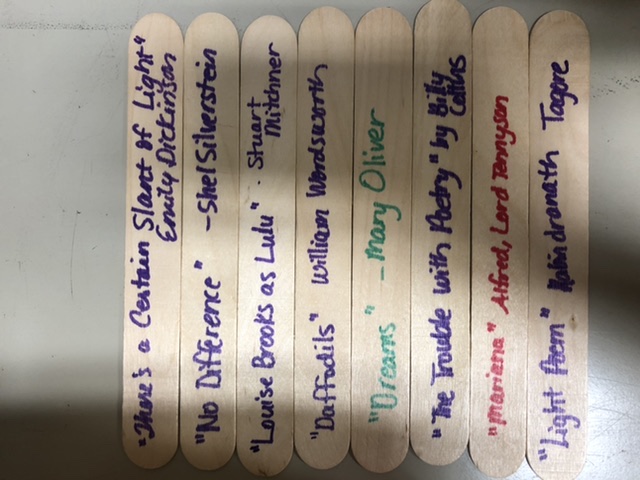
On pages 24-27 of Dictionary for a Better World, the found poem featured is from chapter 1 of Narrative of the Life of Frederick Douglass, an American Slave. Found poems are created by selecting words from existing text – – much like those sticky splotches of melting creamsicles as the dreamy words drip onto the page — and they have so many different variations, from pulling words on a page of text to taking lines from different pages or poems. I love found poems so much that I started a bank of creamsicle stick lines of poetry using craft sticks in 2020 – and my bank has grown. On one side, I write a line of poetry; on the other, I write the title of the poem and the author’s name. Then I mash them up and call them mashed potato poems (the name dreamsicle poems sounds so much better, though). Once they are complete, I photograph both sides to give poets full credit for their lines – and I make a big deal about this with students, because it’s an opportunity to help them understand that words are to be shared, but ownership of expression matters.
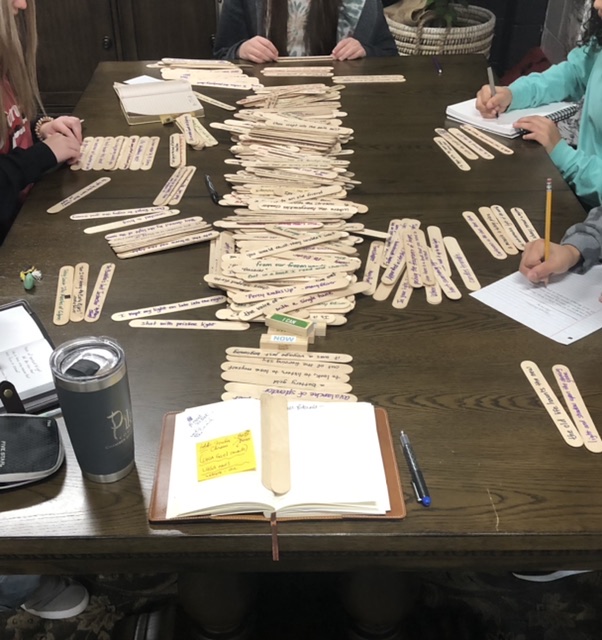
Students write found poetry using a bank of dreamsicle sticks with lines of poetry on one side, title and author on the flipside.

I often search for lines on a theme, but other times I simply write lines that reach out to me. I plan to present this idea at a roundtable discussion at NCTE in Anaheim, California in November, so if you’re there, please come to my session table from 9:30-10:45 in Room 213-CD. I’m looking forward to being there with members of Dr. Sarah J. Donovan’s writing group at http://www.ethicalela.com, and they will also be sharing some amazing ways to write poetry with students (even reluctant writers). Students enjoy the creativity of writing found poems, so I use them in my writing groups frequently when I visit schools to write in small groups. Here is one I wrote for today:

The Dark Buds of Dreams
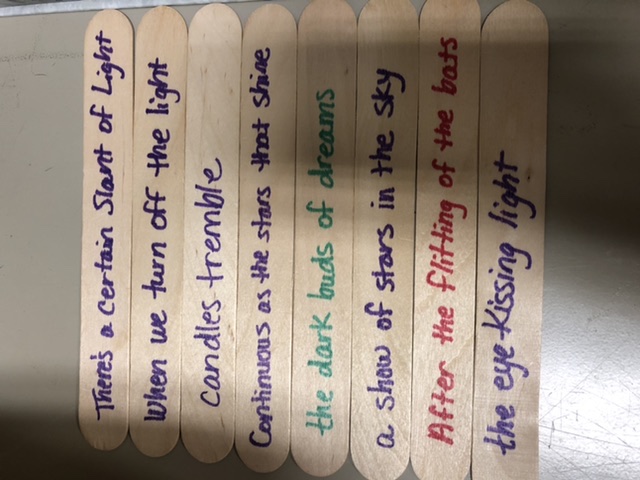
Dreamsicle stick poems with lines of poetry on one side of the stick
Title of poem and author’s name, in order of line appearance in the poem (flipside of stick)

Please share your found poems in the Padlet below, or share the variations of found poetry that you use with students!

Made with Padlet
This image has an empty alt attribute; its file name is resize.jpg

*During the months of August and September on days when I’m not participating in the Open Write at www.ethicalela.com, I will be writing in response to the pages of Dictionary for a Better World: Poems, Quotes, and Anecdotes from A to Z by Irene Latham and Charles Waters, illustrated by Mehrdokht Amini. The poems, poetic forms, narratives, quotes, and calls to action to make one small difference might be just the medicine my world – or the whole world – needs. I’ll be inviting insights in the form of an immersion into a 10-minute-a-day book study (just long enough to read the page, reflect, and connect). If you don’t have a copy of the book, you can order one here on Amazon. I invite you to join me in making August and September a time of deep personal book friendship. A few teachers will be following the blog and engaging in classroom readings and responses to the text. So come along! Let’s turn the pages into intentionally crafting beautiful change together.


Left-Handed? Right-Handed? Practice Being Xenial!

International Left-Hander’s Day is the perfect opportunity to consider the ways that we practice being xenial.

According to http://www.merriam-webster.com, xe·​nial | \ -nēəl, -nyÉ™l \ means : of, relating to, or constituting hospitality or relations between host and guest and especially among the ancient Greeks between persons of different cities. The illustrations on pages 102-103 of Dictionary for a Better World show a world of shoes – (including my favorite Birkenstocks in a color the warmth of sunshine). Desmond Tutu’s message that there are no outsiders in our world is fitting for the day! We all belong.

Today’s poetry prompt is other side poetry – a form that deals with anything on the other side – perspectives, viewpoints, afterlife, global places. You can watch Charles Waters recite his poem for Xenial here. Here is my other side poem:

Criss-Cross Jumprope

right hand washes left

left hand washes right

right brain talks to left

left brain talks to right

like a criss-cross jumprope

hands and brains hold world hope

Criss Cross Jumprope, Pinterest stock photo

Made with Padlet
This image has an empty alt attribute; its file name is resize.jpg

*During the months of August and September on days when I’m not participating in the Open Write at www.ethicalela.com, I will be writing in response to the pages of Dictionary for a Better World: Poems, Quotes, and Anecdotes from A to Z by Irene Latham and Charles Waters, illustrated by Mehrdokht Amini. The poems, poetic forms, narratives, quotes, and calls to action to make one small difference might be just the medicine my world – or the whole world – needs. I’ll be inviting insights in the form of an immersion into a 10-minute-a-day book study (just long enough to read the page, reflect, and connect). If you don’t have a copy of the book, you can order one here on Amazon. I invite you to join me in making August and September a time of deep personal book friendship. A few teachers will be following the blog and engaging in classroom readings and responses to the text. So come along! Let’s turn the pages into intentionally crafting beautiful change together.
Listen! It’s National Julienne Fries Day!

No, it’s not Julianne’s Friday. Listen: It’s National Julienne Fries Day!

At the beginning of the year, I chose the word listen as my one little word of the year – not to be sure I was hearing words correctly, but that I was taking time to consider the ideas and thoughts of others – to let them resonate with me as I reflected and allowed myself to feel the impact of the weight of words.

In Dictionary for a Better World today, the tricube form of poetry is featured – three stanzas, three lines, and three syllables in each line. Back in November, Linda Mitchell from our writing group at http://www.ethicalela.com challenged us to write tricubes. Here is one I wrote about listening for words during a writers’ word drought.

River Tricube

when writing,
ride river
word rapids!

droughts will come
so will rains ~
levels change

when words flow
grab your pen: 
listen in! 

Made with Padlet
This image has an empty alt attribute; its file name is resize.jpg

*During the months of August and September on days when I’m not participating in the Open Write at www.ethicalela.com, I will be writing in response to the pages of Dictionary for a Better World: Poems, Quotes, and Anecdotes from A to Z by Irene Latham and Charles Waters, illustrated by Mehrdokht Amini. The poems, poetic forms, narratives, quotes, and calls to action to make one small difference might be just the medicine my world – or the whole world – needs. I’ll be inviting insights in the form of an immersion into a 10-minute-a-day book study (just long enough to read the page, reflect, and connect). If you don’t have a copy of the book, you can order one here on Amazon. I invite you to join me in making August and September a time of deep personal book friendship. A few teachers will be following the blog and engaging in classroom readings and responses to the text. So come along! Let’s turn the pages into intentionally crafting beautiful change together.
Be Vulnerable on Global Kinetic Sand Day

What’s more pliable or vulnerable than Kinetic Sand in the hands of a curious child? On Global Kinetic Sand Day, we’re challenged to let our guard down and be open to the wonder of experiences that are new to us, as we were when we were children.

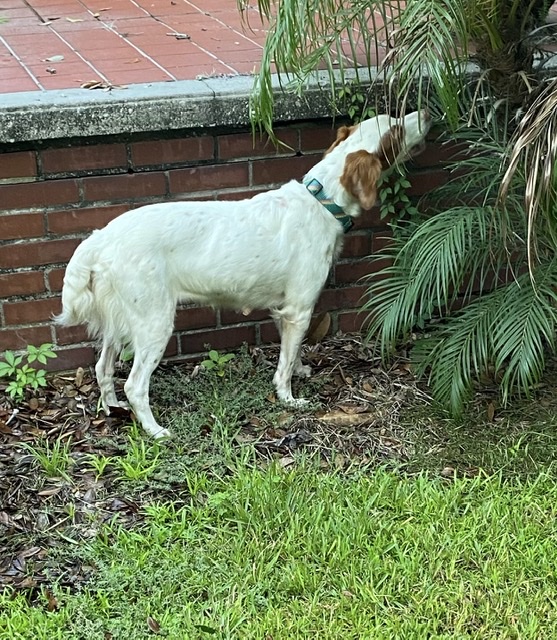
The gogyoshi form in Dictionary for a Better World on page 96 is a 5-line poem without other rules. On July 21, I wrote a gogyoshi when Mo Daley, our host at http://www.ethicalela, introduced us to the form from this book. At the time, I had just helped rescue a dog who had been shot in the left foreleg (probably when chasing someone’s chickens) – a stray on the run who was vulnerable to the elements, the predators, and the people. My brother’s 14-year old dog had recently died, and he was ready for a new canine companion. He needed her as much as she needed him – the perfect match! Here is my gogyoshi from July:

A Better-Fragranced World

She throws a little weight

on her smoking-gunshot paw,

stops to smell the flowers

of a better-fragranced world!

Kasa ~ she’s home.

Kasa, a newly-rescued Brittany, in my brother’s back yard in Coastal Georgia in early July

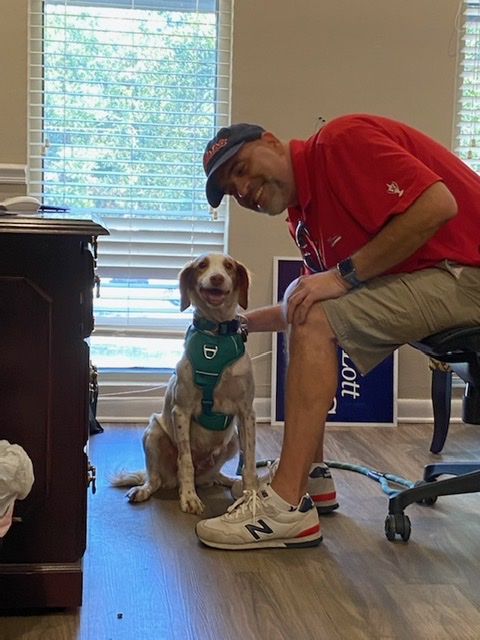
Update: Kasa is happy in her new home. She has received a clean bill of health from her vet – no intestinal worms or heartworms, and she has been spayed, gotten all her shots, had a dental cleaning, and has healed from her wound. She can run on the beach. She goes to work with her master and has made friends in the local dog park – and when they get home after a fun outing, she protests getting out of the car. Sometimes vulnerability brings miracles – it sure brought this miracle pairing of two hearts who found happiness together!

Kasa at the office helping her favorite island realtor (both smiling really big) sell homes.
Home from a fun outing, Kasa protests getting out of the car. She wants five more minutes in the dog park!

Made with Padlet
This image has an empty alt attribute; its file name is resize.jpg

*During the months of August and September on days when I’m not participating in the Open Write at www.ethicalela.com, I will be writing in response to the pages of Dictionary for a Better World: Poems, Quotes, and Anecdotes from A to Z by Irene Latham and Charles Waters, illustrated by Mehrdokht Amini. The poems, poetic forms, narratives, quotes, and calls to action to make one small difference might be just the medicine my world – or the whole world – needs. I’ll be inviting insights in the form of an immersion into a 10-minute-a-day book study (just long enough to read the page, reflect, and connect). If you don’t have a copy of the book, you can order one here on Amazon. I invite you to join me in making August and September a time of deep personal book friendship. A few teachers will be following the blog and engaging in classroom readings and responses to the text. So come along! Let’s turn the pages into intentionally crafting beautiful change together.

I Need S’more Fuel

National S’mores Day brings to mind times around the campfire – – times we share with others, fellowshipping with good food and stories to refuel our spirits as we toast marshmallows and melt chocolate over graham crackers. There’s no better way to connect with the outdoors than sleeping right up under the stars!

Today’s poetry form on page 40 is a cherita, which tells a story in three stanzas of one, two, and three lines.

Campin’ Dogs

“Where are the campin’ dogs?” we ask, and they come running, ready to go.

Ollie first, then Fitzie, then Boo, bounding the stairs into the camper

knowing there’ll be dog-watching, maybe even a pink poodle

And off we go, camper hitched, ready to relax, fireside,

under the stars, fairy lights dancing in the trees like fireflies

~re-kindling, refueling our kumbayah souls

S’mores by campfire

Made with Padlet
This image has an empty alt attribute; its file name is resize.jpg

*During the months of August and September on days when I’m not participating in the Open Write at www.ethicalela.com, I will be writing in response to the pages of Dictionary for a Better World: Poems, Quotes, and Anecdotes from A to Z by Irene Latham and Charles Waters, illustrated by Mehrdokht Amini. The poems, poetic forms, narratives, quotes, and calls to action to make one small difference might be just the medicine my world – or the whole world – needs. I’ll be inviting insights in the form of an immersion into a 10-minute-a-day book study (just long enough to read the page, reflect, and connect). If you don’t have a copy of the book, you can order one here on Amazon. I invite you to join me in making August and September a time of deep personal book friendship. A few teachers will be following the blog and engaging in classroom readings and responses to the text. So come along! Let’s turn the pages into intentionally crafting beautiful change together.

Pause (and Read). It’s National Book Lover’s Day!

On National Book Lover’s Day, pause. Read. Reflect. Let the words and meaning seep into your life and change your world. Today’s word in Dictionary for a Better World, pause, does not come naturally to me. I make daily lists of what all I need to accomplish, and I hyper-focus on the next checklist item rather than enjoying each moment along the way. I need to be more intentional about taking the time to pause, to breathe, and to laugh.

The poetic form featured on page 70 is a limerick, a humorous poem which has five lines with an aabba rhyme scheme.

Pauseth

to pauseth and readeth a book

is to calmeth a world that once shook

when we crawleth in bed

stories filleth our head –

we dreameth, awaketh: look! look!

photo from consciousdreaming.org

Made with Padlet
Please share your responses to the book on the Padlet.
This image has an empty alt attribute; its file name is resize.jpg

*During the months of August and September on days when I’m not participating in the Open Write at www.ethicalela.com, I will be writing in response to the pages of Dictionary for a Better World: Poems, Quotes, and Anecdotes from A to Z by Irene Latham and Charles Waters, illustrated by Mehrdokht Amini. The poems, poetic forms, narratives, quotes, and calls to action to make one small difference might be just the medicine my world – or the whole world – needs. I’ll be inviting insights in the form of an immersion into a 10-minute-a-day book study (just long enough to read the page, reflect, and connect). If you don’t have a copy of the book, you can order one here on Amazon. I invite you to join me in making August and September a time of deep personal book friendship. A few teachers will be following the blog and engaging in classroom readings and responses to the text. So come along! Let’s turn the pages into intentionally crafting beautiful change together.

Reach for Happiness. It Happens.

It’s National Happiness Happens Day.

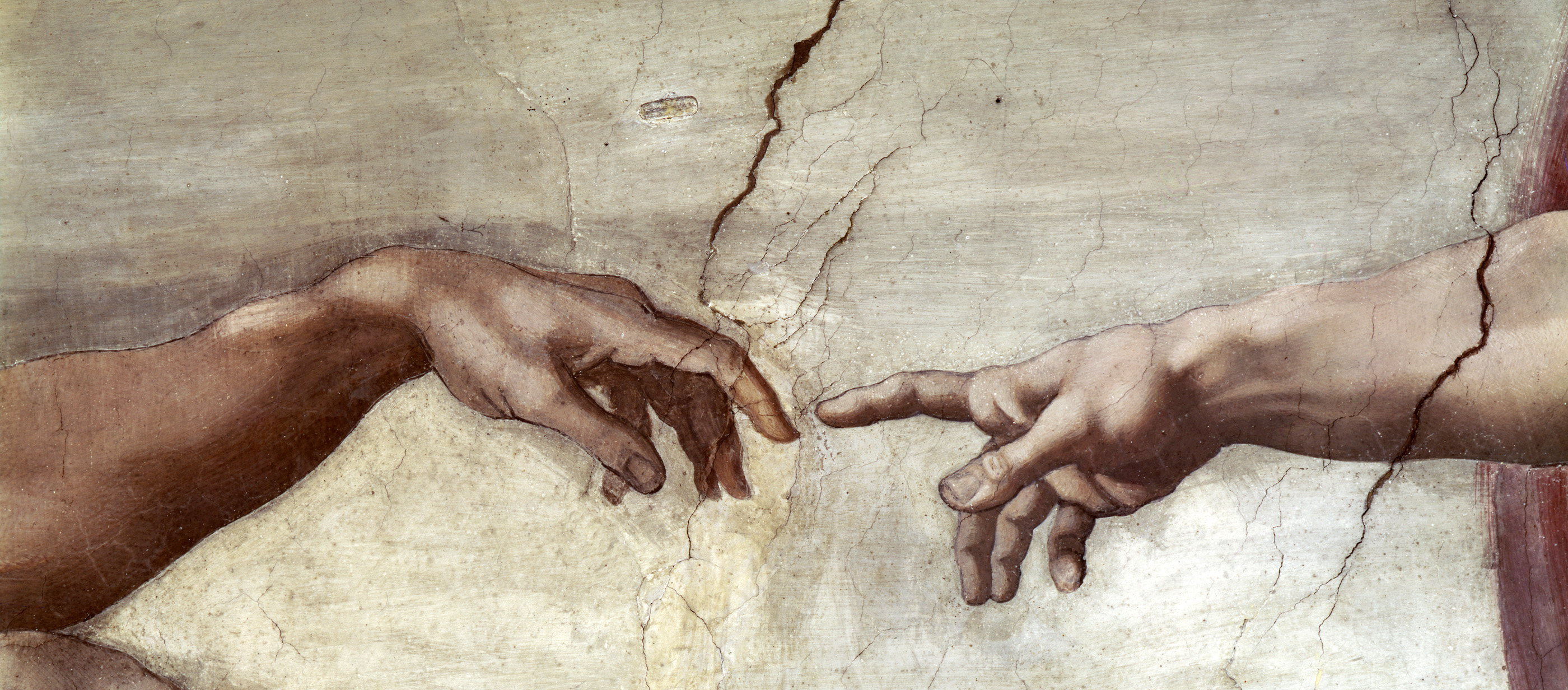
On this day of practicing the active, intentional verb reach, I recognized the artwork by Michelangelo on pages 70-71 of Dictionary for a Better World, and it took me straight back to a day many years ago when my parents visited the middle school where I was teaching at the time. We were walking through the office, where the hands depicted in The Creation of Adam hung over a desk.

The Creation of Adam by Michelangelo

“So,” my Dad asked me as he gestured toward the divine image, “Which hand is God’s, and which hand is Adam’s?”

I’d taken art history in college, but I’d never truly studied this painting, and in the absence of the full image, I wasn’t prepared for the trivia question Dad was asking, especially where others were taking notes of our interaction and waiting for my response.

“I don’t know,” I admitted.

“Look,” he said, “Do you see the hand that is more purposefully reaching, there on the right? That’s God’s hand.”

The painting came to life in that moment, and what I hadn’t seen before, I saw. In July 2019, I got to see it in person when I visited the Sistine Chapel and stared in awe at the ceiling. There are no words to describe the feeling of being there in that sacred space.

Living and connection begin when we take the initiative to reach out. It’s a choice we make. Just like Irene Latham, I am an introvert. Reaching out in a face to face world does not come naturally to me. I’d rather dwell in my quieter world of reading and writing, with a slight buffer zone of physical distance from others way back in the woods of the rural countryside in Georgia. Here in the digital realm, I am more likely to reach out with words and stories. Today, I’ll answer the call to action and practice reaching out in my daily interactions – – and I will also observe to see who may be reaching out to me for a response.

On Happiness Happens day, I’ll purposefully reach out and smile. I’ll make happiness happen.

Made with Padlet
This image has an empty alt attribute; its file name is resize.jpg

*During the months of August and September on days when I’m not participating in the Open Write at www.ethicalela.com, I will be writing in response to the pages of Dictionary for a Better World: Poems, Quotes, and Anecdotes from A to Z by Irene Latham and Charles Waters, illustrated by Mehrdokht Amini. The poems, poetic forms, narratives, quotes, and calls to action to make one small difference might be just the medicine my world – or the whole world – needs. I’ll be inviting insights in the form of an immersion into a 10-minute-a-day book study (just long enough to read the page, reflect, and connect). If you don’t have a copy of the book, you can order one here on Amazon. I invite you to join me in making August and September a time of deep personal book friendship. A few teachers will be following the blog and engaging in classroom readings and responses to the text. So come along! Let’s turn the pages into intentionally crafting beautiful change together.
Eradicating Hate on National Friendship Day

The goal of National Friendship Day was originally to mail a card to a friend. Just this week, I received a card from a friend who is traveling through Iceland right now, and it makes me smile when I think of the inspiration and encouragement she brings to my life. I can’t help thinking of all the hate at the root of evil that would shrivel up and die off if friendship and kindness replaced all the negative energies that seem to hang heavier than ever before in the thick air of our world today. On National Friendship Day, perhaps a smile or holding the door for a stranger or paying it forward at Starbucks might take the place of all the cards I didn’t mail my friends today.

In Dictionary for a Better World, I find today’s page the most unique of all the pages in the book. It’s the only page that features a negative word (but it does it as if the word is now dead and in its grave, hence the epitaph). If you’re participating in the word-a-day journey and take a page-walk through the book, stopping at pages 44 and 45, you will notice that in this entire book that looks like each color from the mega box of Crayola crayons was used so vibrantly, this page is only black and white, like two sides of a fierce argument, with a perfect scribbling capturing the intense rage of hatred that is reminiscent of how I feel every time I read Elie Wiesel’s Night.

What I love most about today’s message on the page is that readers are encouraged to consider the truth of their feelings instead of using hate as the convenient word that it has become for us. Irene’s story encourages us to look deeper into the negative feelings we have about situations and whether it may be disappointment or anger we are feeling rather than hatred.

The quote today by George Washington Carver drives straight to the heart: “Fear of something is at the root of hate for others, and hate within will eventually destroy the hater.” It got me thinking: if hate is its own cancer of the soul and I could cure hate starting with one other word in the book, which word would I choose, and why? Love certainly comes to mind, and so does forgiveness. Empathy and listening and dialogue would work wonders on eradicating hate, too. I thought about each word as I considered what would most heal the heart of a hater. I believe if I could create a nationwide emphasis on eradicating hate, it would all begin with kindness, because if each person really focused on doing something kind with others foremost in mind, I believe we would see even the most bitter, hate-soaked hearts begin to feel the stirring emotions of mattering enough to someone who took time to make a difference.

I keep a stack of stamped, blank postcards ready to be mailed, so I’m wondering how friends might react if I send cards next week that say:

Hi, friend! I was busy on National Friendship Day last week at Starbucks, paying it forward in your honor, and that’s why your postcard is running a little late. Tag. Your turn. Go do something to stop the hate, and light up another heart with kindness. Love, Kim

Which word would you choose to eradicate hate, and why? What are other simple ways to make a difference – (like leaving a basket of soap pods at the laundromat). Please share ideas in the Padlet below by scrolling across to today’s date and posting your response.

Made with Padlet
This image has an empty alt attribute; its file name is resize.jpg

*During the months of August and September on days when I’m not participating in the Open Write at www.ethicalela.com, I will be writing in response to the pages of Dictionary for a Better World: Poems, Quotes, and Anecdotes from A to Z by Irene Latham and Charles Waters, illustrated by Mehrdokht Amini. The poems, poetic forms, narratives, quotes, and calls to action to make one small difference might be just the medicine my world – or the whole world – needs. I’ll be inviting insights in the form of an immersion into a 10-minute-a-day book study (just long enough to read the page, reflect, and connect). If you don’t have a copy of the book, you can order one here on Amazon. I invite you to join me in making August and September a time of deep personal book friendship. A few teachers will be following the blog and engaging in classroom readings and responses to the text. So come along! Let’s turn the pages into intentionally crafting beautiful change together.

Play Outside and Enjoy Nature!

If it’s the first Saturday of any month, it’s National Play Outside Day! Dictionary for a Better World reminds us to spend time in nature . Today’s form of poetry is a Haiku, one of my favorite, which traditionally has seventeen syllables in a 5-7-5 line pattern, but Modern Haiku throws out the rules and urges a short poem in three to four lines and no rules.

Rain

quenching Earth’s dry thirst

steady rains saturate plains

trickle, tickle dirt

Made with Padlet
This image has an empty alt attribute; its file name is resize.jpg

*During the months of August and September on days when I’m not participating in the Open Write at www.ethicalela.com, I will be writing in response to the pages of Dictionary for a Better World: Poems, Quotes, and Anecdotes from A to Z by Irene Latham and Charles Waters, illustrated by Mehrdokht Amini. The poems, poetic forms, narratives, quotes, and calls to action to make one small difference might be just the medicine my world – or the whole world – needs. I’ll be inviting insights in the form of an immersion into a 10-minute-a-day book study (just long enough to read the page, reflect, and connect). If you don’t have a copy of the book, you can order one here on Amazon. I invite you to join me in making August and September a time of deep personal book friendship. A few teachers will be following the blog and engaging in classroom readings and responses to the text. So come along! Let’s turn the pages into intentionally crafting beautiful change together.

On National Work Like a Dog Day, Don’t be Out-serviced!

It’s National Work Like a Dog Day, and I’m considering the similarities and differences between work and service, my word of the day. Dogs seem to have a strong work ethic, naturally – – and they don’t clock in and out. They do what they see needs to be done, and they do it all with a servant’s heart. How many times have I turned over at night to see our Schnoodle, Boo Radley, wide awake, sitting between my husband and me, guarding over us? He loves his people (and besides – he has all day to sleep). He is the nightwatchman, working hard for those he loves and serving us with what he has to give – his dog strengths. He works like a dog, and it’s an act of service, too.

Irene Latham’s story about serving food at a convent as a way to feel satisfaction and unity brings to mind a story that Dr. Kyle Reese, interim pastor of St. Simon’s Island First Baptist Church in coastal Georgia, shared in his sermon last week. He told about a Florida pastor and his wife who’d had a tremendous impact on those in his community. Dr. Reese shared that in one conversation he’d had with his pastor friend, this man explained that God had placed in his heart a strong calling to help those in poverty. After many years of working together with his wife in their ministry, Dr. Reese’s pastor friend died. At the funeral, people spoke about the difference this man had made in their lives.

“He would drive the church van to our neighborhood……,” he said.

One young man said, “He gave us a story. He would drive the church van to our neighborhood and pick up all the kids and take us somewhere during the summer. It didn’t matter where we went, whether to McDonald’s to share a meal, bowling, to a movie, or to a park. The important thing is that we went somewhere and had fun. We all knew that he did this because for those of us who never had a way to go anywhere, we needed a story to write when the teacher asked us the first week of school what we’d done that summer. Because of him, we always had a story to write. He always made sure we had a fun experience like the other kids.”

The quote by Lao-tzu today, “The heart that gives, gathers,” rings truth. While we bless others with our gifts of service, we are the ones who are blessed tenfold when we seize the opportunity to make a difference and act as good stewards of our gifts!

Made with Padlet
This image has an empty alt attribute; its file name is resize.jpg

*During the months of August and September on days when I’m not participating in the Open Write at www.ethicalela.com, I will be writing in response to the pages of Dictionary for a Better World: Poems, Quotes, and Anecdotes from A to Z by Irene Latham and Charles Waters, illustrated by Mehrdokht Amini. The poems, poetic forms, narratives, quotes, and calls to action to make one small difference might be just the medicine my world – or the whole world – needs. I’ll be inviting insights in the form of an immersion into a 10-minute-a-day book study (just long enough to read the page, reflect, and connect). If you don’t have a copy of the book, you can order one here on Amazon. I invite you to join me in making August and September a time of deep personal book friendship. A few teachers will be following the blog and engaging in classroom readings and responses to the text. So come along! Let’s turn the pages into intentionally crafting beautiful change together.