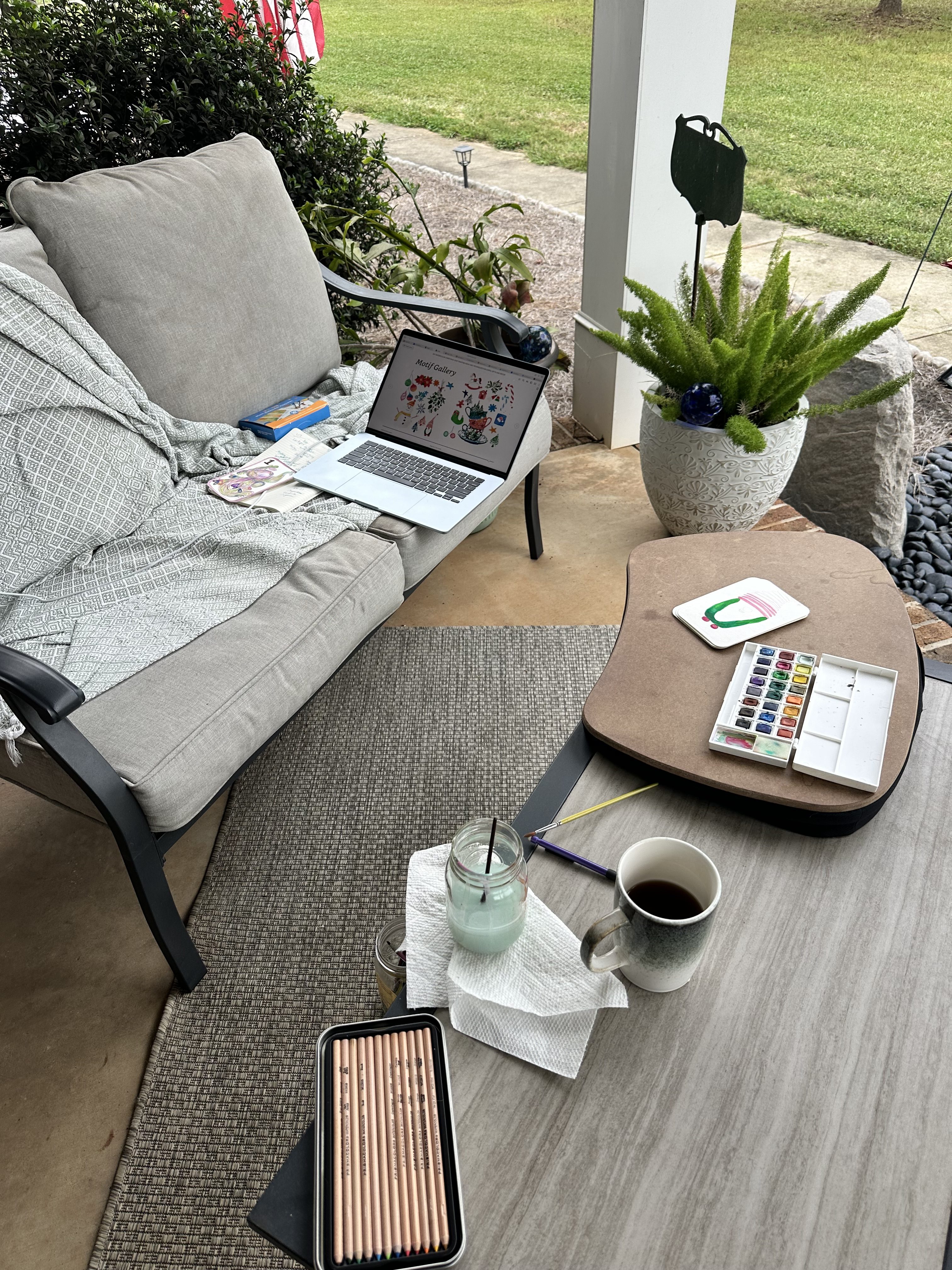
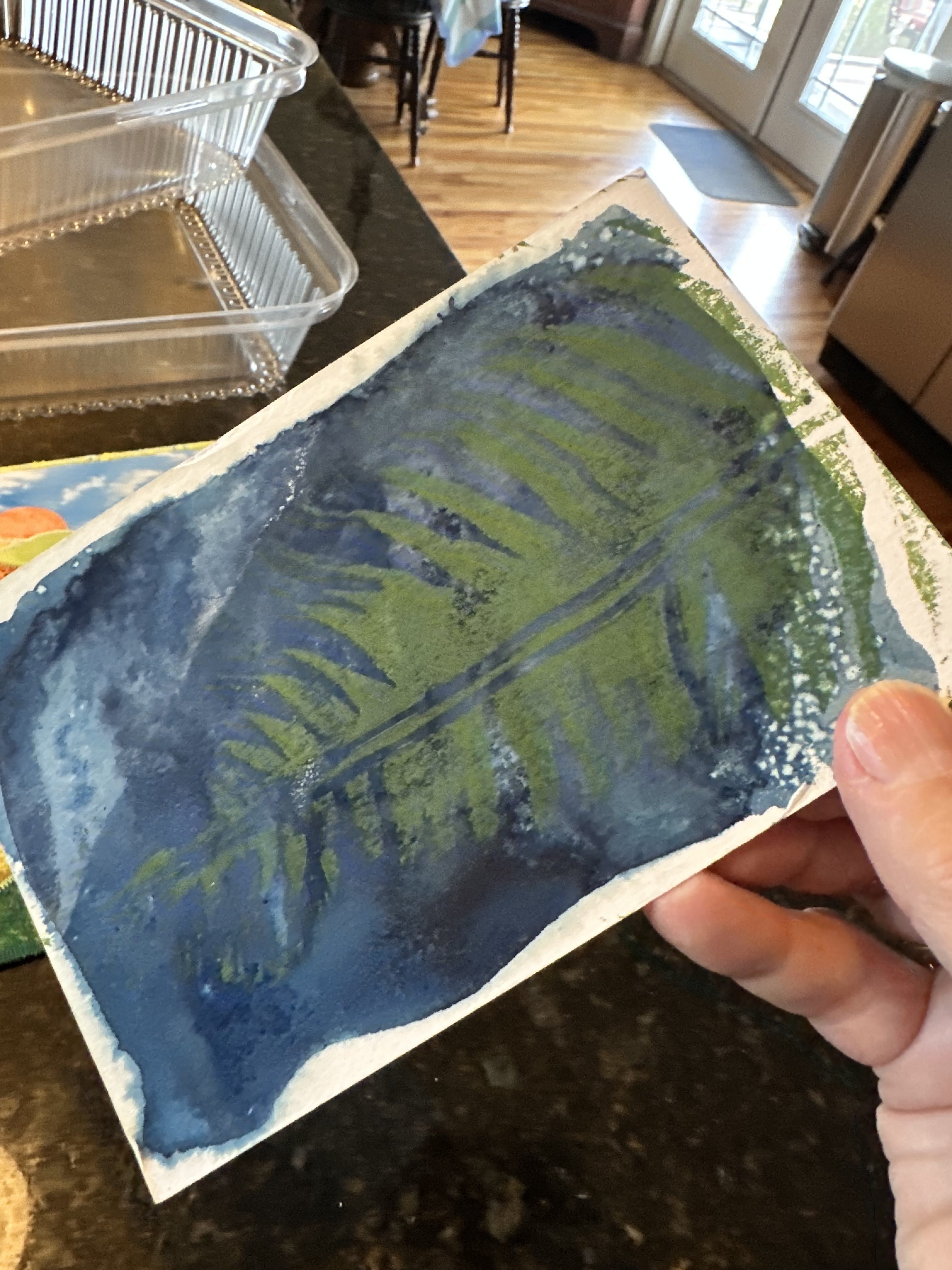
The weekend wasn’t without rain (4 inches, according to our rain gauge) from the hurricane here in middle Georgia, but by Sunday afternoon, the temperatures were too pleasant to stay indoors. I brought my paints outside and enjoyed some time sitting on the porch. It was a wonderful time to get a jump start on painting some postcards for next month’s poetry exchange. Some weekends are largely unproductive in terms of getting things done that need to be done. This was one of those.
I used to love making pressed flowers for bookmarks and decoupaging plain white candles and decorative soaps when I was younger. My mother taught me how to take newspaper and fold it to match the pages of a heavy book and use that as a press. About six weeks later, we’d use tweezers to take the petals and stems and arrange them over a flat surface using Mod Podge. I think our hobby started back in the day when women carried hexagon-shaped wooden purses decoupaged in collage, with tortoise-shelled handles. Macrame purses were all the rage at that time too. As I was looking for some photos of the ones I’d possibly blogged about before, I did a quick search and discovered I had created a list of 50 things I planned to do in retirement from November 2024, and pressing wildflowers was one of them. How did I forget that list? Check it out here. The dream hasn’t changed much!
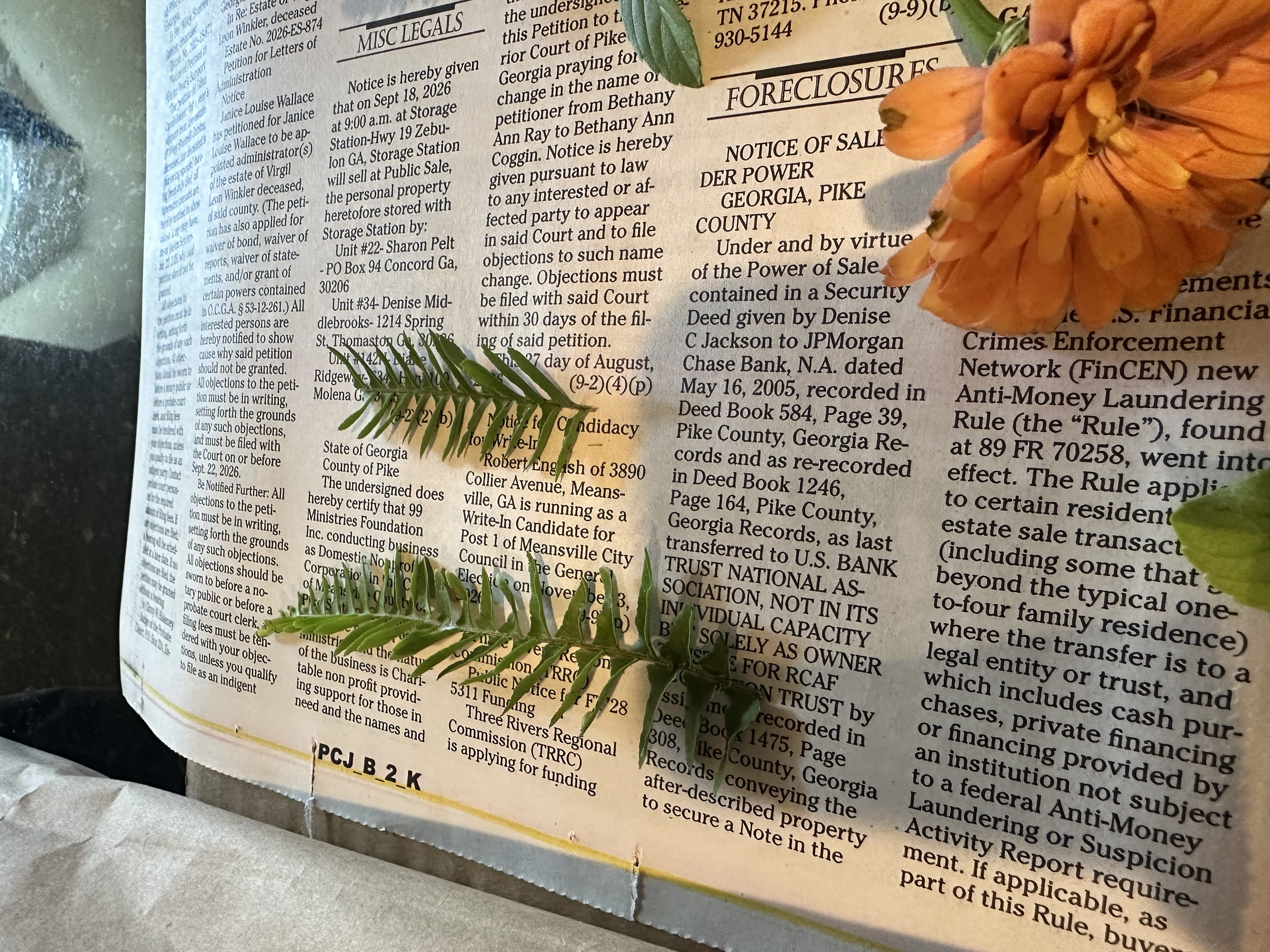
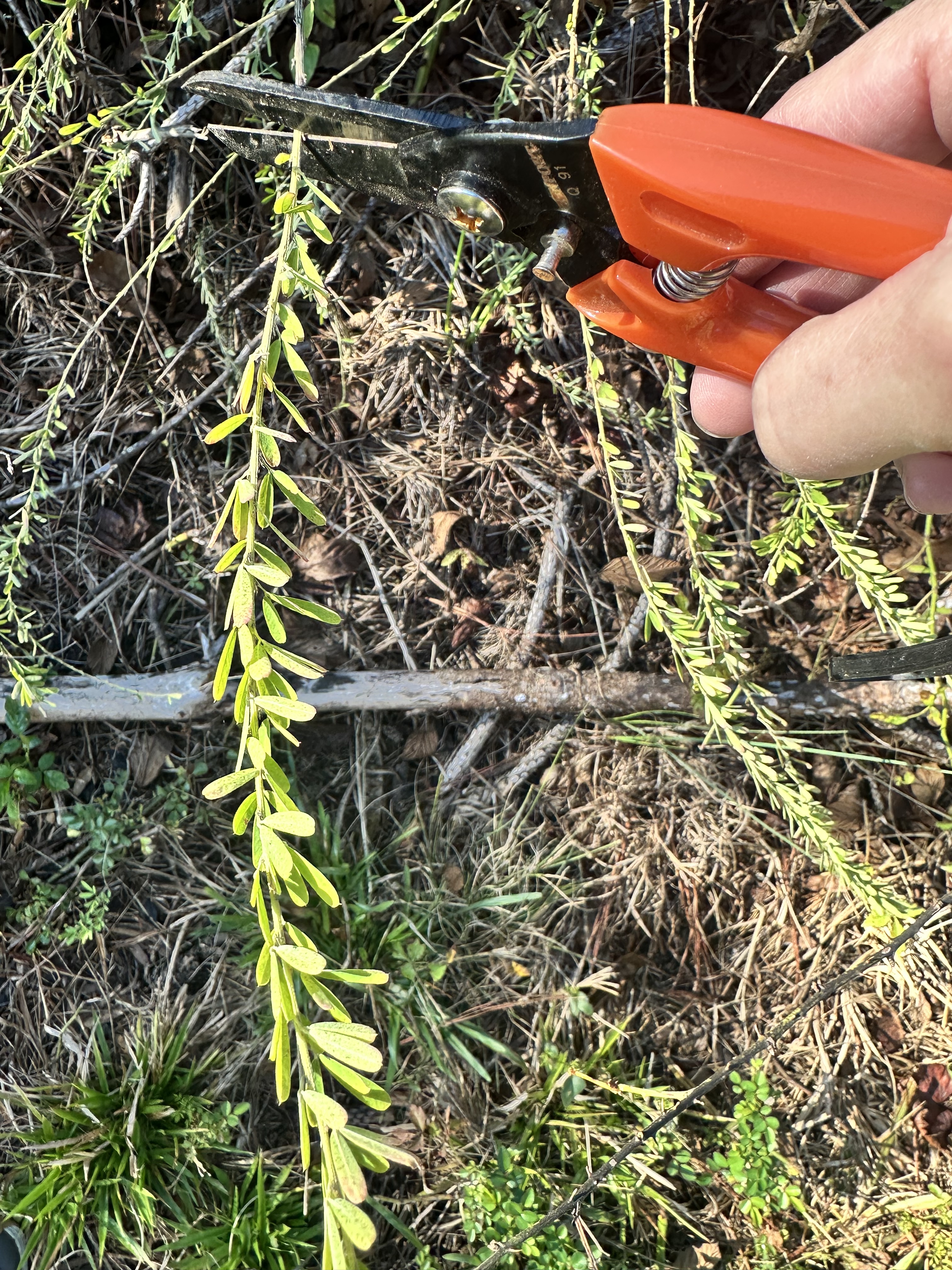
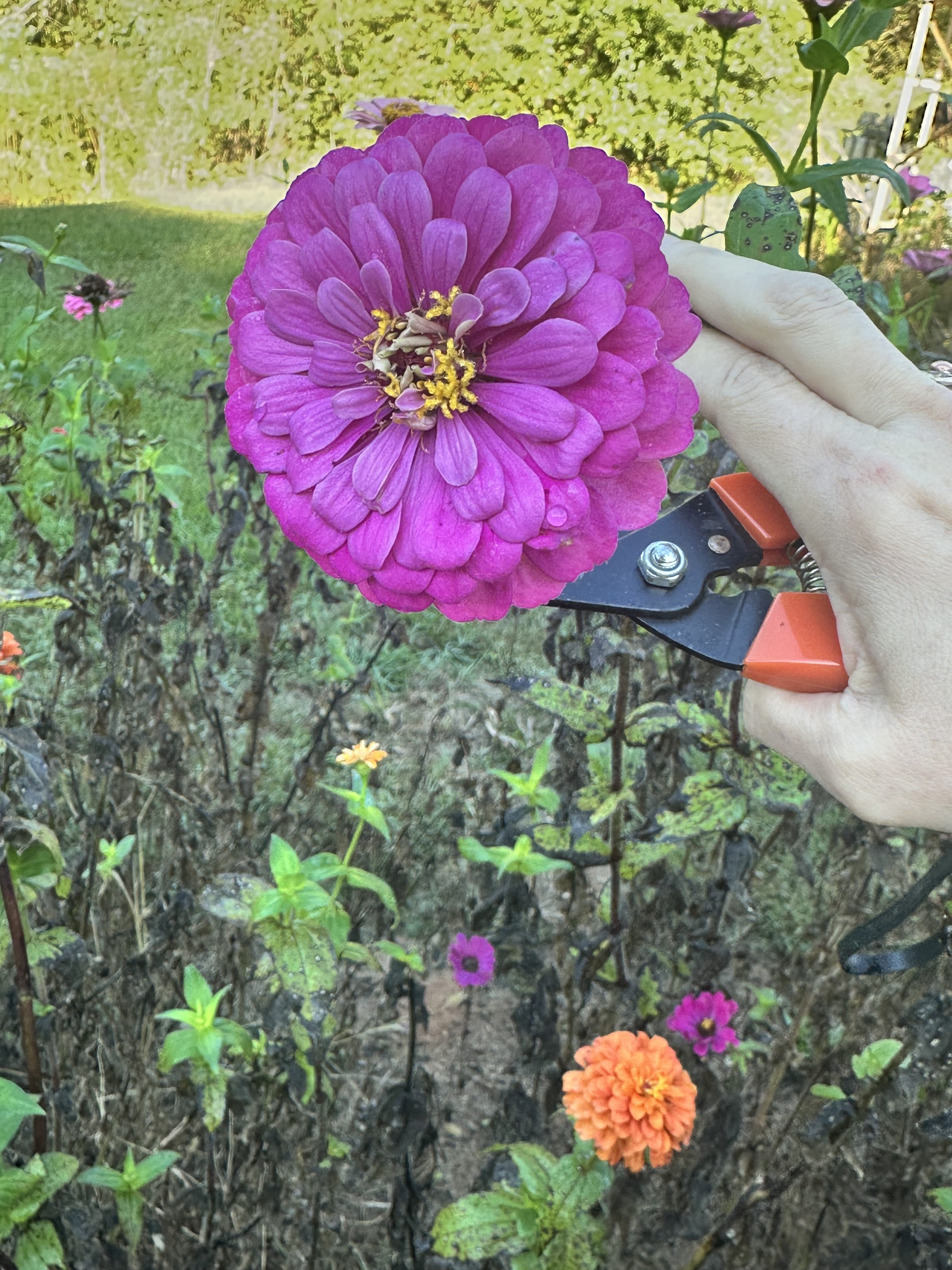
During the middle of last week, I called my sister in law to see about coming to get some zinnia clippings from her wildflower beds to press between old newspapers. Off I went, clippers in hand, and came home and pressed a paper sack full of greenery and flower petals I’d collected. In 2008, I participated in a teachers’ study along scientists doing research in the field in South Georgia, and I became the owner of my own plant press and field guide for the plant studies of native species. Still, I use newspaper and not the fancy acid-free white poster-thickness paper that we used throughout that summer in Americus, Georgia at the Jones Ecological Research Center.
For the first time, I’m pressing fresh basil, since a recent bouquet gift had an abundance of this fragrant herb. One thing that never changes: native Georgia ferns are my go-to greenery in any arrangement.
I’m marking my calendar for mid-November to check the plant press and create some decoupaged pillar candles for a Thanksgiving centerpiece. As we have lost mothers over the years, we light candles to remember them on Thanksgiving, and this year I have something other than the plain white tea lights in glass jars in mind. 🙂
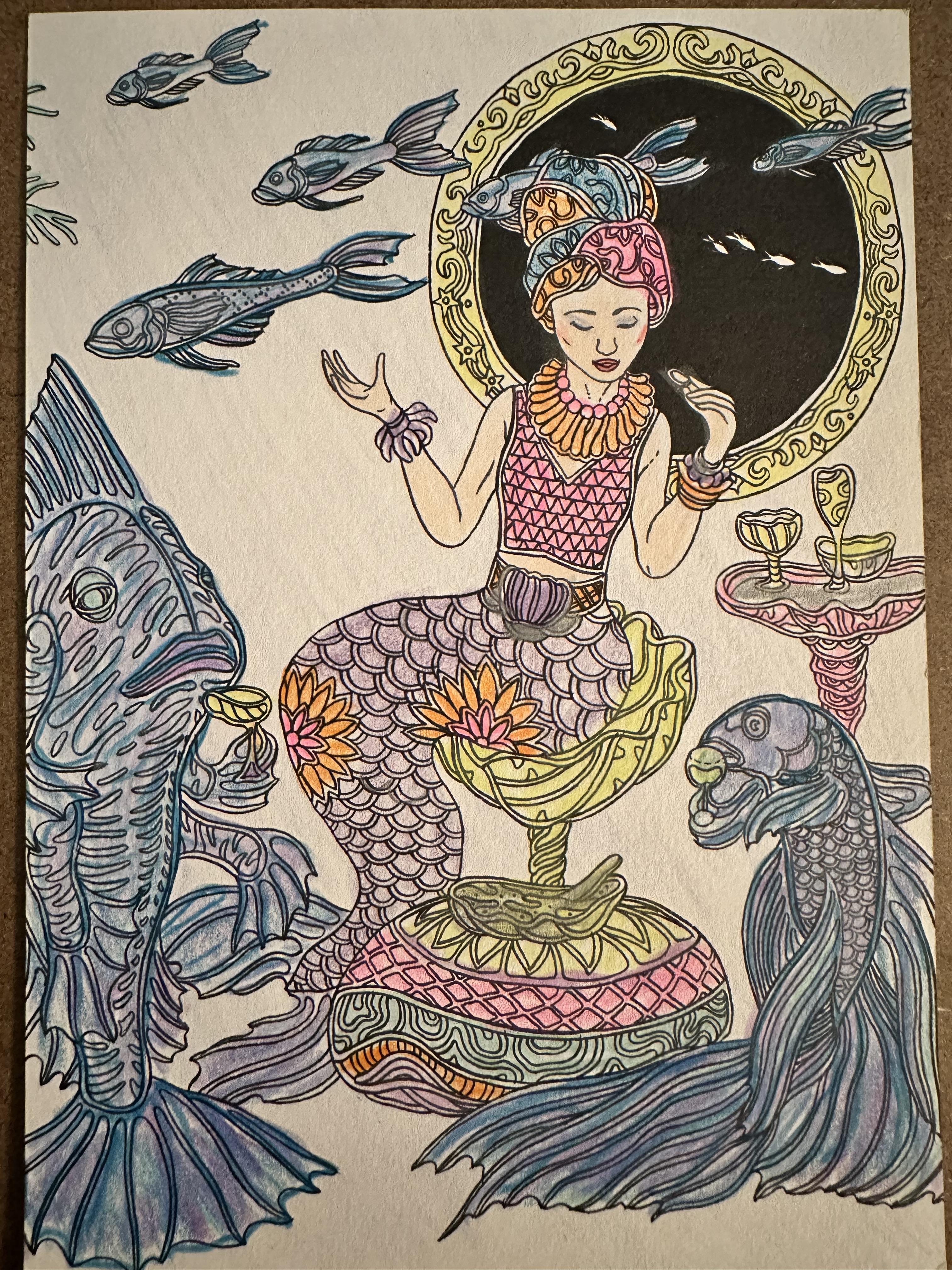
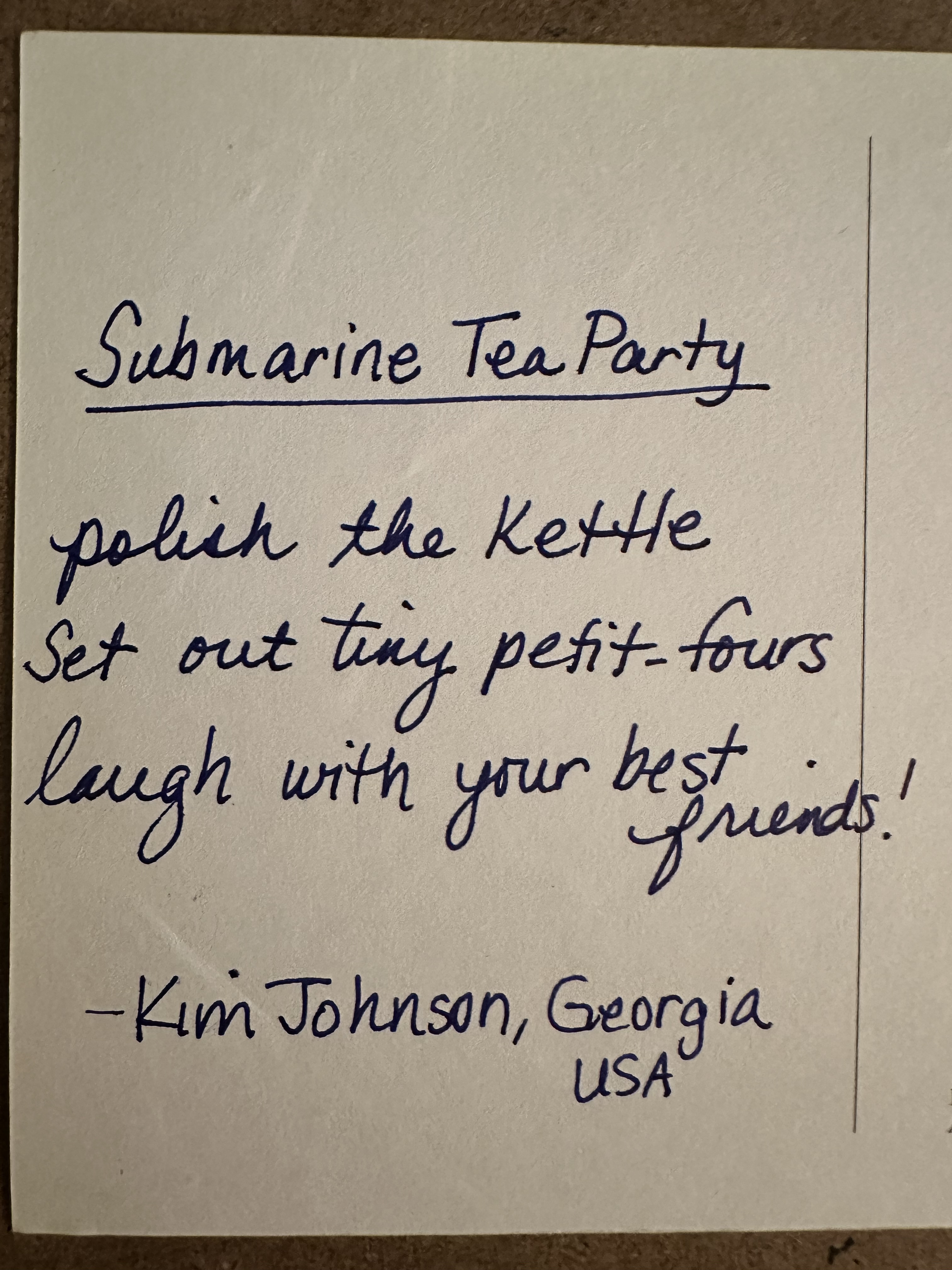
After participating in Postcard Poetry Fest during July, I signed up for a smaller group of poetry postcard exchanges for each month of the year. It’s been thrilling seeing all of the ways that members of the group share art and poems. So far, I’ve colored postcards with color pencil, created fabric design postcards and made fall scrapbook sticker poems. I’ve also bought flower fairy postcards and written Have You Ever poems to go with them. I have a local friend who is diving in feet first, and she’d asked me to share some of the poetry ideas of others, so today I’ll do that! Postcard poetry ranges from plain white 3×5 index cards with nothing but black ink and a handwritten poem to elaborate collage work to vintage postcards to the traditional Wish You Were Here cards from various points across the globe. Each brings its own special smile and gets its own spotlight mailbox moment.
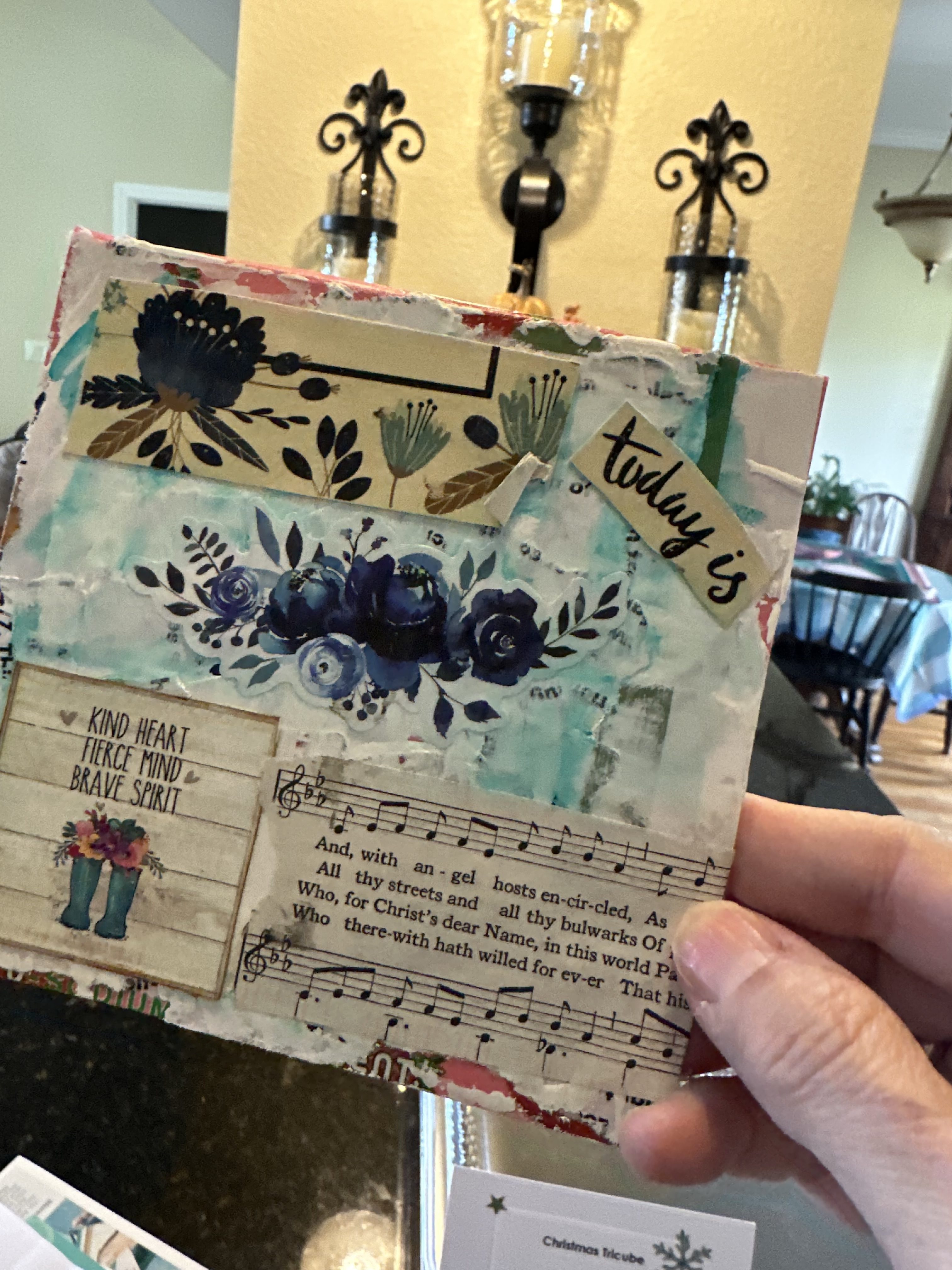
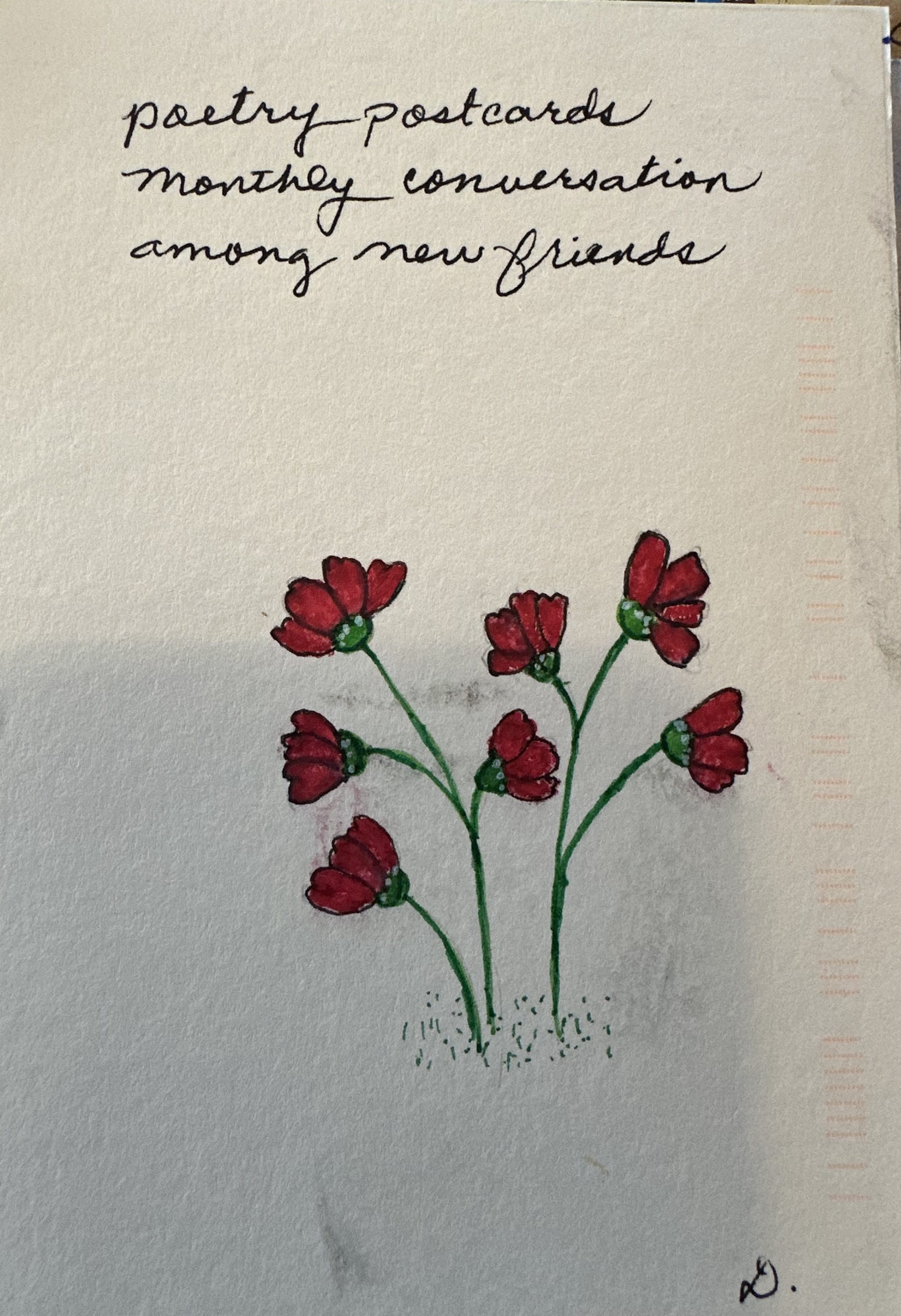
Here are some photos of postcards I’ve both sent and received. Proof positive that the smallest gestures, even the size of a postage stamp, can brighten someone’s day in unexpected ways.
If you are interested in becoming part of this group, Barbara Robinette has shared the following information for group members to pass along to others. I hope you will consider joining!
From Barbara:
The Purpose of the Postcard Poetry Group: To form and maintain a poetry community among poets by sharing our poems on postcards on a monthly basis sent through USPS mail. We need to continue to get the word out that we exist. Please invite other poets you know to join PPG by emailing
By the 30th of each month, I will email everyone the next month’s Name and Address Listing. Rules: Send 1 postcard to 3 (or more) poets of your choosing in either group. If you receive a card from someone you did not send to, please reply with a card. Hopefully, this makes sure everyone receives a postcard poem.
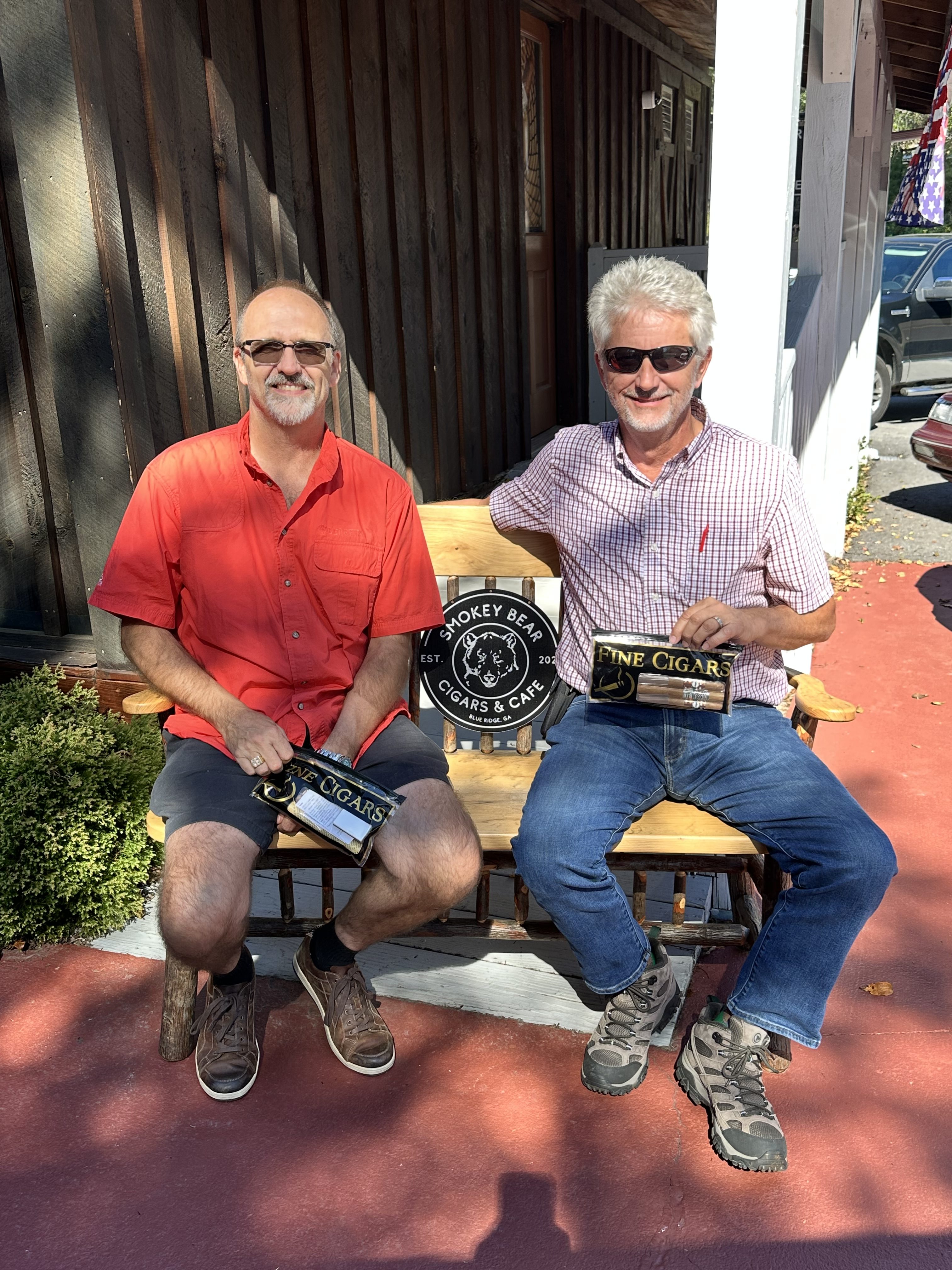
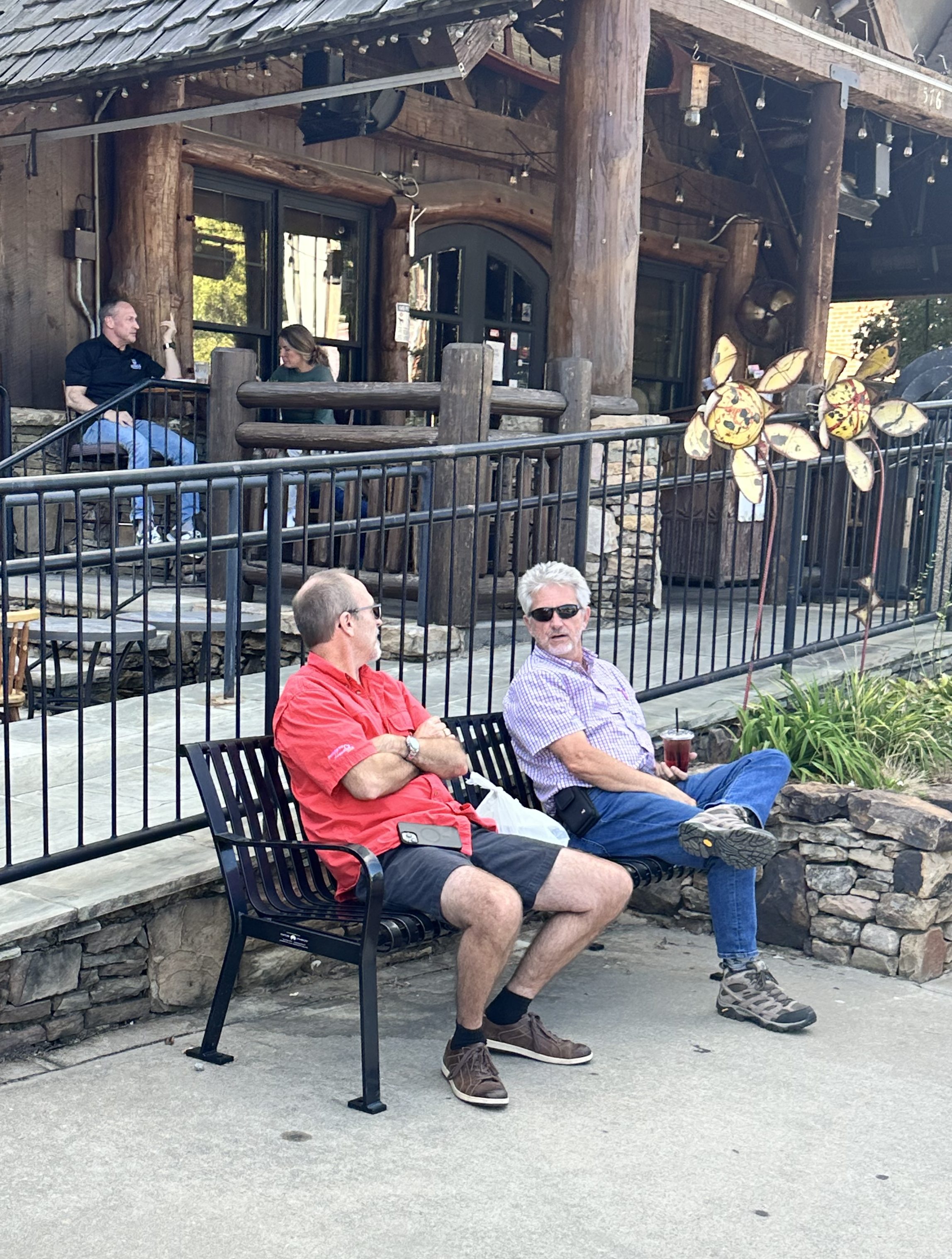
When we drove a little over half of Route 66 in June 2024 with my husband’s brother and his wife, we took a lot of pictures. One theme emerged early into the trip: brothers on benches. Bethany and I would be shopping in a store or ambling along to check things out in the small towns along the way when one of us would suddenly spy the brothers deep in conversation on a nearby bench. We’d snap a photo just to timestamp the moments of our slow-paced trot across the nation, where the scenery changed by the minute but the desire to just sit and talk never did, no matter the GPS point.
Such is the case this weekend in the mountains of North Georgia on our getaway to celebrate Bethany and Kyle’s birthdays this month. The brothers are still finding benches, no matter where we go. And we’re still capturing the moments in pictures. It’s the conversation and not the landscape that remains the constant.
Retirement officially began for me August 1st, and each second and fourth Friday, I’ve begun reflecting on the first year of retirement in two-week windows and what it’s like in this new chapter of life. At the beginning of my first week off, I used a green spiral notebook to make a list of all the things I wanted to do — something enjoyable each week, blending in some new hobbies and routines as well. Friends and family who are still working seemed genuinely curious about what I would do with each day, and that’s what gave me the idea to plan and reflect on the course of my days and adventures. I remember my late father’s words, on retirement: You don’t retire FROM something, you retire TO something, and you’ll be busier than you’ve ever been. He was right, but the busy part is optional, like wearing real clothes on most days instead of my preferred loungewear. And I like having that choice.
Here are some things I’ve enjoyed in my first official eight weeks of retirement, with each being described in detail in previous posts :
23. Labor Day Camping at F. D. Roosevelt State Park in Pine Mountain, Georgia
24. Dolly Parton Tribute at the Grand Ole Opry in Nashville, Tennessee
25. Stafford Challenge Small Group Zoom Meetings
26. Stafford Challenge Writing Workshop
27. Mahjongg Group Formation
28. Almost-Birthday Pedicures with my Sister-In Law
29. Lunch with Friends
Here are the the most recent things I’ve added to my list of 100 Things I’m Enjoying in Retirement:
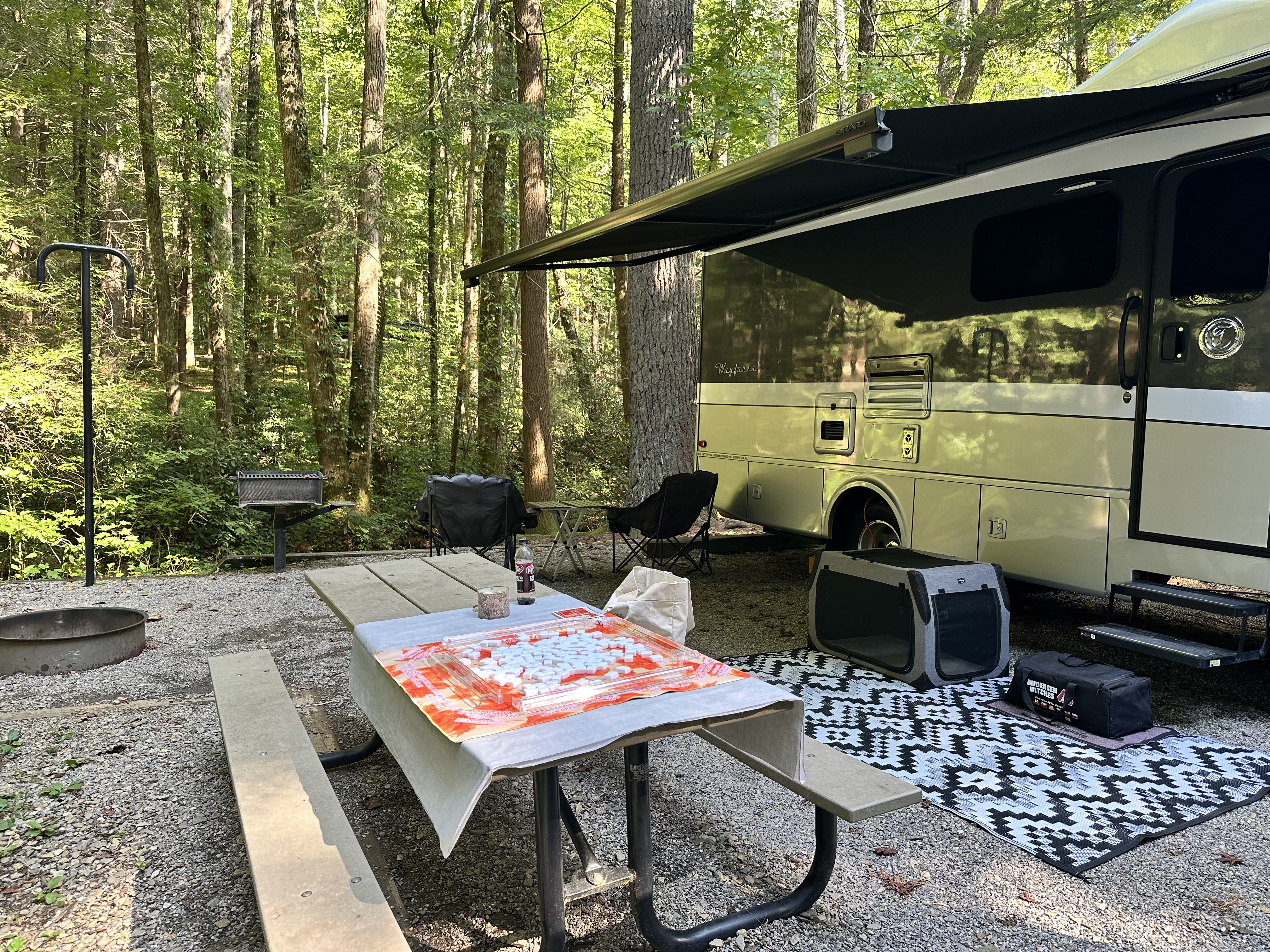
30. Camping at Vogel State Park – We camped in the North Georgia mountains near Neel Gap along the Appalachian Trail. We managed to avoid the “problem bear” that had been frequenting site 52. Whew! We enjoyed sitting outside in the cooler temperatures and listening to the stream that ran behind our campsite.
Our campsite, site 44, at Vogel State Park
31. Hiking the Appalachian Trail – I attempted this one, but took it off the list after setting out thinking that if Grandma Gatewood could do it, so could I. After a mere 36 seconds, I realized I was wrong. Even our recent hike to check in when we went to F. D. Roosevelt State Park took it out of me when I tried hiking mountainous terrain. I like flat, home-based, safe treadmill hiking best.
In which I hike 30 seconds of the actual Appalachian Trail at Neel Gap and give up
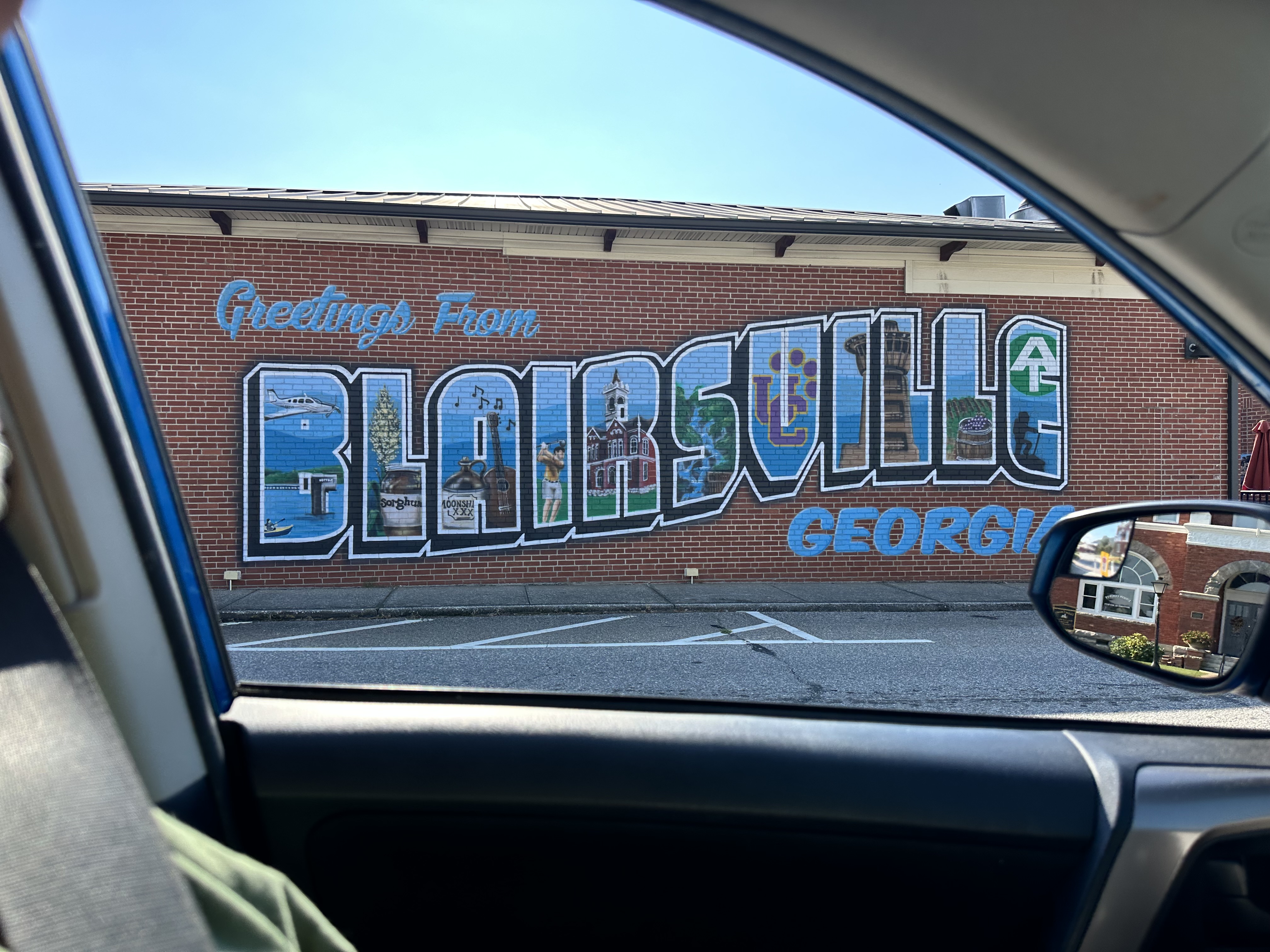
32. Daytripping for Lunch and Small Town Adventuring – My husband and I experienced Blairsville like locals by visiting the county library to ask where to eat and what to see.
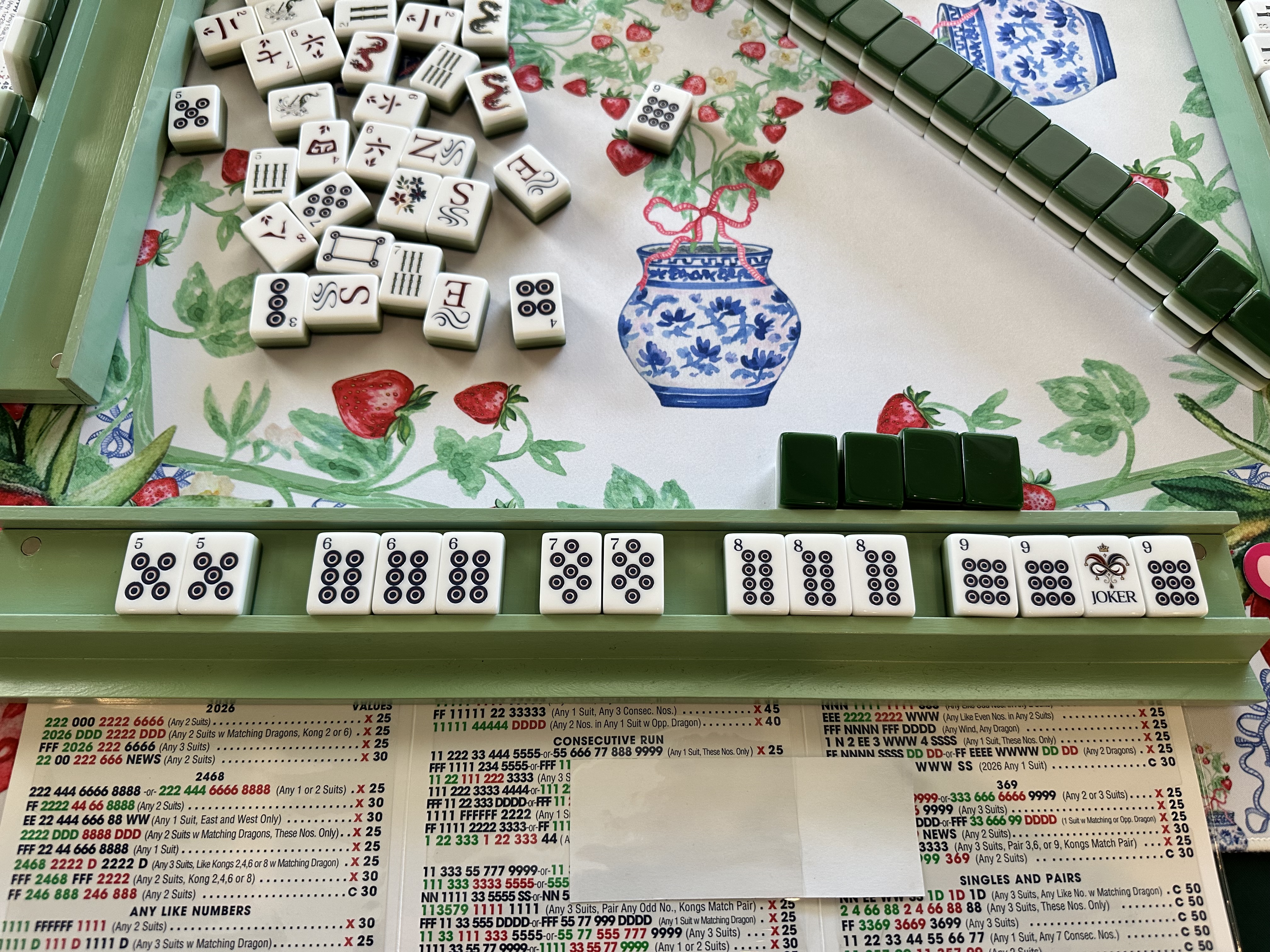
33. Mahjong in Blairsville, Georgia – After realizing it would be challenging to go for days without playing Mahjong with a group, I reached out to a group leader in Blairsville for information on their open group play and joined them for a few hands, even Mahjonging with a consecutive run and getting to pick a trinket (a tiny seal) from their treasure box.
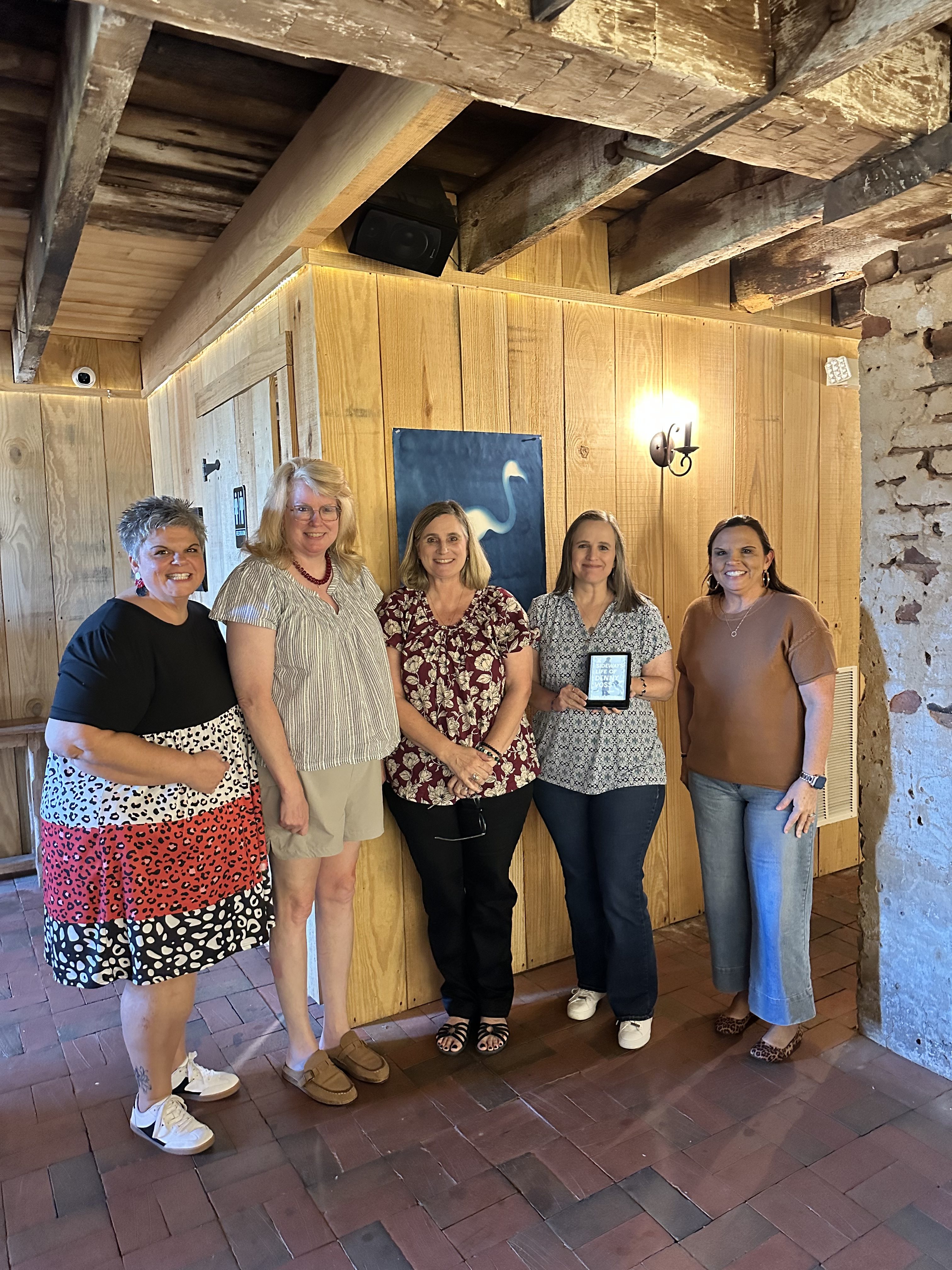
34. Kindred Spirits September Book Club – We read The Sideways Life of Denny Voss by Holly Kennedy as our September selection and set a date for a January getaway to a cabin for some girl time pajama reading.
35. Hosting Open Write – One writing community that sustains me is the Open Write at http://www.ethicalela.com. I enjoy writing with them monthly and also hosting a couple of times a year as well. I hosted one day during the month of September and will host again in 2027 during April. My reading and writing communities mean so very much to me.
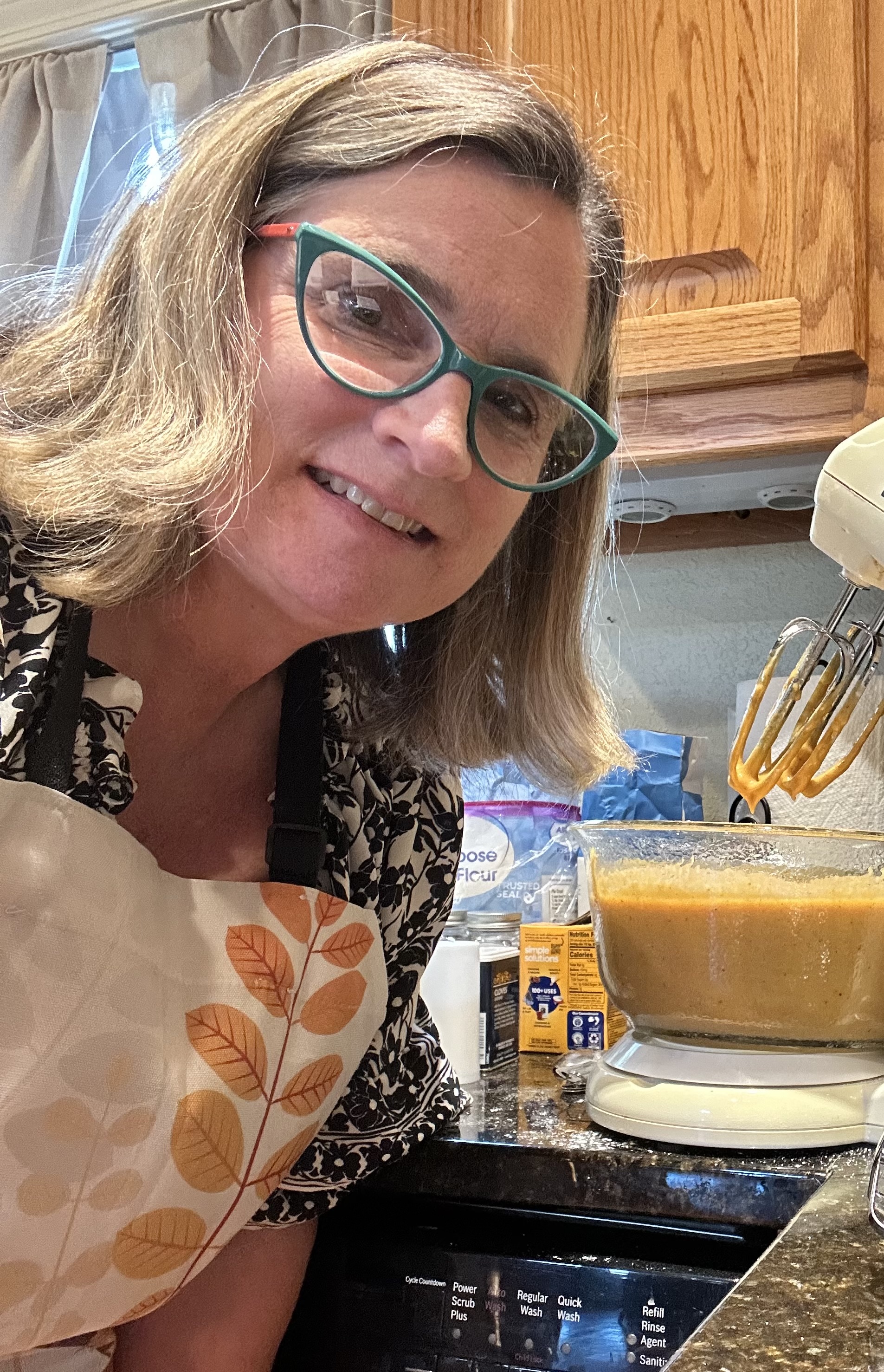
36. Fall Baking – I was having the ladies over to play Mahjong on the first day of fall, so to welcome autumn, we celebrated with fall foods. I baked pumpkin bread and banana walnut bread, and I even wore my favorite fall apron! The whole house smelled of cinnamon and spice, and the vibe was that kind you wish you could keep all year long. I’ve always wanted a slow-paced fall baking day just to call a baking day.
I’m freezing some of the pumpkin bread to take with us to a cabin in the North Georgia Mountains. We’re leaving on Saturday, and we’re going on a special excursion that I’ll share on the next Retirement Adventure countdown……
At the end of the second month, I’m more than a third of the way through my list of 100 Things.
One of my favorite parts of RV travel is going into small towns along the way to see what life is like there. I don’t mean it to sound like I perceive other places as somehow foreign in an Earthling versus Alien kind of way, but I like to see what everyday is like for those who live in places other than where I live. I like to see their favorite places to eat, their shops, their town squares, their Walmarts, and their libraries. I like to experience a day in the place of others whose shoes I can share for even just a day.
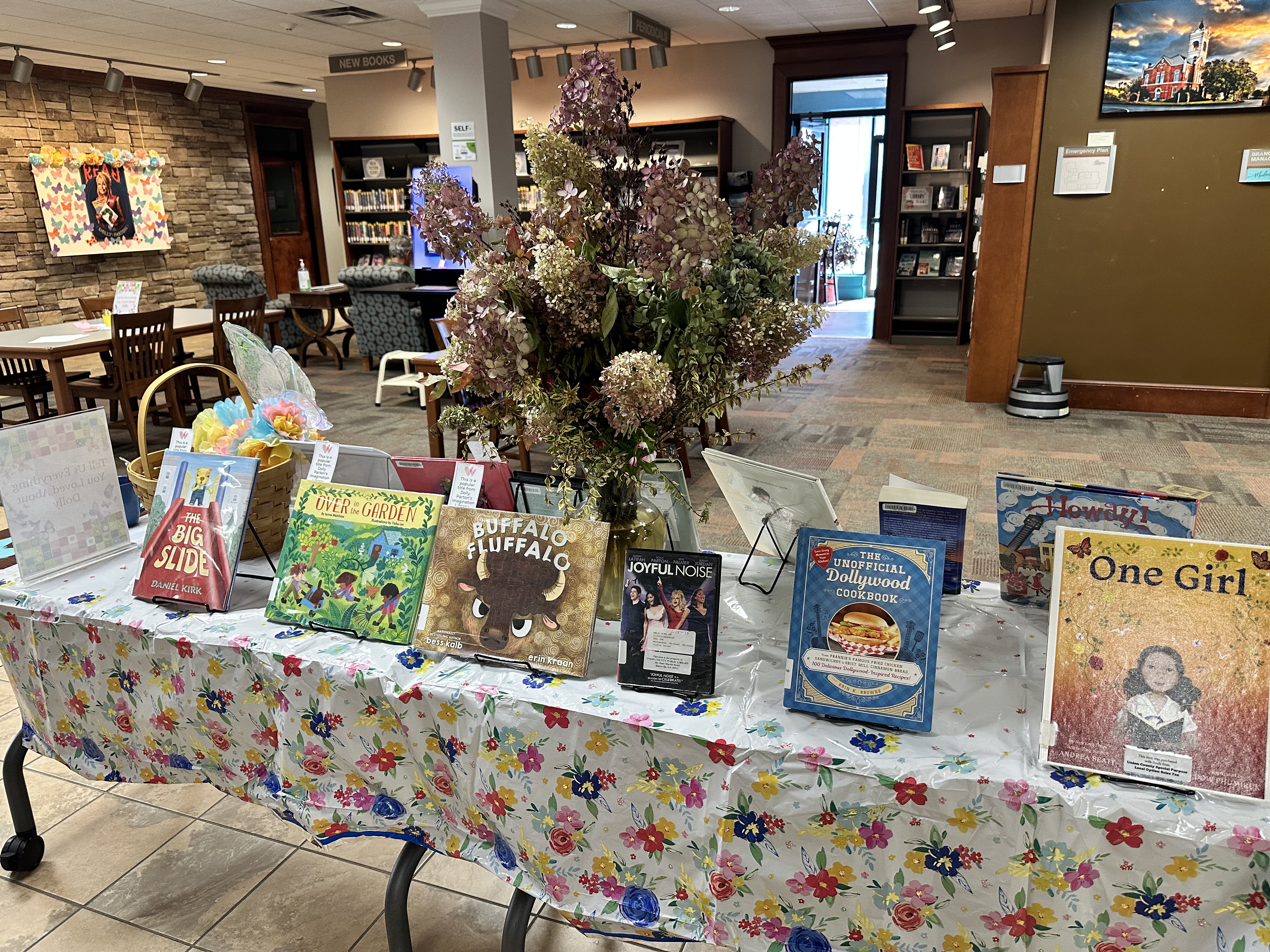
During a recent trip to North Georgia, we spent a little time in Blairsville. Our first stop was the county library, where we checked out the book collections and programs and also asked about where the locals like to eat. The Union County Library has a Dolly Parton display and a plant swap going on right now, and when I go to other libraries around our state, I feel sad for our small library without the resources that others have.
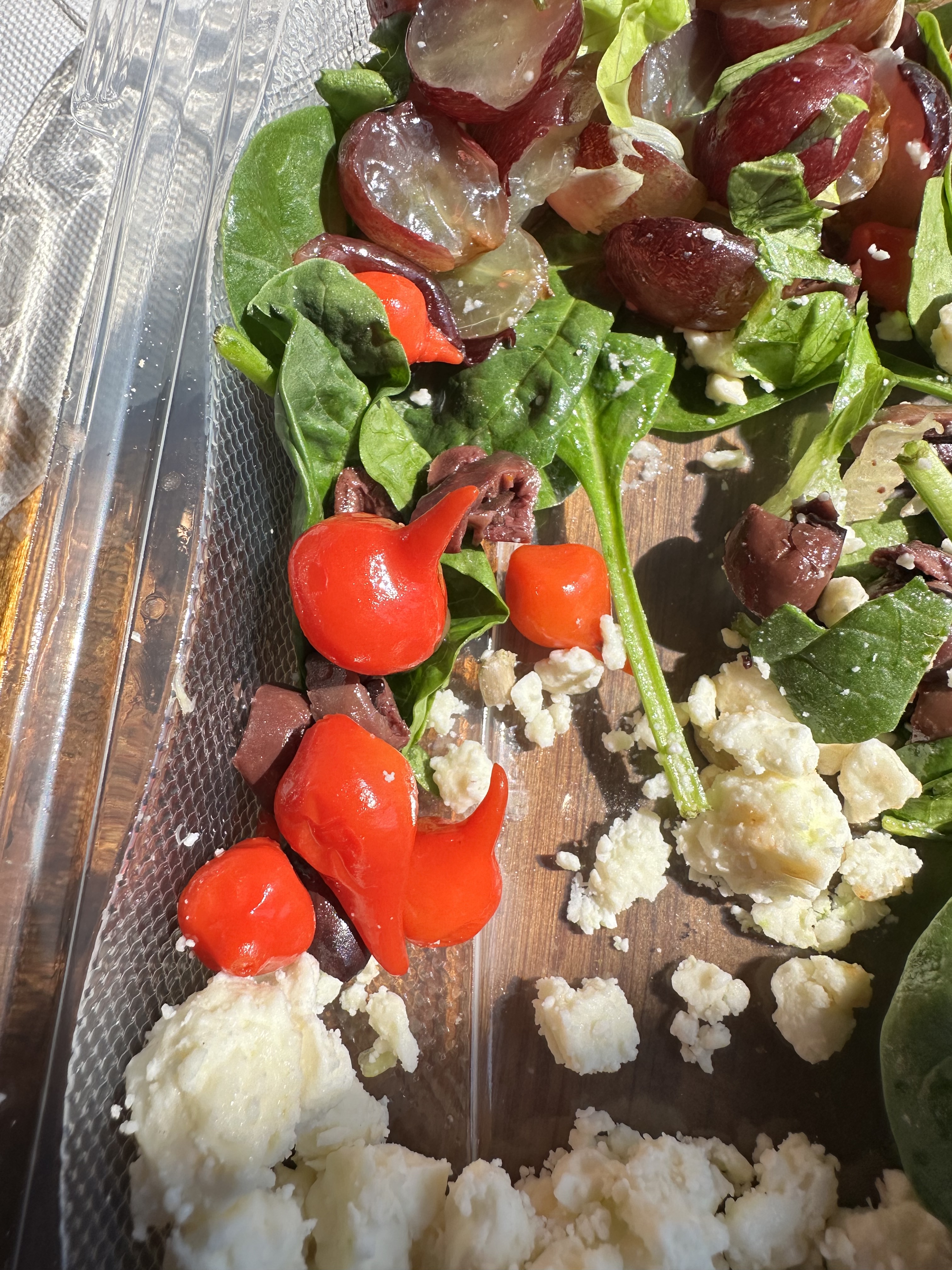
We got several restaurant recommendations, including Belly Pizza and Hole in the Wall. At Belly Pizza, we had a supreme pizza and ordered a large so we’d have leftovers for the next day (we are “lazy” campers who prefer microwave leftovers to cookouts). We also ordered a Catalina Wine Mixer salad, which had baby spinach, red grapes, Kalamata olives, red onion, roasted tomato, sunflower seeds, feta cheese, Catalina vineyard dressing, pepperoncini peppers, and…..ta daaaaa…. pepper drops, also known as Biquinho peppers. In all my life, I have never had these, and they were fabulously flavorful. They’re the red bulb-looking peppers in the photo below. They’re a full taste explosion, popping like a firm grape and tasting like a cross between a sweet tomato and a soft bell pepper.
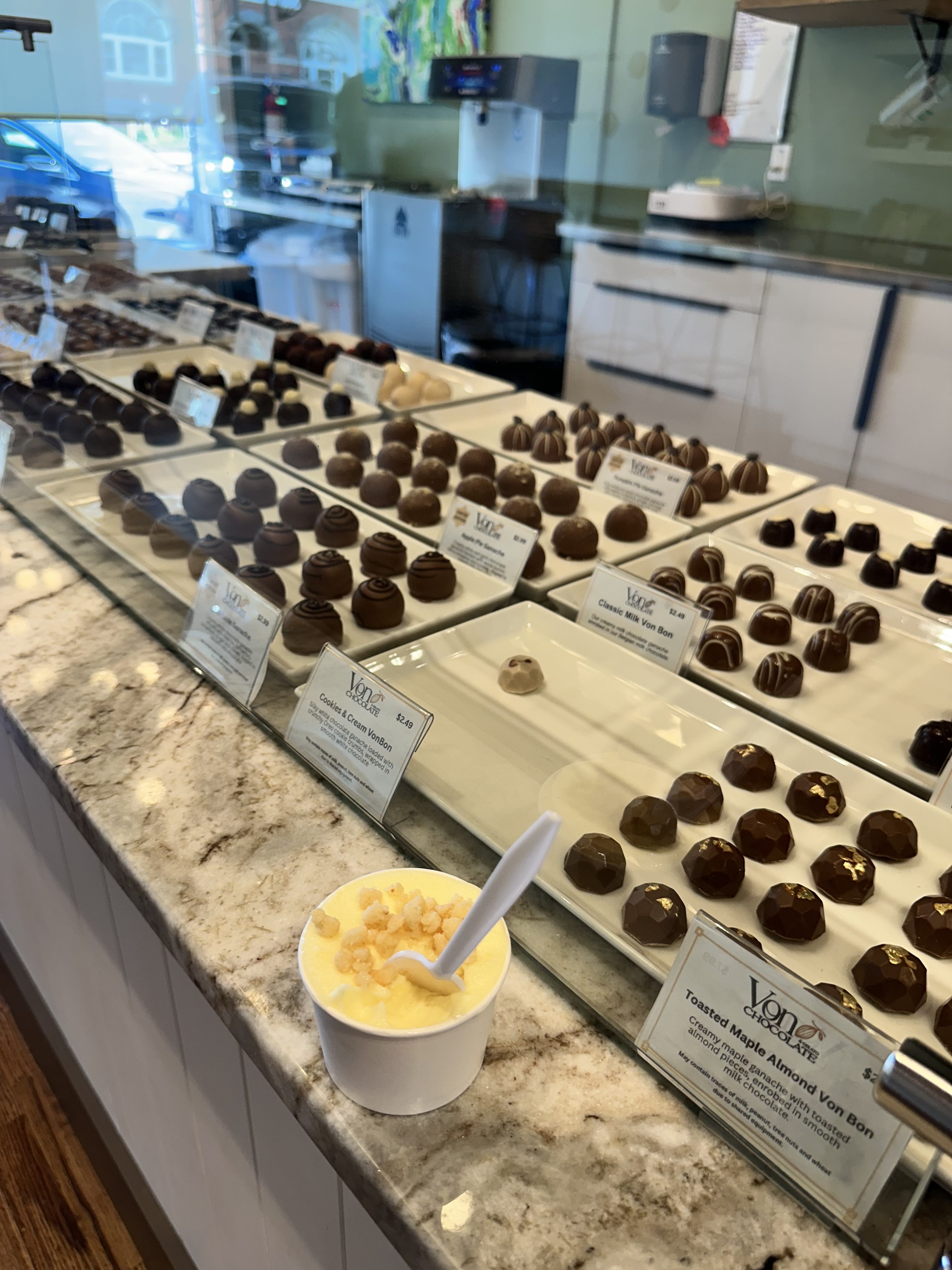
We also ducked into a gelato and chocolate shop for a sweet treat. The lemon gelato was delicious with a. sugar cookie crumble topping, and the chocolates looked good, too, but we stopped at one small sweet treat and resisted the urge to splurge worse.
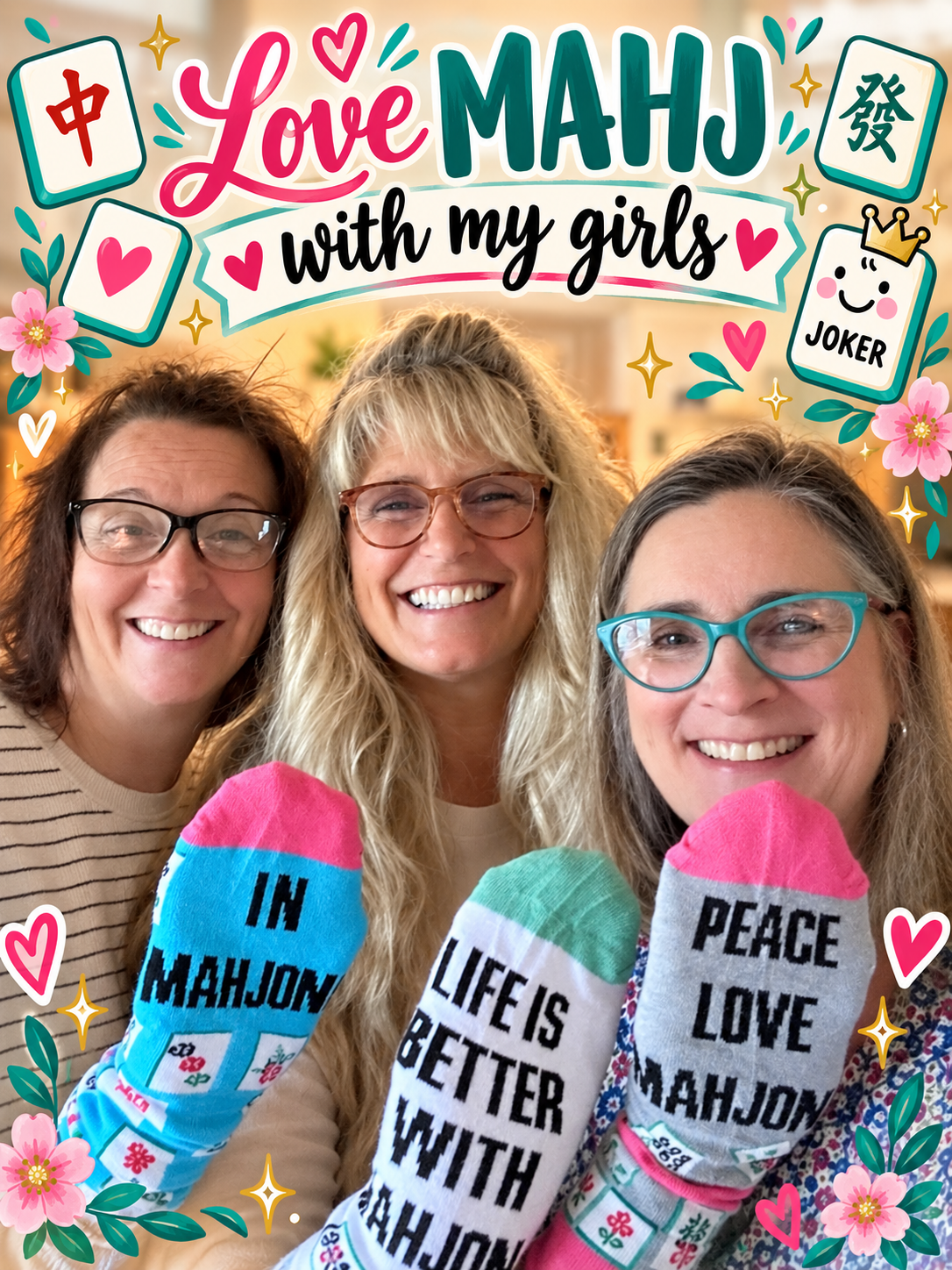
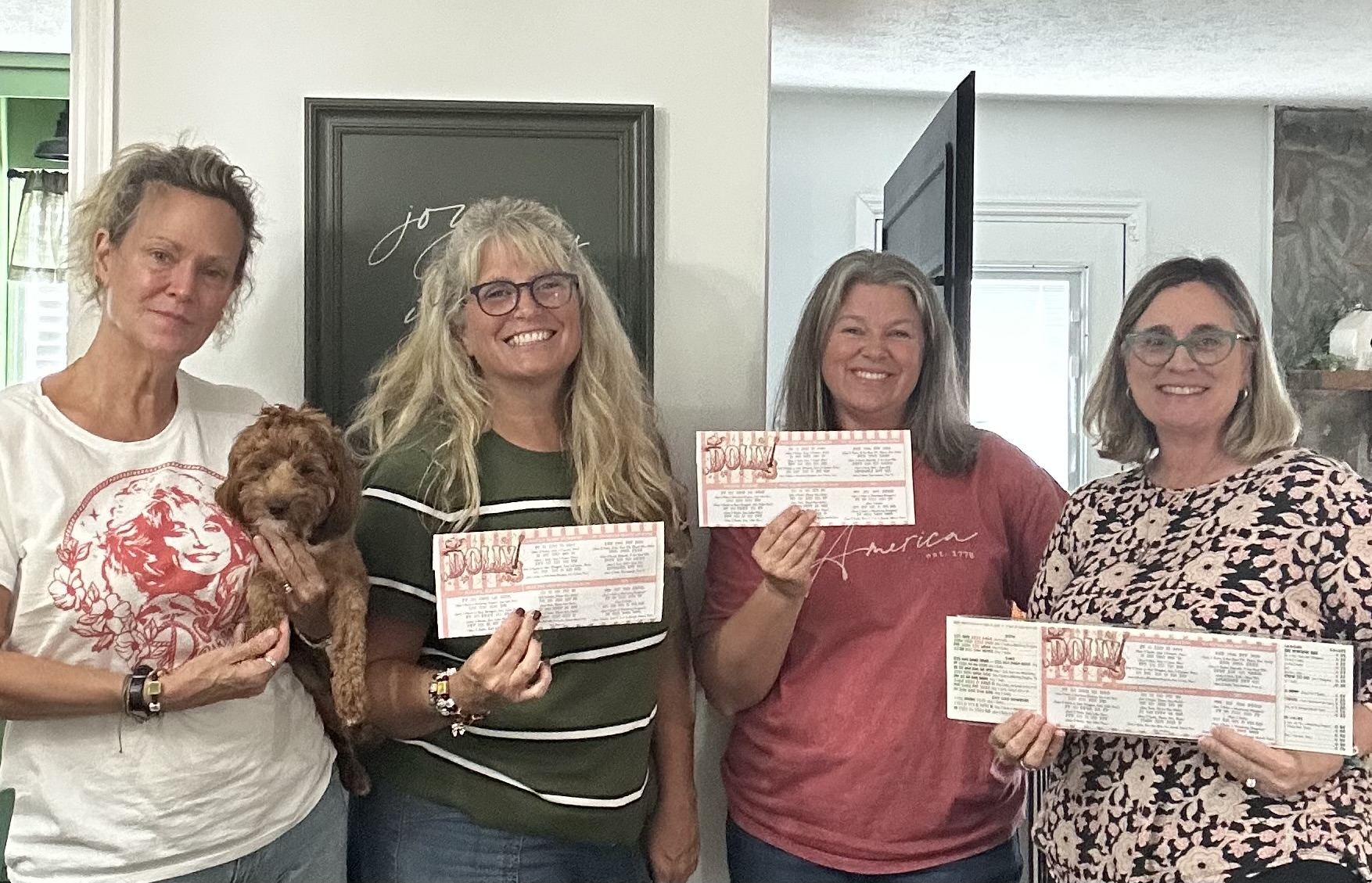
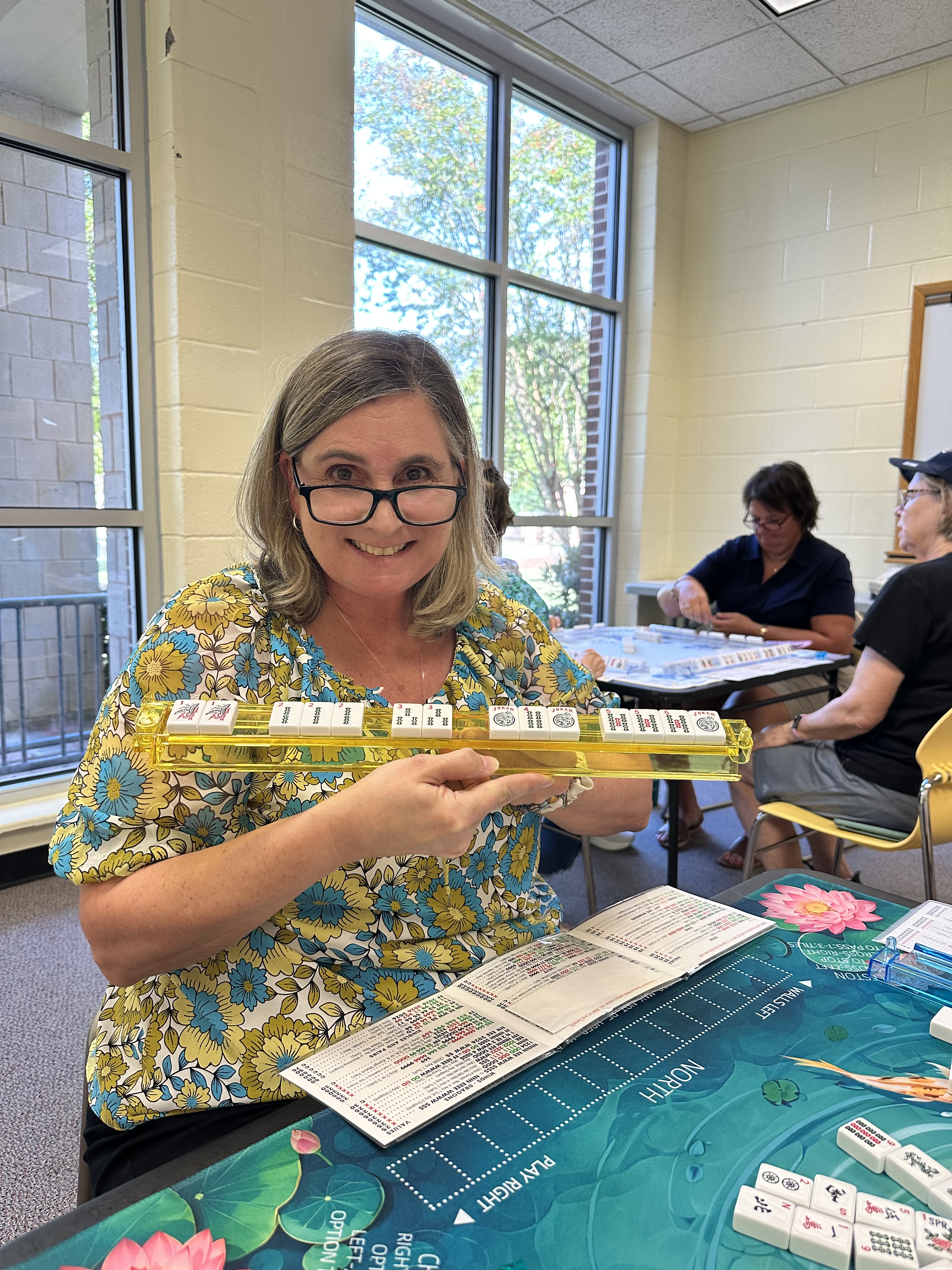
I also made some new friends in Blairsville, too. Debbie Lynn, a fellow blogger from Texas, shared with me recently that Mahjong groups are generally welcoming of outsiders, and so I reached out to the leader of a group that plays on Wednesdays and joined them. I’m so glad I did! It was nice to see all the lovely tablescapes and meet new friends along the way! This group charges $3 to play for the afternoon, and from their monthly earnings, they pay part of the proceeds to their clubhouse for utilities and dues, and part to a charity. When Dolly Parton died, they played the 9-2-5 Mahjong cards and sent the contributions to the Imagination Library. I’m learning a lot about how a brain-stimulating game can connect people and help organizations.
My Favorite Neighborhood
consecutive run
no jokers allowed in pairs
still, a winning line!
Whether we are at home in our own small town or off exploring in other places around our great state or nation, it’s a warm feeling to belong and feel welcome. For this week, I’m back with my own neighborhood Mahjong group, reading with my dogs nuzzled beside me, and dreading the dentist visit today at 11:00…….I love clean teeth, but I hate the scraping.
Today’s host of the final day of the September 2026 Open Write at www.ethicalela.com is Leilya Pitre, who writes: In Louisiana, we often use the word lagniappe, meaning “a little something extra.” It is an unexpected gift offered in generosity. Today, I welcome you to a little lagniappe: one more space for conversation, reflection, encouragement, or an unexpected poem.
Leilya invites writers to look back or look forward and suggests considering a Gogyohka. She explains: Developed by Japanese poet Enta Kusakabe, a Gogyohka consists of five lines. Each line holds one phrase or breath, but there are no syllable counts, required themes, or preferred topics. You may write about anything that calls to you. That’s it: five concise but free lines.
Today, I’m hosting the second day of the September Open Write at http://www.ethicalela.com. You can read my full prompt here and then, later in the day once all the poets have had a chance to write to the prompt, visit the site to read the poems others have written.
My writing communities have a huge impact on my life as a consumer and creator of poetry. Each month, writers of Ethicalela and other groups encourage me with prompts and ideas. I am blessed that other writing friends freely share ekphrastic prompts (Barb), prompts from Substacker Audrey Gidman (Denise), prompts from Georgia Heard (Margaret) and prompts from Writer’s Digest (Glenda) and so many others. This month, I’m using Robert Lee Brewer’s Wednesday Poetry prompt idea shared by Glenda to get us started on what we want to get back to. While many are going back to school, I’m getting back to knowing myself at the pace of retirement. What are you getting back to?
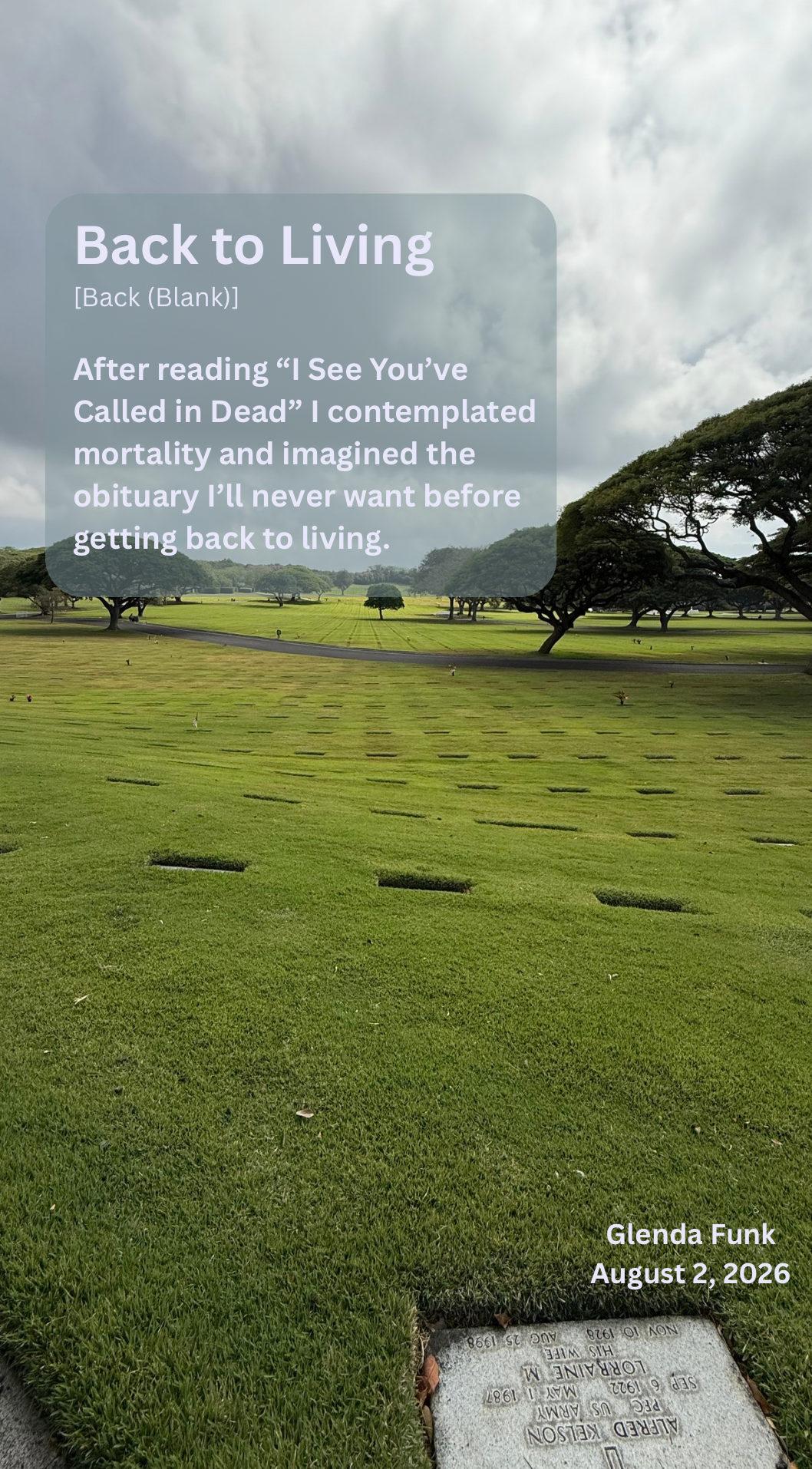
Make a list of all the possibilities of things we can get back to. Back to the Future. Back to Back. Back to School. Back to School Shopping. Back to the topic at hand. Back to What We Were Talking About. Back to Sleep. Then, create a poem along that line of thinking. Glenda Funk and I offer two short forms below.
Glenda’s Poem
My Poem
Getting Back to Me: A List Poem
I’m getting back to
pressing wildflowers
sipping coffee later
writing poetry
reading books
watching sunsets
feeding hummingbirds
wearing jeans and Birkenstocks
napping with dogs
learning mahjong
mailing postcards
building campfires
painting with watercolors
stretching yoga poses
peeing on my own schedule
lingering over lunch
taking walks
driving the back roads
sewing rag quilts
getting to know myself
….all over again
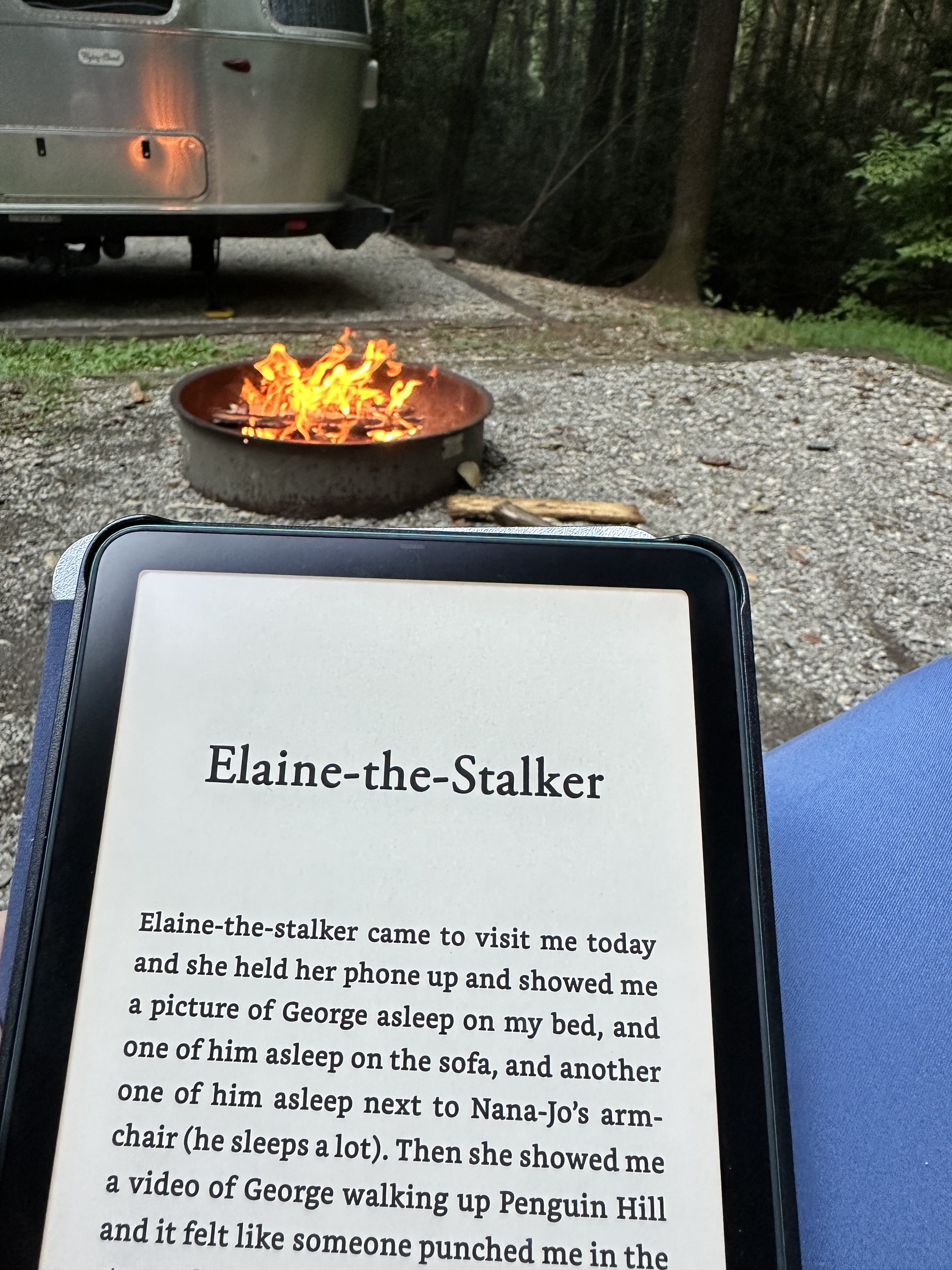
Campfire reading at Vogel State Park in the North Georgia Mountains, September 2026. Book: The Sideways Life of Denny Voss by Holly Kennedy
Each month, as part of The Stafford Challenge writing group led by Brian Rohr of Portland, Oregon, I look forward to the virtual writing workshops and visits with poets. Earlier this month, Melissa Helton, Director of Literary Arts at the Hindman Settlement School in rural Appalachia, offered a bonus writing workshop in which she shared several of her favorite poets, their poems, and prompts to inspire us to write our own poems. For the next few days, I’ll share the way she presented the information and the way she led attendees to write poetry using mentor poems.
When we arrived in the session, Brian introduced Melissa, who took us on an exploration of four poets by briefly sharing a little about each. Then, she shared a poem that had stuck with her. She read a single poem by each writer and then gave a prompt, inviting us to write our own poems.
One poet was Frank Walker, who wrote the poem Affrilachia on race and cultural identity. After reading this poem aloud, Melissa invited us to write to this prompt: make a list of all the groups with whom you identify, such as churches, hobbyists, sports, regional affiliates, etc. Then, pick two and write about what it’s like in the intersection where two things are an unlikely crosspoint. I thought of the ancient Chinese game of Mahjong, which I have recently begun playing, and how it has now become Americanized and even theme-based.