Shaun of Las Vegas, Nevada is our host today for the 18th day of #VerseLove2024. He inspires us to read this poem by Charles Bukowski that you can find here, along with the full prompt. [Bukowski, Charles. Sifting Through the Madness for the Word, the Line, the Way. New York: Ecco (An imprint of HarperCollins Publishers), 2003.]
Then, he urges, Think about your life. Do you feel like there is something holding you back? Do you feel stuck or helpless in your circumstances? Do you remember a time when you persevered and overcame the challenges thrown at you? Perhaps you can tap into your inner-coach and deliver that life-changing halftime motivational speech!
I found inspiration in these lines of Bukowski’s
just watch them. Listen to them.
I also added ending lines from Old Woman of the Roads by Padraic Colum
out of the wind’s and the rain’s way
The Neighborhood
there they are building nexts in the garage again three already
we can’t even put the door down because there’s one on top and on the toolbox and in the corner in a box
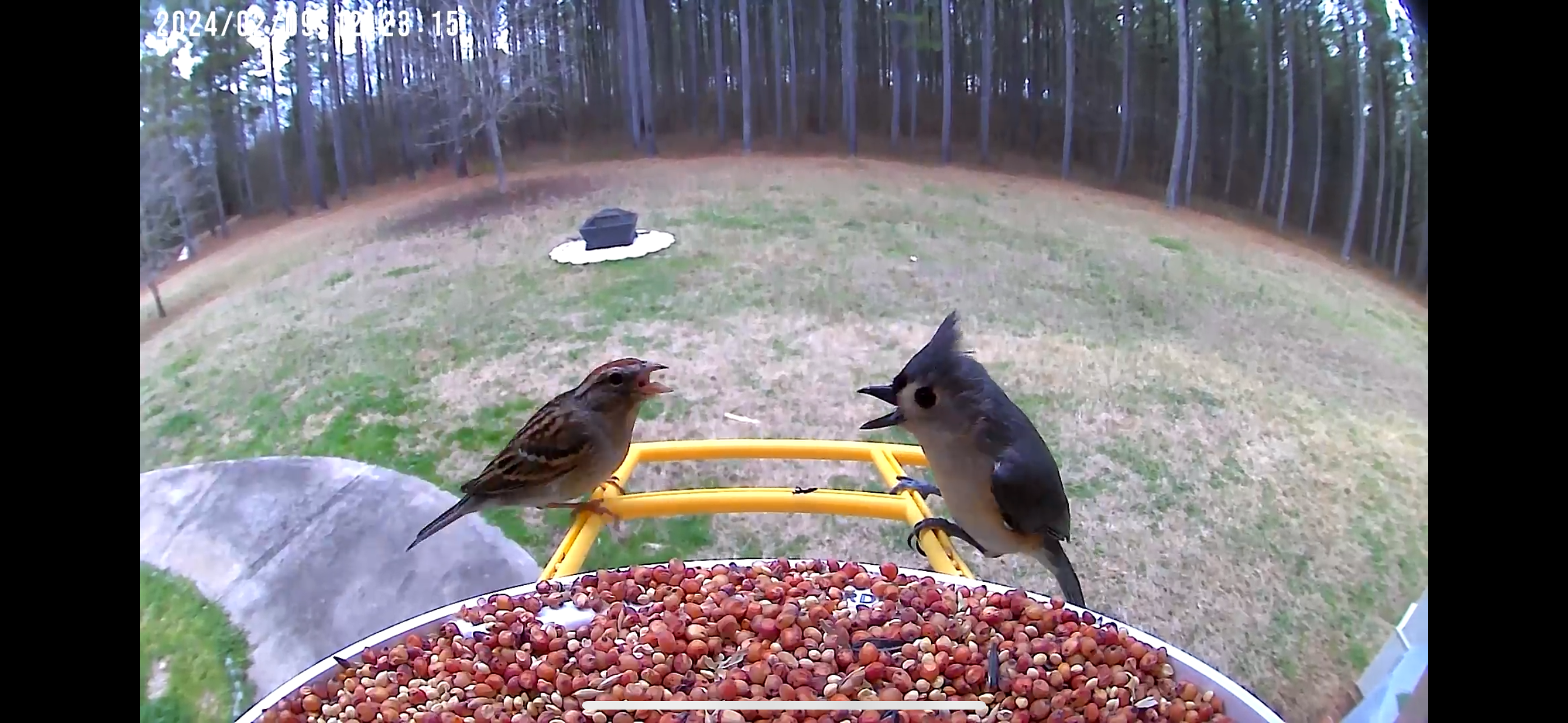
Today’s poem is a Haiku, inspired by the footage on my Netvue bird camera. We always seems to find such joy in watching birds, but the truth is that they argue and antagonize each other as much as people. Perhaps we laugh because they help us see the humor in human nature and how ridiculous we look.
The Quarreling Songbirds

quarreling sparrows
bicker, spar over birdseed
like squabbling siblings
Chipping Sparrows spar for the Johnson Funny Farm Birdcam
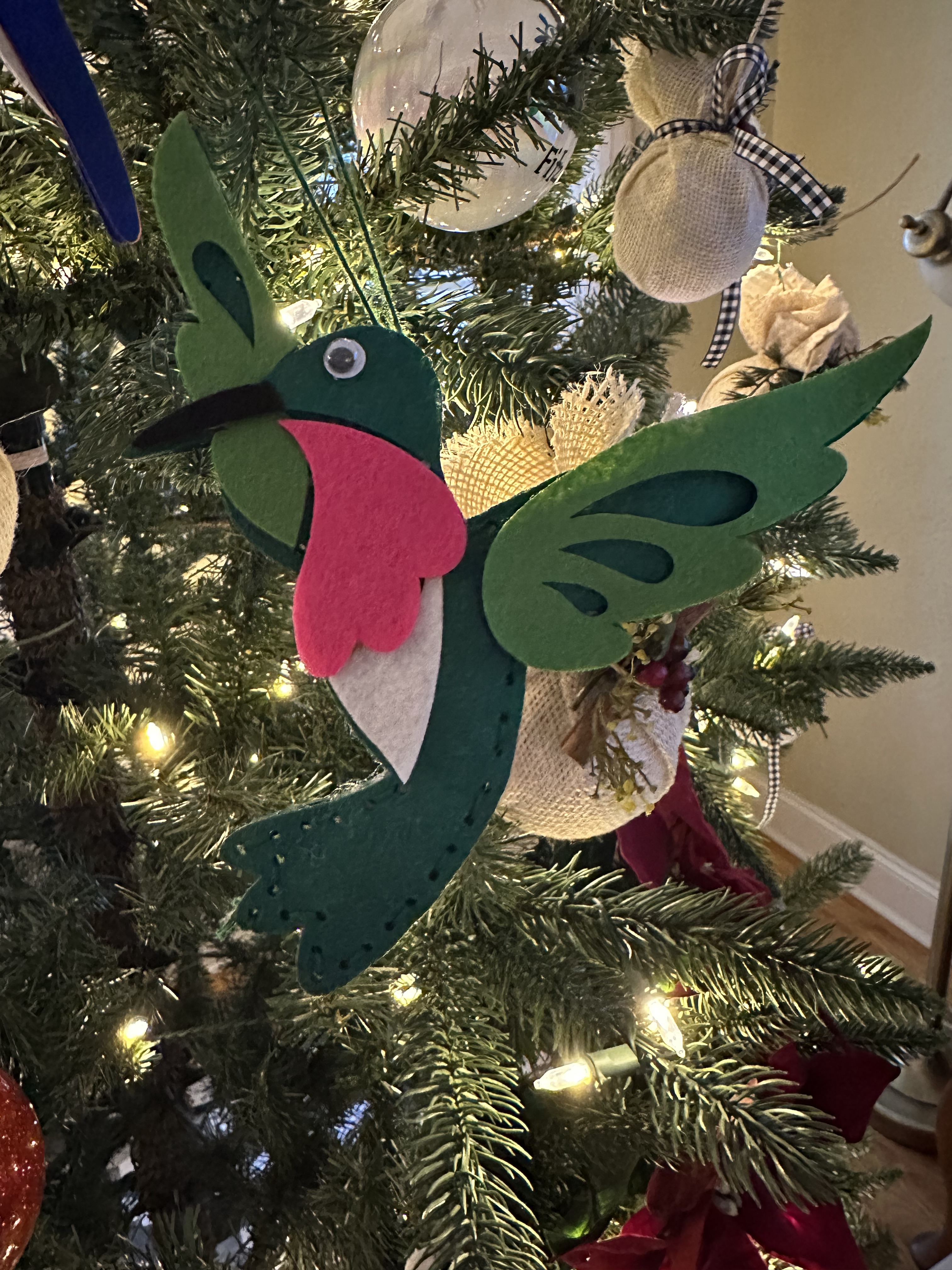
For Christmas, my grandchildren made me hand-stitched birds. The love that went into each stitch is precious and was a labor of love and patience for them and for their mother. They will adorn my new office space as soon as we get moved into our new building. These are far too lovely to hang only once a year on a tree. I need them where I am reminded daily of my blessings, for those times I get caught up in the work day and forget that there are so many reasons to smile and take things in stride. I love that their mother is already teaching them that the key to the fine art of gift giving is in the heart of the recipient – and that handmade gifts are the most special of all!
Fran Haley and I are hosting this week’s Open Write at http://www.ethicalela.com as we prepare for April’s discussions on Ada Limon’s The Hurting Kind. You can read Fran’s prompt today here or below. Be inspired and come write with us!
Title: Birdspiration
Our Host
Fran Haley is a literacy educator with a lifelong passion for reading, writing, and dogs. She lives in the countryside near Raleigh, North Carolina, where she savors the rustic scenery and timeless spirit of place. She’s a pastor’s wife, mom of two grown sons, and the proud Franna of two granddaughters: Scout, age seven, and Micah, age two. Fran never tires of watching birds and secretly longs to converse with them (what ancient wisdom these creatures possess!). When she’s not working, serving beside her husband, being hands-on Franna, birding, or coddling one utterly spoiled dachshund, she enjoys blogging at Lit Bits and Pieces: Snippets of Learning and Life.
Inspiration
As previously mentioned in this series of Open Writes: Come April, Kim Johnson and I will be honoring National Poetry Month by facilitating discussion of The Hurting Kind, the most recent book by U.S. Poet Laureate Ada Limón(you can join us via Sarah Donovan’s new Healing Kind book club).
In preparation for this event, I came across a May 2022 interview with Angela María Spring of Electric Lit in which Limón speaks of inspiration for her book and the way humans search for community: “It’s the Earth and it’s the animals and it’s the plants and that is our community.”
What a glorious opening for birds today.
Over several summers past, I facilitated a writing institute for teachers. We spent a portion of one session crafting poems about birds, for, truth is, everyone has a bird story of some kind. Just as we went out for lunch, two doves flew into the building to land on the windowsill of our room. How’s that for symbolism?—and awe.
Process
Listen to or read the brief transcript of Episode 674 of The Slowdown, Limón’s podcast. Here she shares a poem by Hai-Dang Phan entitled “My Ornithology (Orange-crowned Warbler)”. Note Limón’s reflection: In observing birds and their world, we learn something true about ourselves. Experience Phan’s warbler up close and personal through every rich detail in the poem.
Now, consider what you’ve learned from birds in some way. Find a kinship. You don’t have to love or even like birds; you could contemplate the Thanksgiving turkeys sacrificed for your holiday table.You might go on a birdwalk or watch awhile through your window for birdspiration.
Explore birds and their lessons for your life in a short form like haiku, senryu, tanka, or a series of stanzas with the same number of lines. Invent a form! Phan uses three lines over and over. Consider how enjambment and varying sentence lengths can create bursts and phrases like birdsong. After all, poetry is about sound.
Play with form today. Let your lines sing.
What truths have birds taught you?.
Fran’s Poem
Harbingers
That Morning You Drove Me Home From the Medical Procedure
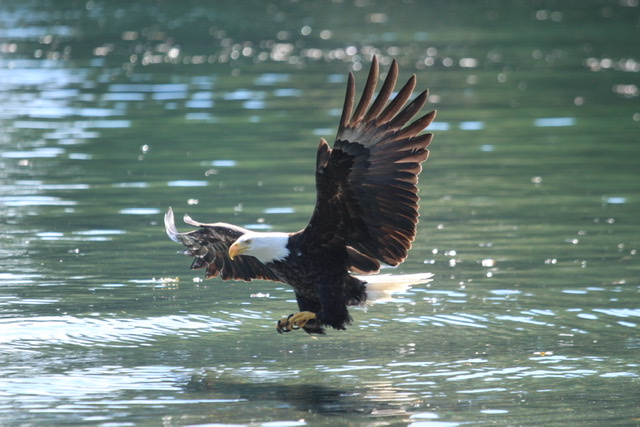
back country byway, winter-brown grass trees, old gray outbuildings, zipping, zipping past small pond clearing, wood-strewn ground bald eagle sitting roadside—too profound—
I thought it was the anesthesia until you saw it, too, before it flew.
And I knew.
On the Morning I Returned to the Hospital After Your Surgery
lanes of heavy traffic, day dawning bright our son says you had a painful, painful night dew on the windshield, fog in my brain all hope of moving past this gridlock, in vain but for the glory of autumn leaves, a-fire against cloudless blue where a solitary flier glides by, white head and tail gleaming in the sun…
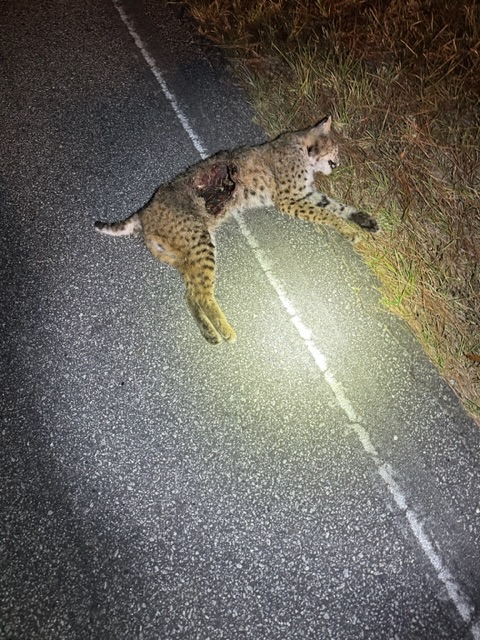
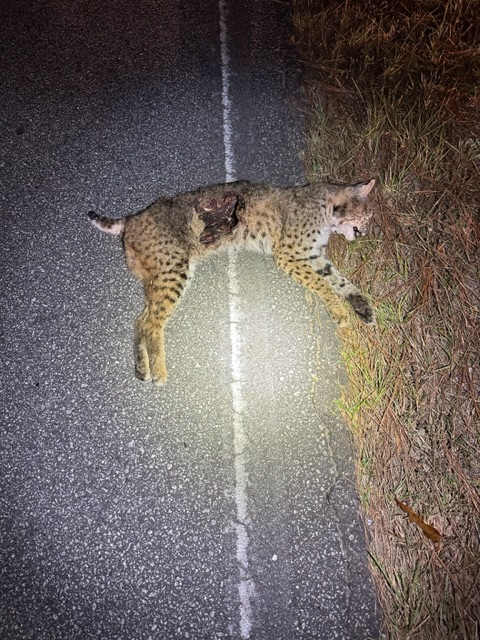
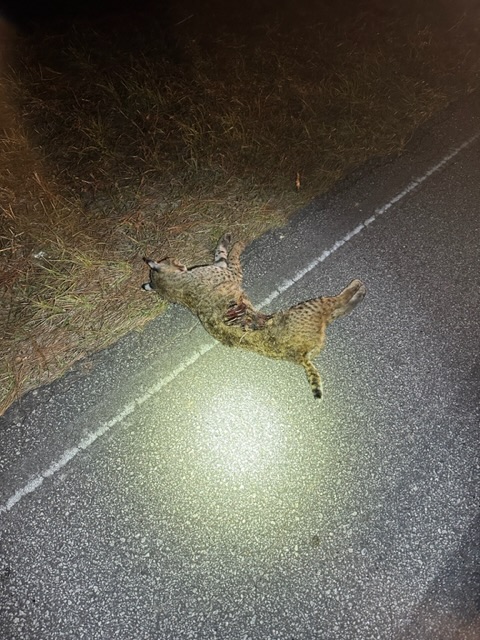
Warning: Photos of dead bobcat in photos at end of post. Do not read further if this makes you uncomfortable. It saddens me, but country living is full of both delights and horrors, and I take the bad with the good.
At 7:52 a.m. yesterday when I pulled into the parking lot at work, I reflected on my morning. Already, I’d seen a dead bobcat, two rabbits (one alive that ran in front of my car, and one dead that didn’t make it when it ran out in front of someone else’s), a squirrel, a large buck and small spotted deer. I’d heard the calls of the Downy Woodpecker, Eastern Phoebe, Blue Jay, Carolina Chickadee, Ruby and Golden-Crowned Kinglets, Carolina Wren, Eastern Bluebird, American Robin, Pine Siskin, Chipping Sparrow, Eastern Towhee, Northern Cardinal, and Orange-Crowned Warbler. I’d walked our three schnoodles and discovered a new scratched-up area in the ground cover along the woods of the driveway, showered, dressed, and had my mushroom coffee and protein shake.
Ollie checks out a new ground scratching
I’d been in the shower when I heard the phone’s text ding. I saw it was my husband, so as soon as I was reasonably dry, I read the text: Please call me before you leave for work.
He told me he thought he’d seen a dead wildcat on the side of the road where the neighbors with the black Suburban live. “Take a look when you drive by, and let me know what you think it is. It might be a bobcat.”
He knew I wouldn’t be able to wait on fixing my hair, clothes, and makeup. So off I went in my robe to see this creature whose fate had been determined somewhere between 10:30 Thursday night and 6:00 Friday morning.
I stopped the car in the road and turned on the flashers, got out with the flashlight, and made pictures. Sure enough, it was a wildcat. Its gut organs had been eaten, but the rest of it was still in fairly good condition for something that was hit by a car going the speed limit on Beeks Road. I didn’t think a car had done this, or at least not the blood and gut part.
I made some pictures to help me in my research and theories about what happened. Imagine: a half-clad, robed wildlife crime investigator out on a rural road before daybreak, wet hair, no makeup, snapping photos of a dead animal carcass. That was me.
I mourned the life of this cat for a moment, despite the fear its kind evokes in me each time I take my dogs for a walk. Moments like these are powerful reminders of why I believe strongly in keeping my dogs on a leash at all times. People think it strange that I live on a family farm in the country on the backside of nowhere and leash my dogs. This is why: bobcats, foxes, coyotes, owls, red-shouldered hawks as large as the Great Horned Owls, rogue dogs, wild boar, cars, venomous snakes, and hunters. Not to mention those who believe that every dog they see off a leash needs rescuing, posting on social media for three days, and then rehoming (a/k/a dognappers who believe they are fully justified). Ours are chipped, but walking unleashed in our neck of the wilderness simply isn’t worth the risk.
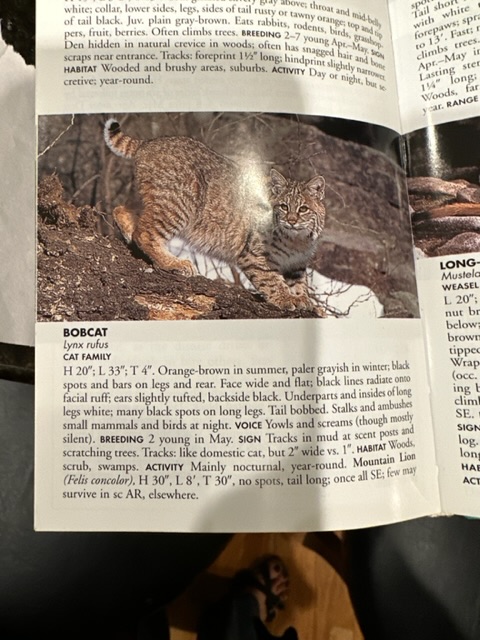
I raced back home to pull my Audubon book out and make a 100 percent positive identification on the bobcat. Check.
Then I began the investigation. “Hey, Google. What are a bobcat’s natural enemies?”
Google rarely lets me down. “The most common enemy of bobcats is man, but they also have other predators, including owls, eagles, coyotes, and foxes, mountain lions, and wolves.”
I looked closely at the photos and observed that this bobcat appeared to be in good shape except for the gaping gut hole that had been devoured by something. I also noted an odor that suggested the bobcat had been dead for longer than a couple of hours, even though it wasn’t there the night before. It seemed odd it was in the road smelling of decay already, and not fresh-since-last-night meat. It was also on the edge of the road where it would have likely been hit a number of times by texting drivers who failed to see it in time and move over a little.
A pack of coyotes would have picked this bobcat clean and torn its limbs apart, so I ruled them out. I have never seen a wolf here, and it’s been years since anyone has seen a wild boar on this property. A fox lingered for a passing thought, but one predator emerged as the prime suspect. We have three active culprits, and they’re nocturnal. The Great Horned Owl.
Most people would shake their heads and dismiss this possibility. No way an owl would kill a bobcat.
Here’s a way: a bobcat is struck by a car and crippled but not killed. It languishes for several days in the brush, and finally succumbs to its pain and lack of food or water, probably realizing that whatever animal stumbles across it will consider it a gourmet meal.
I believe it was the Great Horned Owl who watched to see that the bobcat was alive for a time, and then when it knew this creature was too weak to fight back, but probably still alive, it swooped in for the feast. I believe it dragged it to the road for a better angle and strategically placed the stomach organs on the line in the road where the elevation dips back down so it could get to all the good meat in much the same way we invert the yogurt lid to lick the top, and I believe it ate the stomach organs and the eyes.
I believe all of this because I have seen over the years how the Great Horned Owls prefer organs. They eat the heads of rabbits, taking out the brains and leaving the rest. This carcass destruction made sense to me.
I can’t imagine the sheer shame of the bobcat spirit in bobcat heaven, reading the Georgia Rural Wildlife newpaper obituaries about his tragic end:
Robert W. Cat died Friday, November 10, 2023, killed by a Great Horned Owl with a five-foot wingspan. His friends all believed that he was the fiercest of his kind there in rural Georgia but report they had noticed a slip in his swagger in the days preceding his death. His wife reported she had heard rumors he was out running around on her with his sly catlike ways, and moved on just hours following her husband’s death, noting simply, “I hope he was in life number nine. He was a real animal.”
In recent days leading up to the first day of fall, I’ve been intentional about getting out and soaking up some nature time – driving, walking, sitting to just observe and appreciate the beauty of where we live and celebrate the changing season. My friend Margaret Simon commented this past week that she’d noticed many were lamenting the end of summer while I was heralding the onset of fall, and she inspired me to share some of the reasons I could live in the world of autumn year-round.
Ours is a small, rural county in middle Georgia with huge orange sunsets that dip down between the rolling hills, nuzzling down into an heirloom quilt for a good night’s sleep. Sometimes, we are “those people” who really do take Sunday afternoon drives with nowhere to have to be and no time to have to be there – just so we can take it all in!
A family of deer come along their path daily, walking along the edge of the trees. Their darker winter coats are starting to come in, and the babies are losing the last of their spots.
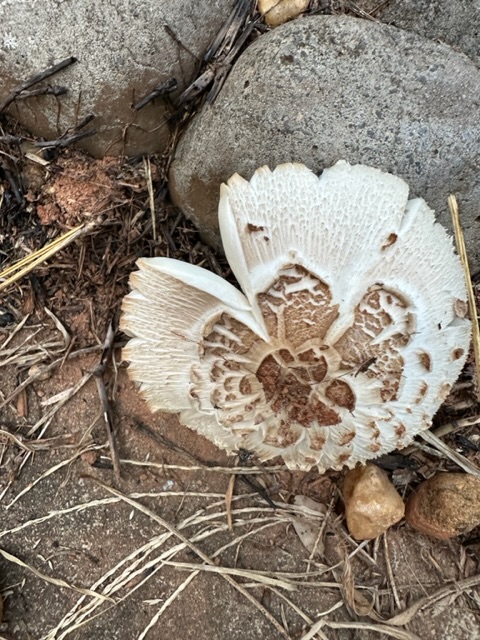
Mushrooms are growing along the rocks, and leaves are dropping in shades of red and yellow from the trees, spinning down to blanket the ground.
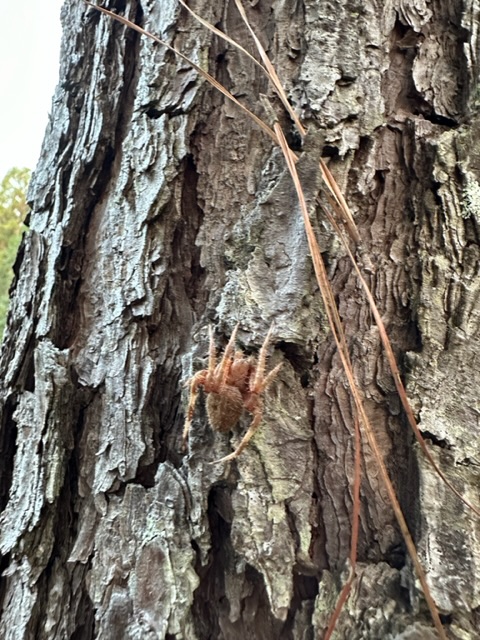
And spiders are becoming more plentiful – the big ones, spinning webs between trees, setting traps for unsuspecting prey. Somehow, they give off a Halloweenish vibe, especially as our resident bats circle overhead in the evenings.
The most hopeful time happens as the day begins when the sun is rising and the light infiltrates the trees, pounding down on the grass like a warmed oatmeal breakfast with a multivitamin and a glass of orange juice, turning on the light, greeting us all with an enthusiastic “Good Morning!” as it peels back the covers of night.
Redbirds lurk and loiter, running off the last of the small songbirds from the feeders as they migrate south. They’ve already laid claim to the feeders that will get them through the freezing winter ahead.
Monarchs and Black Swallowtails feast on the last remnants of the withered figs.
Fish Crow
The American Crows and the Fish Crows, too, become more abundant. They sit on church steeples, thanking their maker for a reprieve from the brutal heat of the summer. Their caws stir in a dash of Poe.
Our pair of Great Horned Owls was visiting every night, but now they are in a different spot on the west side of the farm. We can still hear them, but they haven’t made themselves evident lately.
Even if I only spend ten minutes each day outdoors, I notice the small changes that are happening around me and feel grateful to be able to admire the transition from summer to fall. I’m choosing a tree this year to photograph every 5 days so that I can see the change as a time lapse once the leaves have all let go and the summer-to-winter transformation is complete. I can learn much from trees that shed worn leaves and bloom again fresh in the spring.
I take pictures and count the blessings of each magnificent and microscopic moment of beauty. How do you celebrate the changes as fall approaches? I’d love to hear all the ways we welcome the season!
I thought I’d share a few photos of wildlife on the Funny Farm I’ve seen throughout the week. This week has been stressful, finishing testing and analyzing data, along with the other general parts of wrapping up a school year. It’s nice to come home and walk the dogs and breathe fresh air and forget about the demands and deadlines, if only for a few minutes.
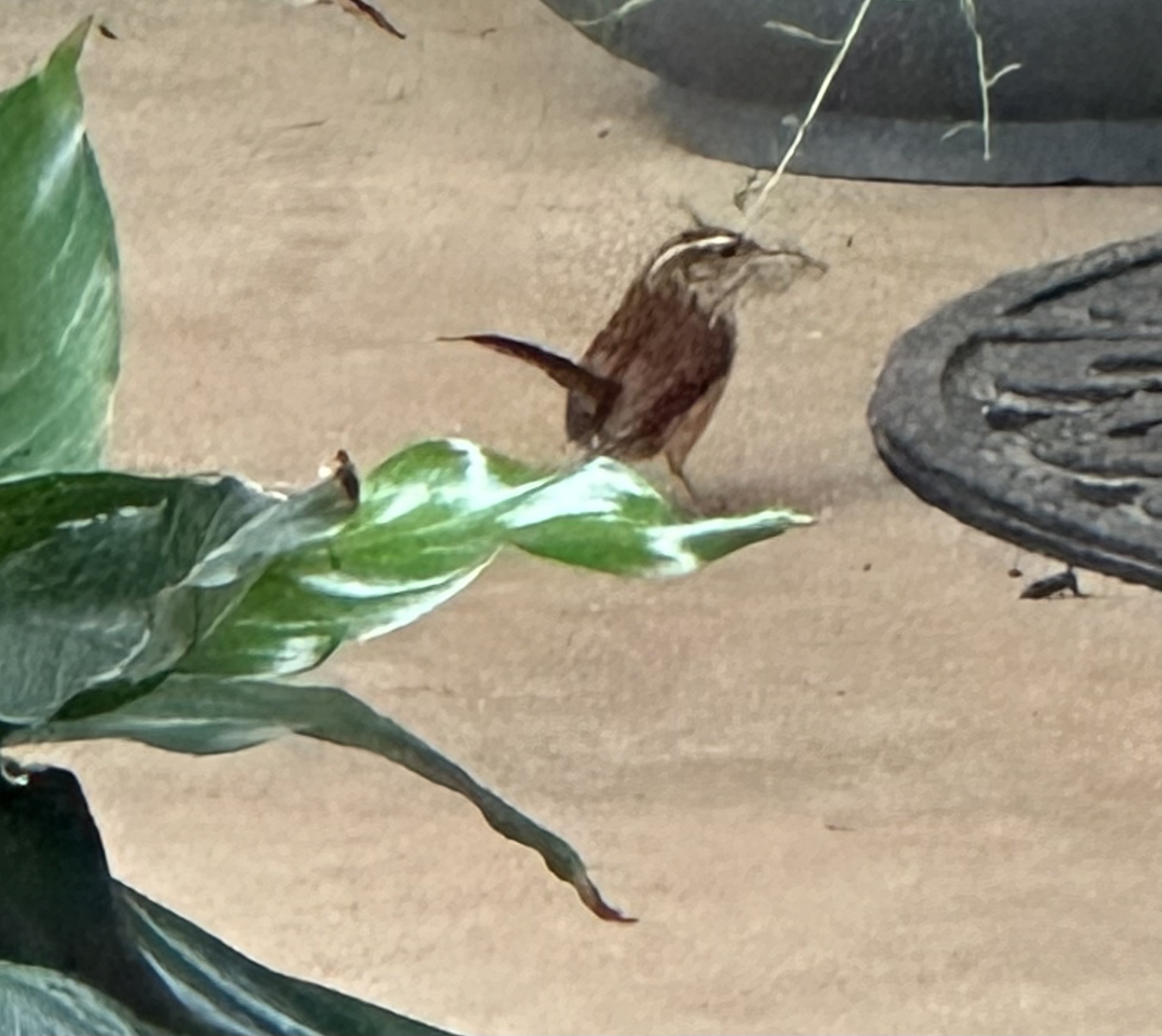
Carolina Wren on the front porch, gathering nesting materials
Carolina Wren, singing, singing, singing
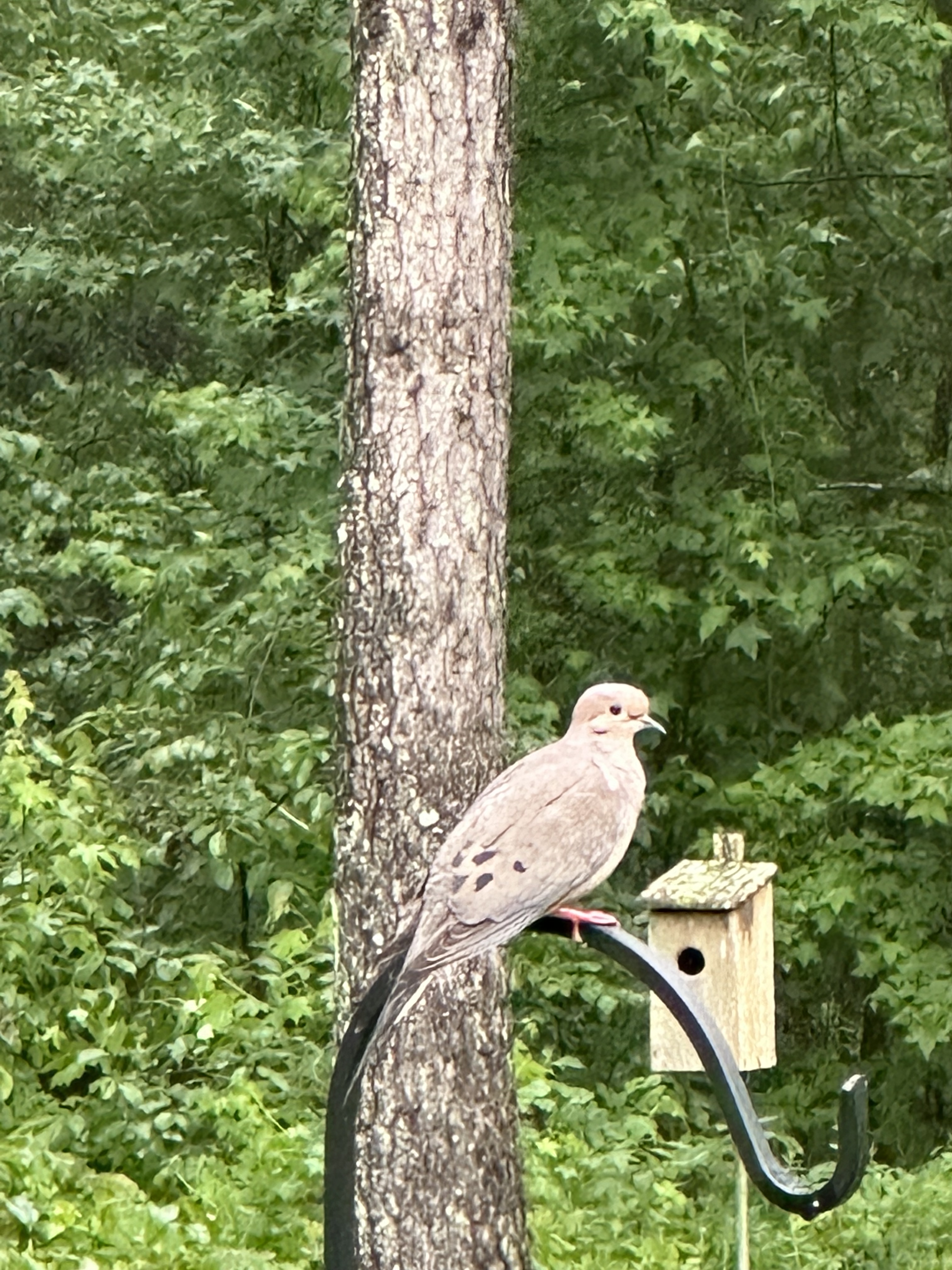
Mourning Dove
Funny Farm Bunny – there is a colony of them that lives down at the end of the driveway.
Funny Farm Finch
Carolina Wren singing a morning song
Deer (picture taken through a screen)
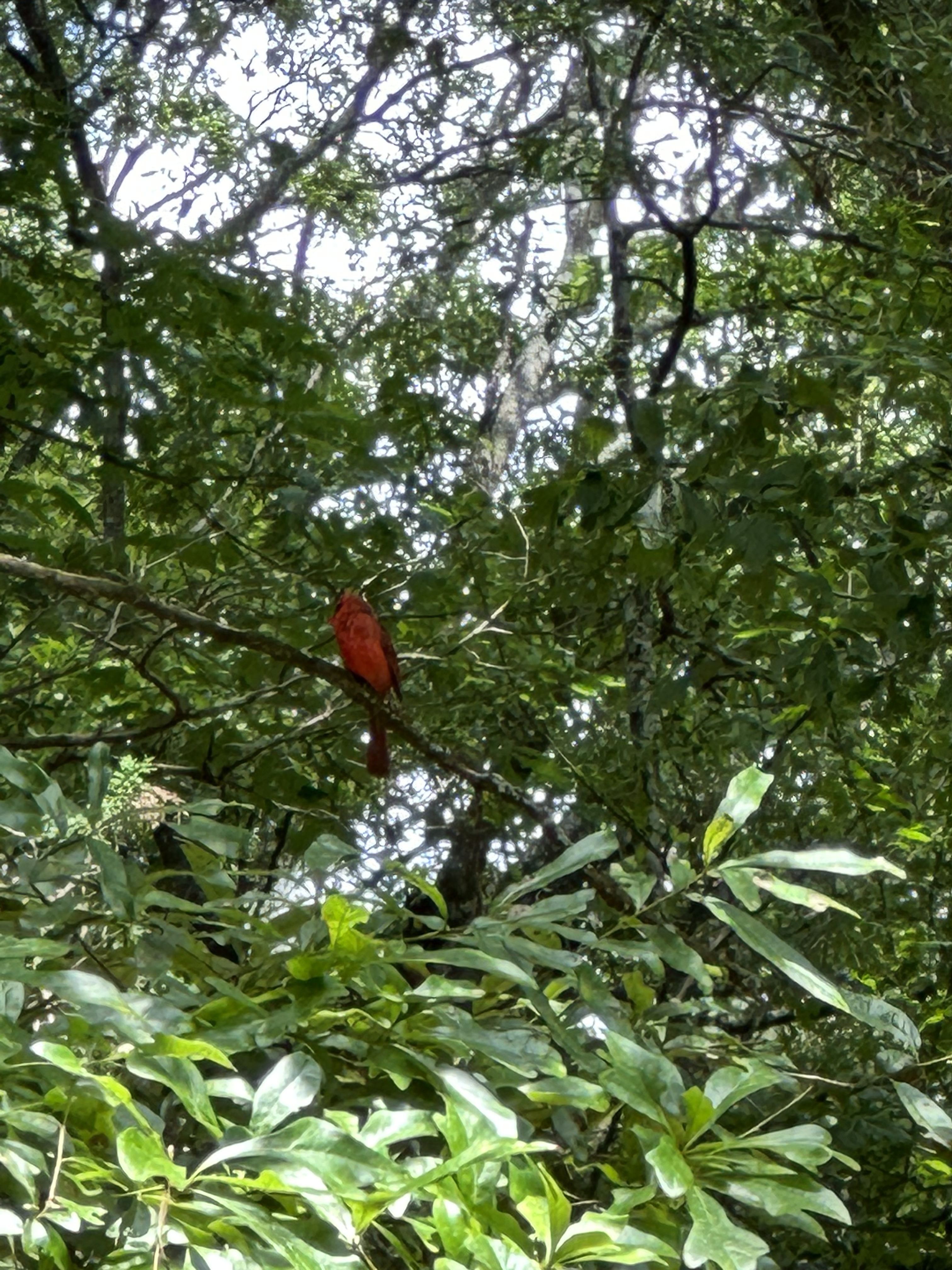
Northern Cardinal
May 18 – Hawk in a tree, Johnson Funny Farm
Hawk in a tree (just left of center) – funniest thing: I said a quick prayer, “Lord, I would love to see a hawk today.” I always feel my mother’s presence when I see one. I did what I always do: I pulled into the driveway, turned off the air, put the windows down so I could drive slowly, hearing the gritty crunch of gravel under my tires, and began inching up the driveway. I first saw a tufted titmouse, then a robin. As I approached the top of the hill, I caught a glimpse of a large upward wingspan swooping up off to the left. I grabbed my camera, and for one moment the hawk took it all in and the next swooped off back into the deeper woods. I caught one photo, here, and one of just his tail as he flew away. What a beautiful moment – a prayer for a hawk sighting, a hawk, and the feeling of the presence of my mother. No prayer is ever too big – or ever too small!
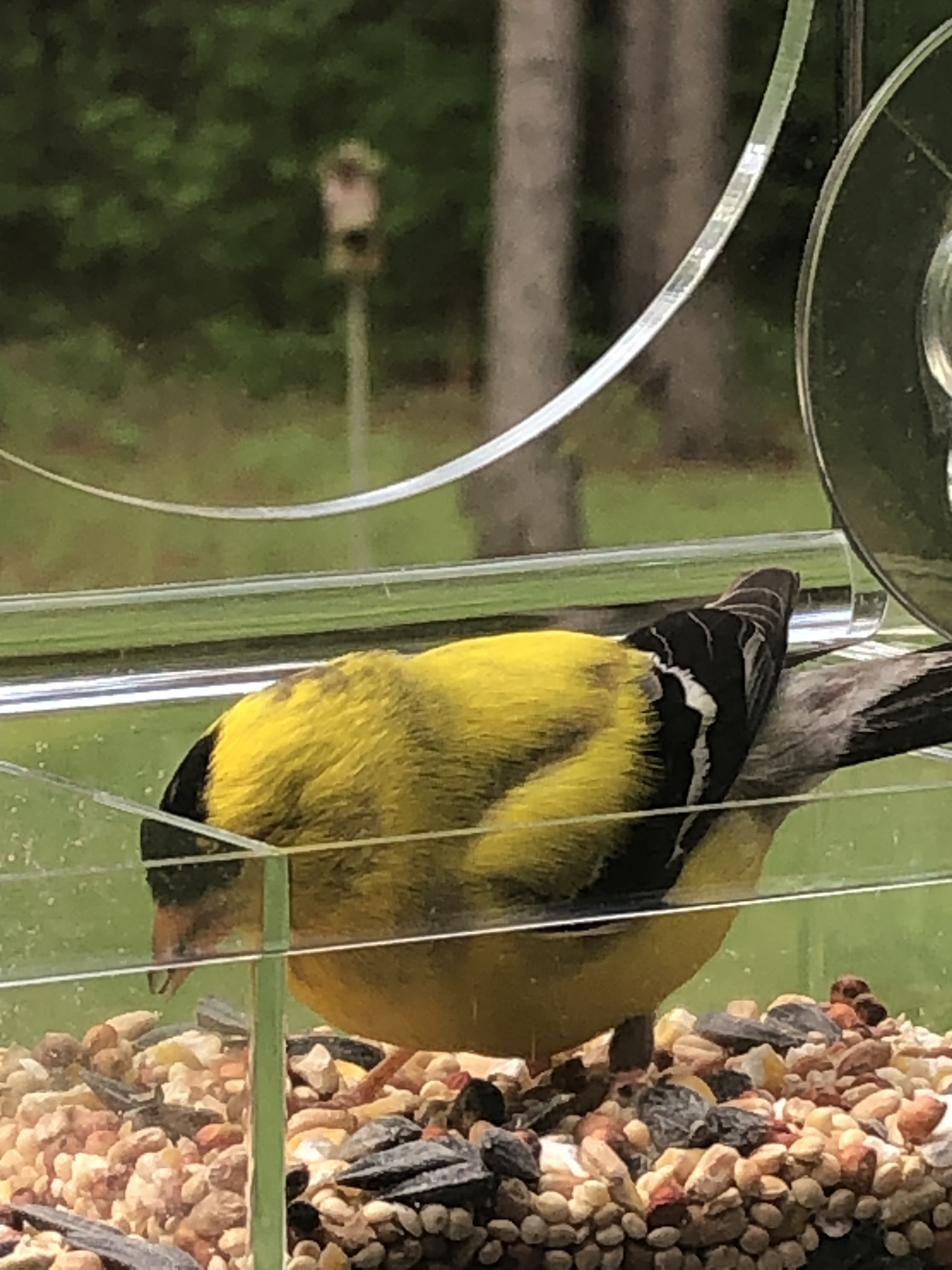
Male American Goldfinch at my window feeder on the Johnson Funny Farm – so close you can see his knobby knees!
One of the greatest pleasures in my life here on the Johnson Funny Farm in rural middle Georgia is birdwatching from the comfy chair by the window in my reading room. Each spring, we deep clean our feeders and add a new type to the all-you-can-eat bird garden buffet. Two years ago, I added four clear acrylic window feeders – and now we each have a coveted seat right by the window, with a front-row view.
The American Goldfinch is one of my favorite visitors. We also have Cardinals, House Finches, Pine Warblers, Indigo Buntings, Black-Capped Chickadees. and different varieties of nuthatches. sparrows, and wrens who love these smaller covered feeders. When it rains, they like to sit “inside” like the kids in The Cat in the Hat and look out their “window.”
We can get so close to our birds that we can see if they are missing any feathers or tell if they might have been in a fight. If we had ever wondered whether birds have tiny teeth, we could tell that, too. We ease up to the window and take a mannequin stance, careful not to throw our breath fog on the glass. The reflection from the outside makes it easy to remain undetected for long periods of time, watching our little frequenters blissfully fill their bellies with seeds, nuts, and berries.
A wide variety of birdseed mixes brings the fanciest charms and flocks and hosts and herds (I’m including a fuller list of specific bird group names at the bottom of this post). I found a chart at Pike Nurseries that has been helpful in matching seed, feeder: and bird type to maximize our traffic. For example, I look at the foot perch size, the encased wire openings for smaller birds, and the opening sizes where the seeds come out. All of those, along with location of the feeders, make a difference in all the species we have been able to attract. When Ace Hardware has a Buy One, Get One Free sale on brand-name birdseed in my small town, they know I’ll be there to get a cart full.
And these winged angels sing the most glorious songs of food blessings to their creator that I want to name them all Little Tommy Tucker!
If your mother doesn’t have a window feeder for the birds, it would make a lovely gift next weekend, along with a variety of seeds! I’ll be filling my feeders and remembering my mother, who shared with me the sheer joy of bird watching.
This chart makes attracting birds easy by telling which types of foods they like.
List of bird group names retrieved from: http://birding-world.com/names-bird-groups/

Aerie of hawks

Band of jays

Bazaar of guillemots

Bevy of larks

Bevy of quail

Bevy of swans (when in flight)

Boil of hawks (when in flight)

Bouquet of pheasants

Brace of grouse

Brace of pheasants (when dead)

Brood of chicks

Building of Rooks

Bunch of ducks (when on water)

Bunch of waterfowl

Cast of falcons

Cast of hawks

Chain of Bobolinks

Charm of finches

Charm of hummingbirds

Cluster of Knots

Colony of gulls

Colony of vultures

Company of parrots
Squadron of pelicans

Company of widgeon

Concentration of kingfishers

Congregation of plovers

Constable of Ravens

Convocation of eagles

Covert of coots

Covey of grouse

Covey of partridge

Covey of ptarmigan

Deceit of Lapwings

Descent of woodpeckers

Desert of Lapwings

Dissimulation of birds

Dole of doves

Drift of quail

Dropping of ducks (when on water)

Exhaltation of larks

Fall of Woodcock

Flamboyance of Flamingos

Flight of cormorants

Flight of doves

Flight of Goshawks

Flight of swallows

Fling of Dunlins

Flock of birds

Flock of birdwatchers

Flush of Mallards

Gaggle of geese (when on ground)

Gathering of birdwatchers

Gulp of Cormorants

Herd of cranes

Herd of Curlews

Herd of wrens

Horde of crows

Host of sparrows

Huddle of penguins

Jubilee of eagles

Kettle of hawks

Kit of pigeons (when in flight)

Knob of waterfowl

Murder of crows

Murmuration of Starlings

Muster of Peacocks

Muster of turkeys

Mustering of storks

Mutation of thrushes

Nye of pheasants

Ostentation of Peacocks

Pack of grouse

Paddling of ducks (when on water)

Parliament of owls

Parliament of Rooks

Peep of chickens
Chattering of Choughs

Pitiousness of doves

Pitying of turtledoves

Plump of waterfowl

Plump of wildfowl

Quarrel of sparrows

Raft of coots

Raft of ducks (when on water)

Raft of loons

Rafter of turkeys

Richness of Purple Martins

Rookery of penguins

Scold of jays

Sedge of Bitterns

Siege of Bitterns

Siege of cranes

Siege of herons

Skein of geese (when in flight)

Sord of Mallards

Spring of teals

Stand of flamingos

Strand of Silky Flycatchers

Sute of Mallards

Team of ducks (when in flight)

Team of geese (when in flight)

Tiding of magpies

Tittering of magpies

Trembling of finches

Trip of Widgeon

Trip of wildfowl

Trouble of hummingbirds

Unkindness of Ravens

Volery of birds

Walk of snipe

Watch of nightingales

Wdge of swans (when in flight)

Wedge of geese (when in flight)

Whisper of snipe

Whiteness of swans (when in flight)

Wing of plovers

Wisdom of owls
I enjoy the structure of short syllabic forms of poetry, so I was thrilled with today’s VerseLove prompt using prime numbers from Erica Johnson at http://www.ethicalela.com on this 11th day of the writing challenge. I found a unique book in my mailbox yesterday from my writing sisterfriend Fran Haley from North Carolina, and it inspired today’s poem. We are both watching eggs ready to hatch any day now. I used a partial borrowed line from a poem in the book entitled Memory Garden (in bold) for today’s writing that includes prime numbers of syllables in ascending line order (2,3,5,7,9,11,13….) and I added an ending line of 3.
Feathered Friends
today’s poetry: Language of the Birds cherished gift in my mailbox from a sisterly friend sharing peace and warmth grass withers, flowers fade, but books live on forever like friendship
Today at http://www.ethicalela.com, Emily Yamasaki is our host for Day 8 of #VerseLove. She invites us to write Something You Should Know poems in the style of the great Clint Smith. You can read her full prompt and poem here.
Note to readers:  try this one!  I just rambled. Sometimes I use a Sarah Donovan strategy I learned several years ago: just write for 10 or 15 minutes and see what you get.  Don't worry about editing or word choice or anything - just draft.  That’s what I did today.  Please come write with us!

Something You Should Know

is that I only moved my lips when Mrs. Flexer
    played Living For Jesus all those Sundays
       in the big group before small group
          because I can’t sing except with
                my heart

and that I just acquired the old oak secretariat that
    has been in my parents’ home since I was
       a baby in Kentucky along with the old red
          milk can for my porch, but back to the
            secretariat: I love that it shares
               the name with the greatest horse
                 who had to win in Kentucky first
                   to win the Triple Crown

and that as a child I was mesmerized by Harold Monro’s
   poem Overheard on a Salt Marsh
     from Childcraft Volume 1 Poems and Rhymes
       with the nymph in the green dress
         and it’s framed by my bed today because
           I’m still mesmerized by it

and that I savor Saturdays with morning coffee
    and good conversation
       and that I love plants but can’t grow them
         because they all die except Leafy Jean and
           Leon Russell, who are thriving on the front porch

and that I have four bluebird eggs in one birdhouse
    and baby Carolina Wrens in my garage
       up over the garage door apparatus
         and Brown-Headed Nuthatch hatchlings in another birdhouse
          and fledgling cardinals in my Yellow Jasmine vines
and a nest under the porch eave
            and I saw an eagle a week ago

and that all three of my Schnoodles have literary names
   Boo Radley for obvious reasons
     Fitz because of, you know, the party animal F. Scott
       and Ollie for my favorite poet Mary Oliver

and that I blog daily and call all my writing group
    people my friends
      including you.
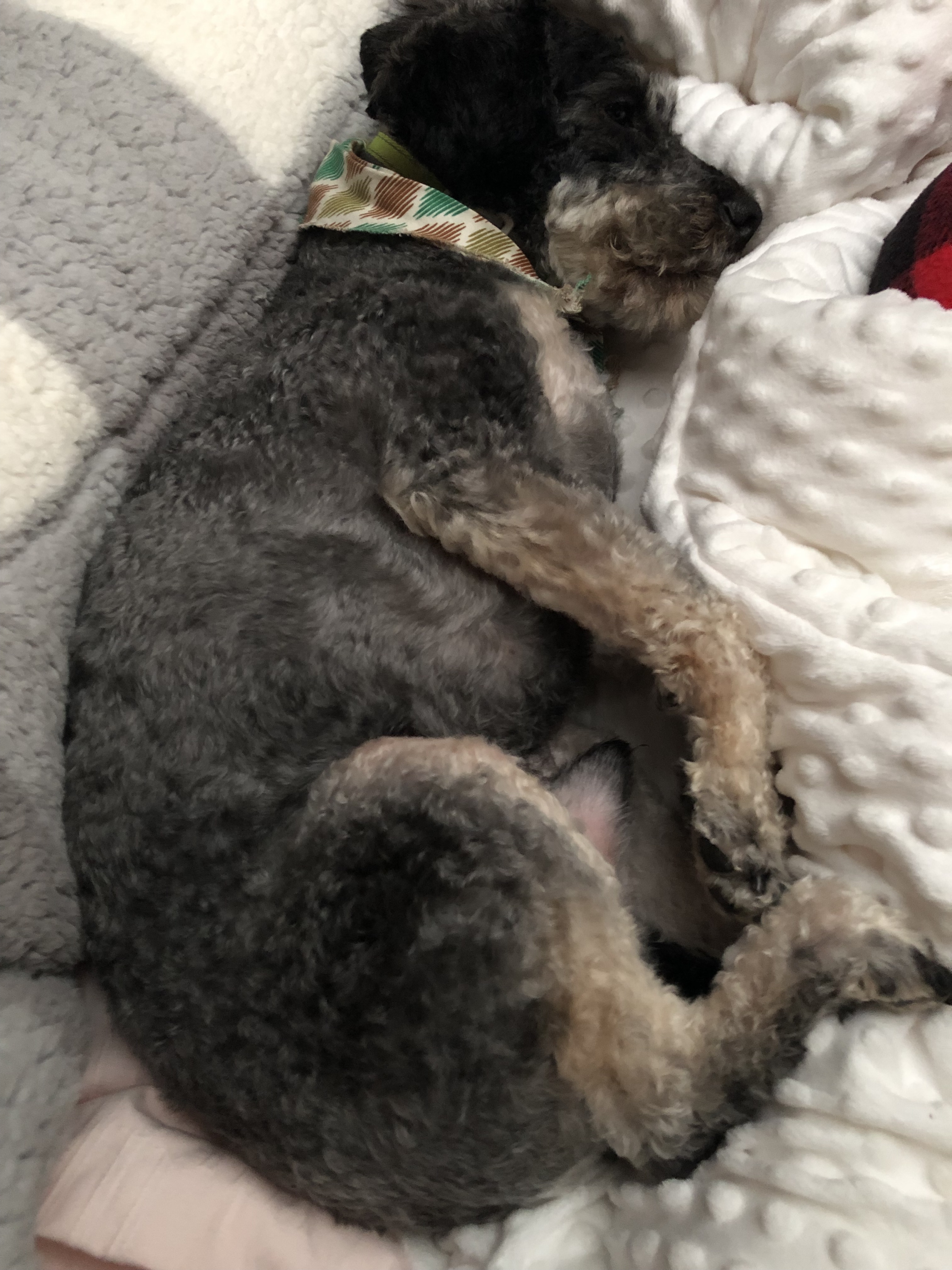
Ollie, all tucked in while campingFitz, a true party animalBoo Radley, who recently lost his beard for running through the pasture and getting matted with field spurs

















 Common Threads