With special thanks to Slice of Life for giving writers inspiration, space, and voiceRiver Street – Savannah, Georgia
When I was a teenager living on Hilton Head Island, South Carolina, I attended H. E. McCracken High School in Bluffon, South Carolina. In the early 1980s, no one waited to be a senior to take part in Senior Skip Day. We all eagerly honored our graduating class each year by skipping school right along with them on the traditionally declared skip day, piling into cars and crossing the nearby state line into Savannah, Georgia to join the throngs of people who converge on the city every year to attend the nation’s second largest St. Patrick’s Day parade and celebration. We flooded River Street, carefully descending the old stone steps and navigating the cobblestone streets to admire the river that was turned shamrock green back in those days to commemorate the occasion. We stood along the streets cheering the parade, decked out in green beads, wearing green “Kiss me, I’m Irish” or “Patrick was a saint. I ain’t” t-shirts, green eyeshadow and glittery antennae four leaf clover headbands. Green beer flowed more swiftly than the Savannah River on those streets, but a few of us stopped at a taste or two just to say we’d partaken in such novel revelry. Then we’d go home at our regular weekday times as if no parents were ever the wiser.
It was all fun and games until the wreck.
Highway 46 was the two-lane highway that led to Savannah. It was paved with narrow lanes and curves that required careful attention; there wasn’t much margin for error on that highway back then.
I’d been home for a while that afternoon when the house phone rang. I was in the den when my mother answered, and as a preacher’s kid, I knew all the meanings of the tones when my mother summoned my father from his study- from the joyful news of babies just born to the heartache of disease and dying to the crisis mode of Dad dropping everything and leaving in a hurry to go be present with someone.
Whenever Dad went to go be present with someone in a crisis, it was hard to resume any focus until we knew things were better. This time, they weren’t. We learned that a student from our school had been driving home drunk from Savannah and had swerved across the center line, killing a father in our community. The students in that car all survived the wreck; one was the son of one of our church families, and his parents were in shock and disbelief at the scene.
Since that dreadful day, there hasn’t been a St. Patrick’s Day when I haven’t remembered the impact of the choices that we make and the effects that they have on others. On this St. Patrick’s Day, I journey not to a senior skip day, not to a place of celebration or parade festivities, not to a place where I dwell on luck and leprechauns and rainbows, but instead back in time as I remember those who lost a precious family member forty years ago and think of all that was taken from them.
With special thanks to Slice of Life for giving writers inspiration, space, and voice
Slice of Life Day 16 of 31: Journeys (my March theme)
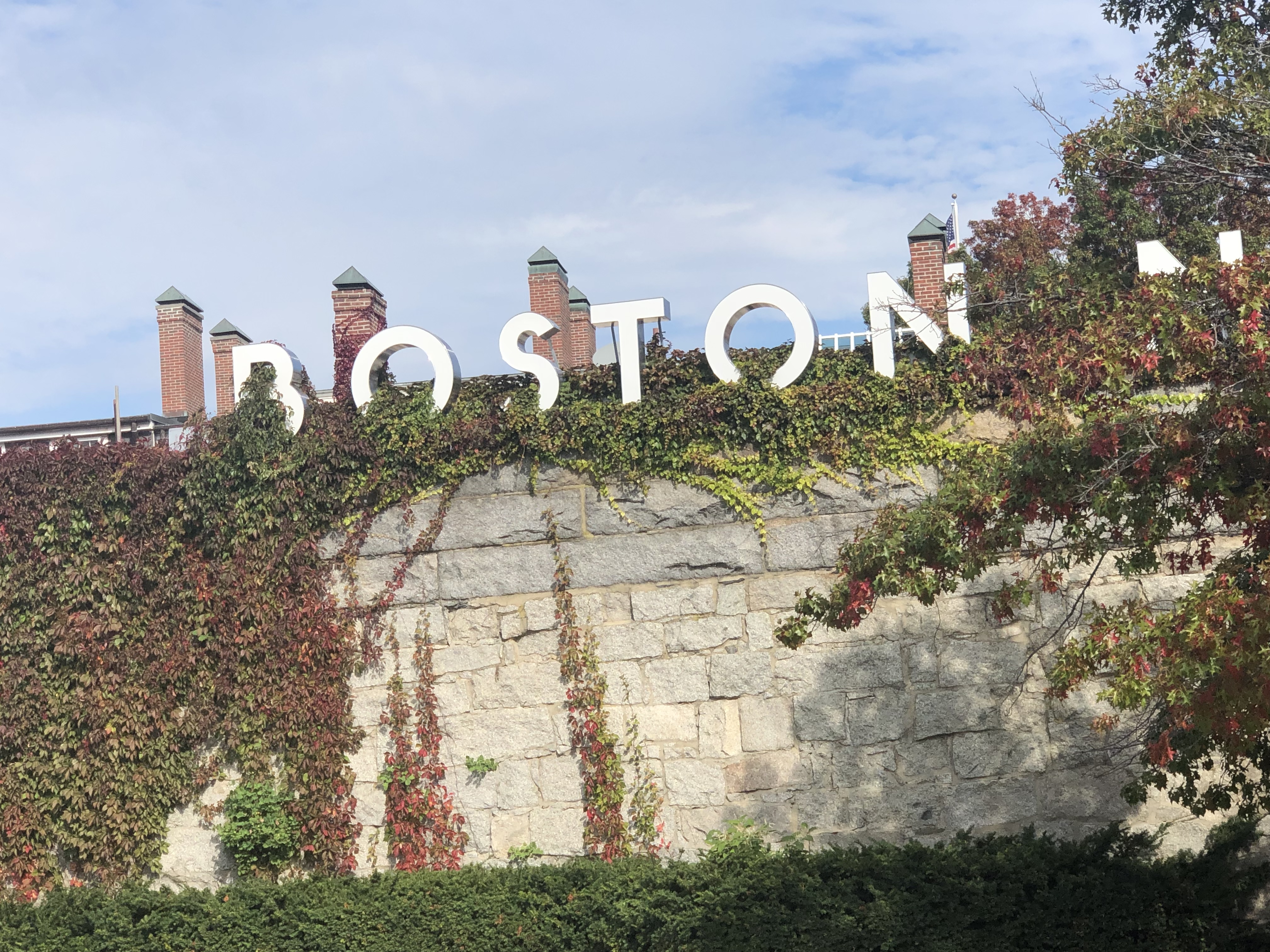
Boston
Boston, Massachusetts holds special memories for me. When my grandmother Haynes died in 2003, she left each of her grandchildren a small inheritance. I’d been planning to get my Master’s Degree, so I invested mine in furthering my education – something that never depreciates and would have made my grandmother proud (and it also can’t be split 50/50 in the event of divorce, which happened in my first marriage). I explored a fast-track program called the National Institute of Teaching Excellence (NITE) at Cambridge College in Boston. I applied, was accepted, and registered to attend in the summer of 2005, where I’d spend six weeks in the city studying during the week and exploring on weekends. I’d been there once before, in 1998, for a long weekend to see the fall leaves and take our youngest daughter to visit the Boston Science Museum. She climbed up and down the musical chiming stairs in the museum with such joy!
The City View Hop On/Hop Off Trolley is a great way to get around Boston!
We’d walked the Freedom Trail and stopped by the Boston Public Garden to see the Make Way for Ducklings statues based on the book by Robert McCloskey. I’ve seen on the news this week that someone knitted a yellow and blue sweater and placed it on a duckling to show support for Ukraine, but for me it carries more than a show of support for Ukraine – that sweater on a duckling is a sobering reminder that there are children involved in this crisis. Children through the years have lined up to climb on the backs of the ducklings one by one, Leapfrog-style, until they get to the to the mother duck at the front; then, they run back and get in line to leap to the front all over again.
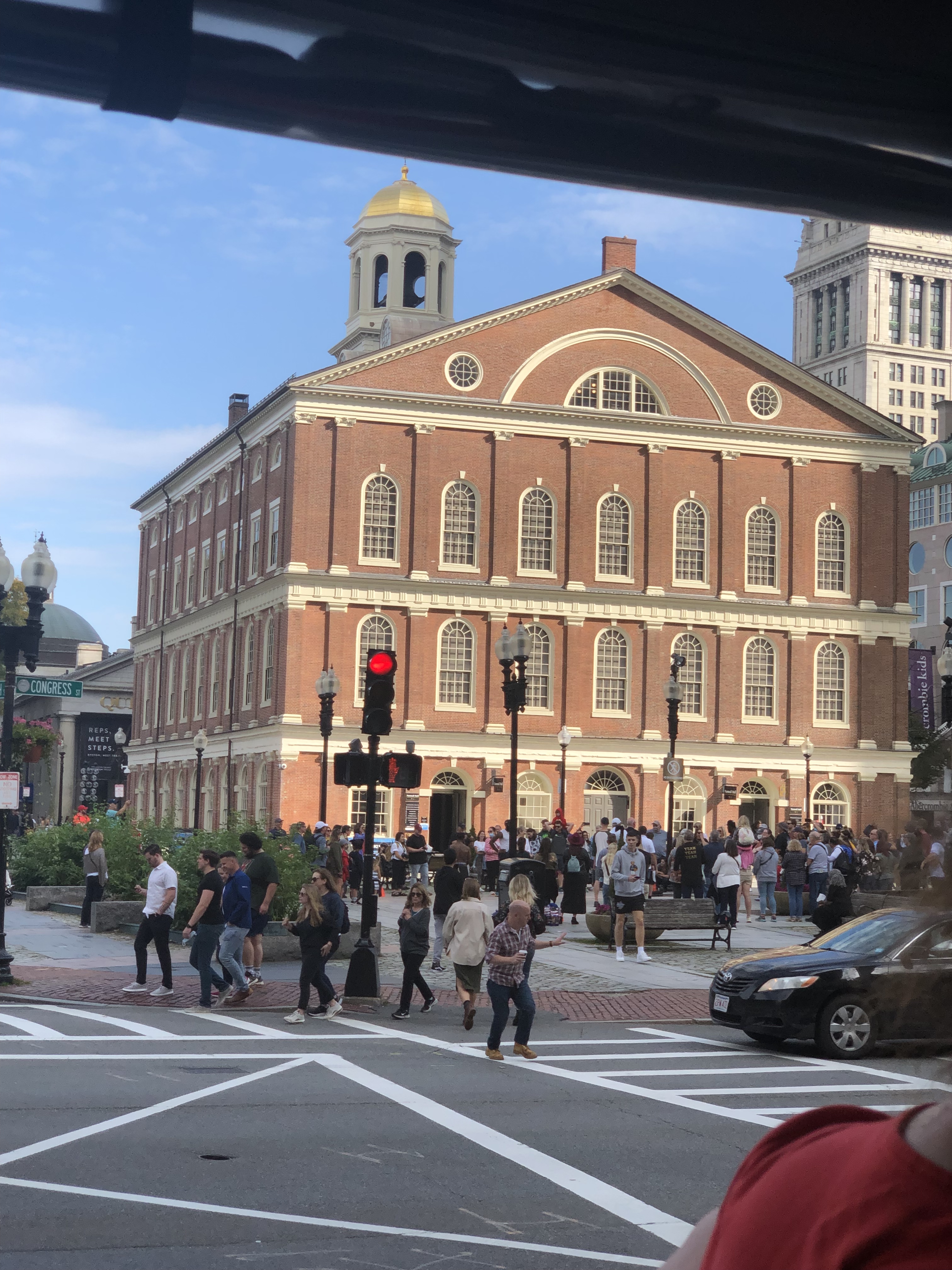
Ansley on a duckling statue, Boston, MA- October 1998Make Way for Ducklings Statue in Boston, MA – March 2022Faneuil Hall is a crowd favorite for live soapbox entertainment and shopping
I fell in love with the New England Aquarium, where Sy Montgomery conducted her research for her book The Soul of an Octopus. As I turned each page of the book, I reflected on my time in the aquarium and envisioned the events unfolding with Athena and Octavia and all the other octopuses and their antics. I could spend weeks more in Boston and never get enough of the city, from the USS Constitution to Boston Harbor to Old North Church and the Paul Revere Museum. I love it even more than Manhattan because of its unique history and the ease of getting around.
New England Clam Chowder
If the experiences and places of travel create the memories, then the specialty food of a place adds a dimension of richness of the cultural experience. Even though my October 2021 trip to Boston didn’t allow more time than one loop on the Hop On/Hop Off Trolley for a refresher glimpse of the city, I didn’t miss the opportunity to hop off and eat my favorite Boston meal. I ordered a bowl of New England Clam Chowder in a pub near Faneuil Hall and savored every bite of my chowdah – something I enjoy whether it’s hot or cold weather whenever I’m visiting Boston!
With special thanks to Slice of Life for giving writers inspiration, space, and voice
Slice of Life Day 15 of 31: Journeys (my March theme)
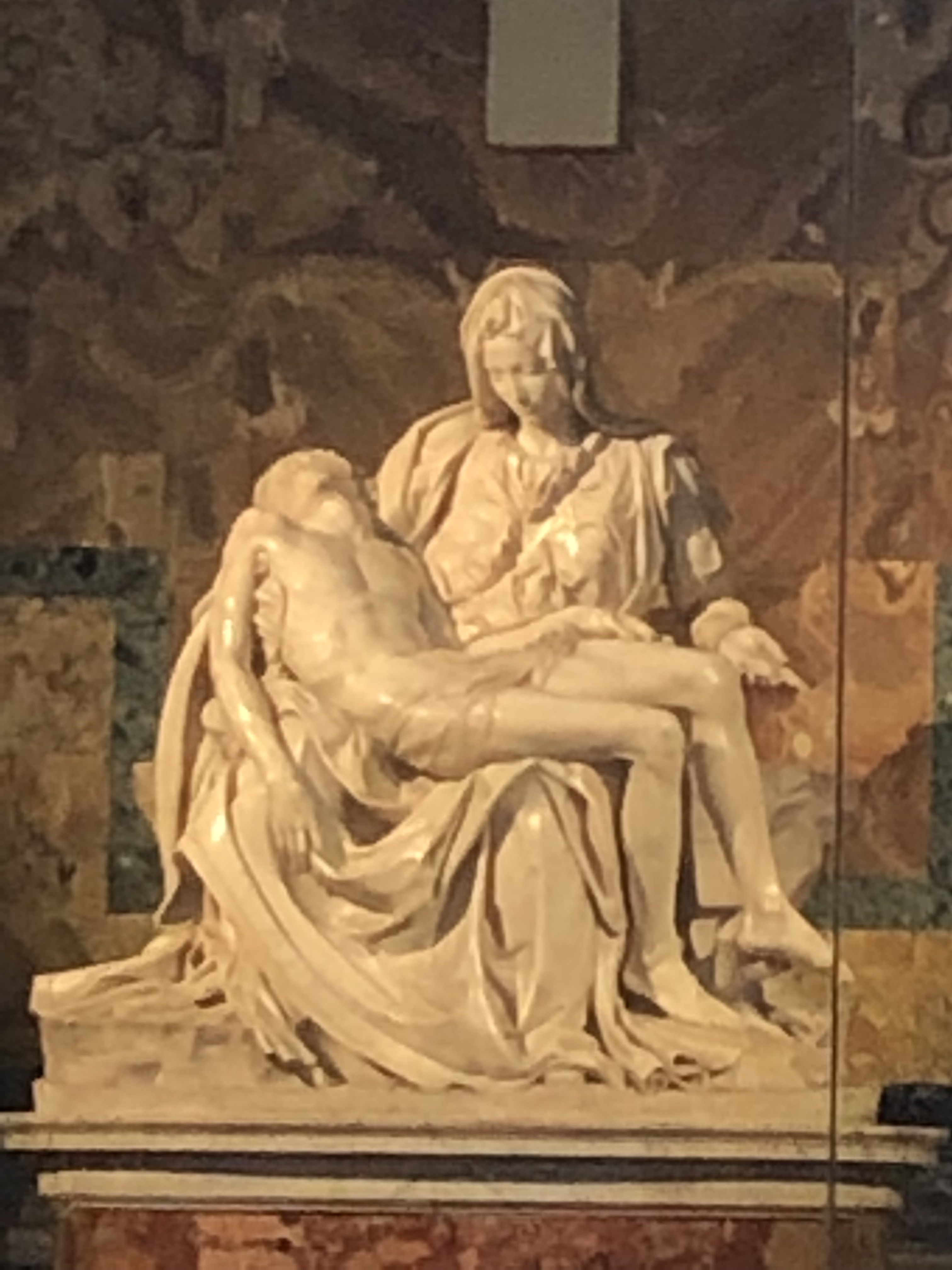
Visiting Rome in June 2019 was one of the highlights of all my travel experiences. The city holds powerful ancient history, the most heartbreaking and moving sculpture in all the world, and the footprints, fingerprints, and brush strokes of the most accomplished artists who’ve ever lived. It’s a mecca for culinary delights – pastas, sauces, olive oils, pizzas, gelatos, and tiramisus.
Rome is also home to the most iconic fountain in all of Italy – the Trevi Fountain, full of the coins of those who have thrown in one coin (from their right hand over their left shoulder) wishing to return to the city of Rome, two coins to fall in love, or three coins to marry the person they love. I am blessed to be married to the love of my life, so I threw one coin.
Rome is also where Julius Caesar was betrayed and stabbed by those who conspired against him after having been warned by a soothsayer about the Ides of March.
Two conflicting ideas came to mind as I left my own footprints on the streets of Rome: persecution and promise. Each day, we make choices about what we believe – whether to live in fear of persecution or to proactively place our hope in the promise of a better tomorrow. Sunday’s sermon reminded us that we are travelers on this journey, pilgrims on the intersecting roads of time- weaving past and present to plant the seeds of the future. In a world of soothsayers seeking to squelch all hope, I turn from all bewaring of the Ides of March to beholding the fountain of promise.
I hum the postlude the pianist played in church last Sunday, “O God, our help in ages past, our hope for years to come, our shelter from the stormy past, and our eternal home.”
The Trevi Fountain in Rome, Italy – June 2019At the Colosseum, Rome, Italy – June 2019The Pieta, St. Peter’s Basilica, Rome, Italy – June 2019
Hebrews 6:18
18 So God has given both his promise and his oath. These two things are unchangeable because it is impossible for God to lie. Therefore, we who have fled to him for refuge can have great confidence as we hold to the hope that lies before us.
With special thanks to Slice of Life for giving writers inspiration, space, and voice
Slice of Life Day 14 of 31: Journeys (my March theme)
Before October 2021, I believed that visiting Salem, Massachusetts in October was a bucket list experience that everyone should have in a lifetime. I’ve revised my position: if I were to visit Salem again, I would not go in October – it’s far too crowded! Perhaps I might go on the 13th of a month instead, for superstition’s sake. The 13th: a jinxed number, paranoid with black-cloud cover and omens.
Salem, Massachusetts in the 1690s gave rise to one of the darkest periods of New England’s history – an era that defined the concept of witch hunts that still take place today. Arthur Miller’s The Crucible is an allegory that uses the Salem Witch Trials to illustrate its similarities to McCarthyism – and portrays how ridiculous accusations can result in people being “black listed” with no concrete evidence, often so illogically and outrageously that it shakes the rest of us to the core. Social media perpetuates the whole avalanche of mob mentality that can ruin innocent peoples’ lives.
A gentle whale plays off the coast of New England, October 2021
Due east of Salem in the the Atlantic Ocean, the hunt for other innocent creatures was also happening, as Herman Melville describes in his iconic literary masterpiece Moby Dick (Nathaniel Philbrick describes the true events inspiring Melville’s novel in his book In the Heart of the Sea: The Tragedy of the Whaleship Essex). If we were to walk back into Biblical times and cast an injustice-sweeping net across the globe and drag it through history, our fishnet would rip wide open with the ugly gut-wrenching truths that the most innocent among us have been persecuted since the dawn of time, even while singing songs of hope and praise from chambers of anguish.
Tourist dressed as a witch on the streets of Salem, MA, October 2021
In the Salem Witch Museum, I read the names of those accused of witchcraft and their fate in the hands of swift Puritan judgment. From the deck of a tour boat in Gloucester, I admired the peace of gentle whales in the Atlantic Ocean, wondering how likely it might have been that their very own great grandparents were victims of Ahabs aboard Pequods. And I pondered the tremendous responsibility I have to be a vessel of light in a dark, unfair world -to journey inward to understand a person, a situation, an event – rather than to judge, to jump to conclusions, to throw jabs or join the fray.
Journeys create moments of deep introspection like these that help us see the world and seek our place and purpose in it.
The streets of Salem are filled with those dressed as witchesA tender scene, filled with such irony in the history of this place: a man is working with this service dog and this blind woman on the streets of Salem. They were counting steps and learning commands. I sat eating a sandwich in an outdoor cafe, considering the stark differences between vision and discernment, between perception and reality.
Psalm 40:11
Take not away your gentle mercies from me, O Lord; let your mercy and your faith keep me safe for ever.
With special thanks to Slice of Life for giving writers inspiration, space, and voice
Journeys: Day 12 of 31 (my March theme)
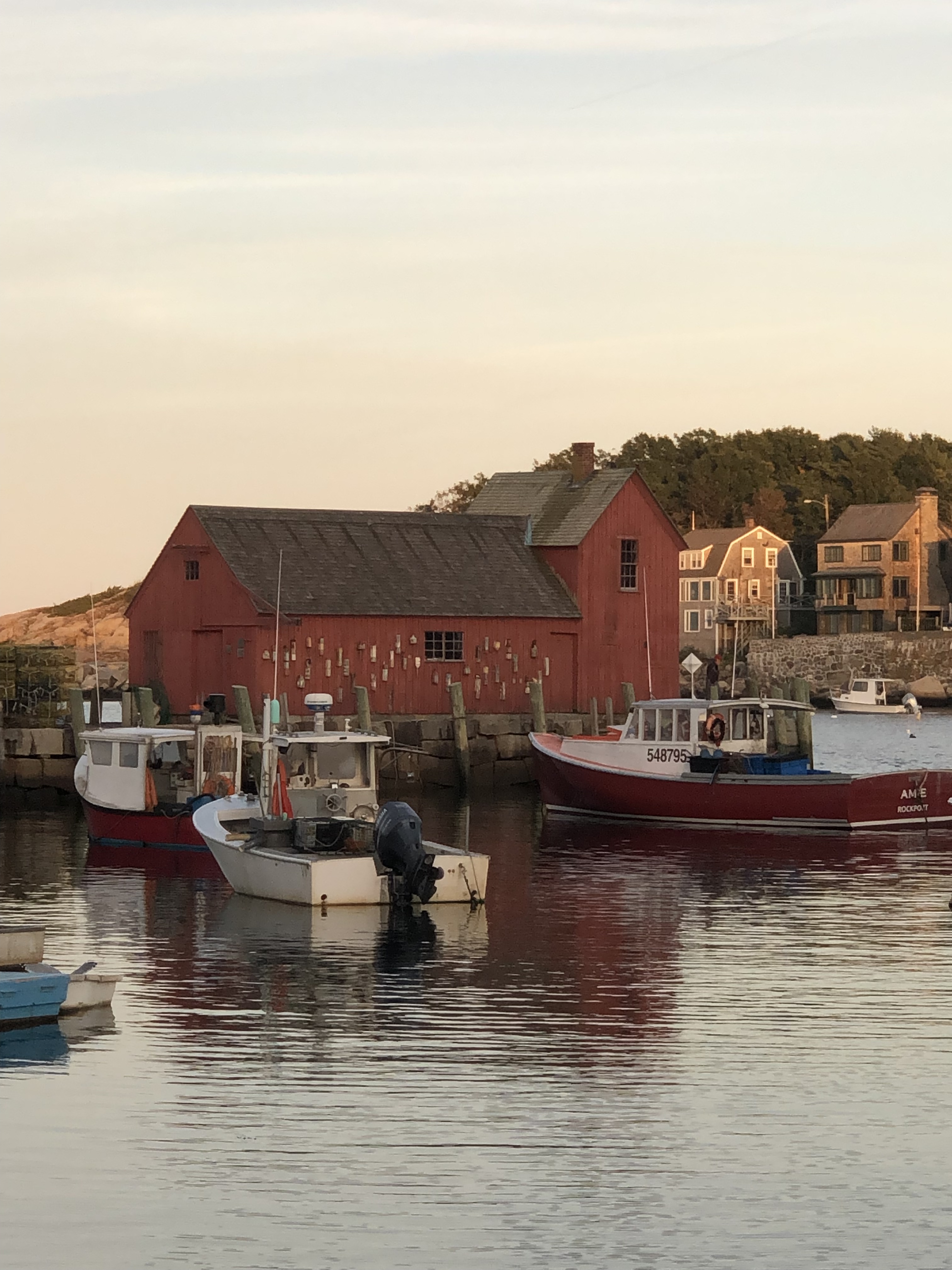
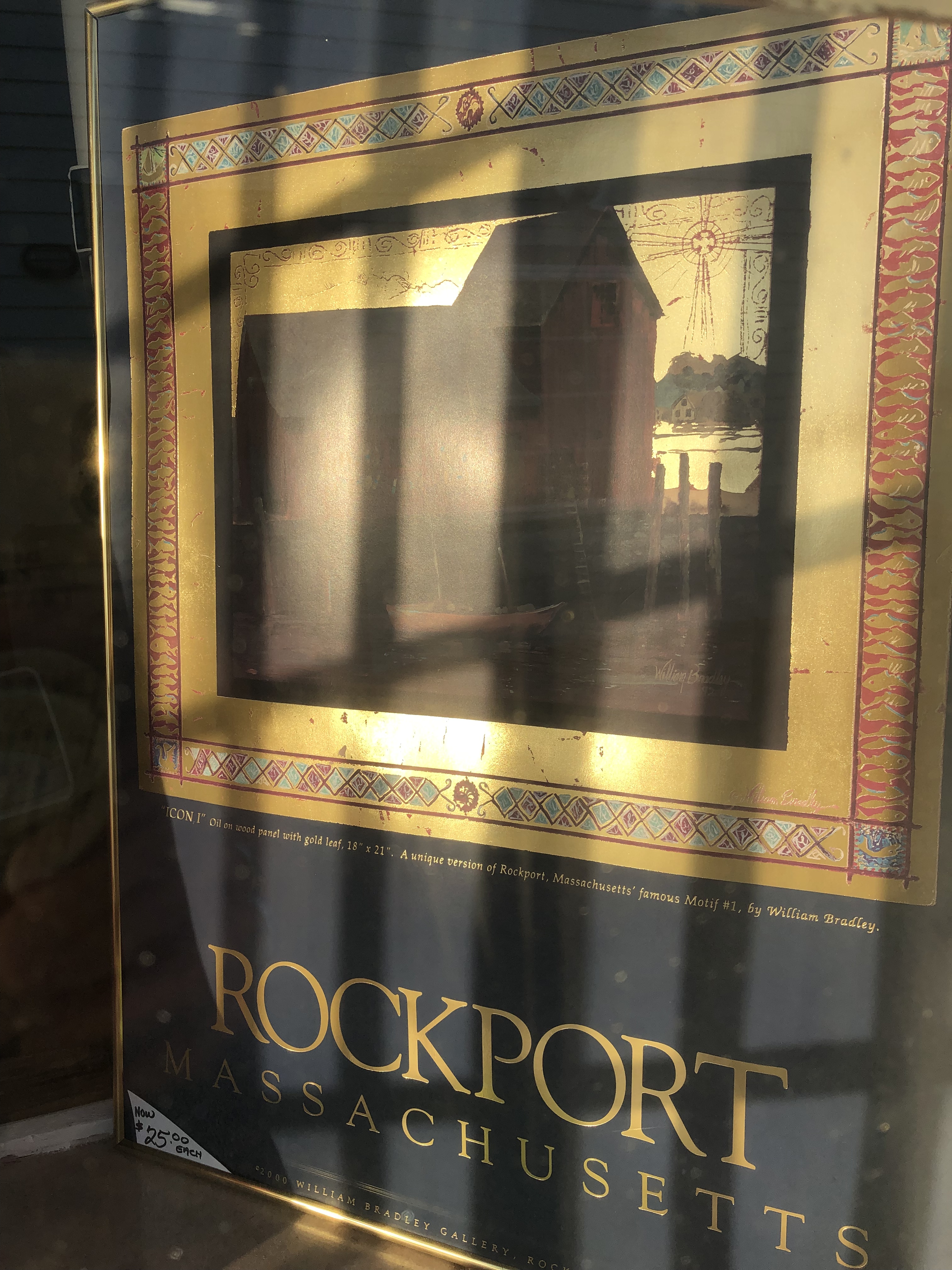
In October 2021, I visited Rockport, Massachusetts, where I stayed in a quaint little VRBO named the Sail Loft of Bearskin Neck, right next door to the leather shop in the heart of town. The New England vibe was strong, and my heart swelled every time I took a walk in the crisp autumn air. The church bells chime the hour and evening hymns from the church steeple blanket this charming town with peace that quiets the soul, a reminder to pause and praise.
The iconic Motif #1 in Rockport Harbor, October 2021
There are three theories explaining how Bearskin Neck got its name. The most commonly held story is that a young bear was caught by the tide and killed in 1700. The second story is that early settlers in the area encountered aggressive bears and would lure the bears onto the neck where they could trap and hunt them. The third story is that Bearskin Neck was named after Ebenezer Babson saw his nephew being attacked by a bear and intervened, luring the bear into the water and killing it with a fishing knife.
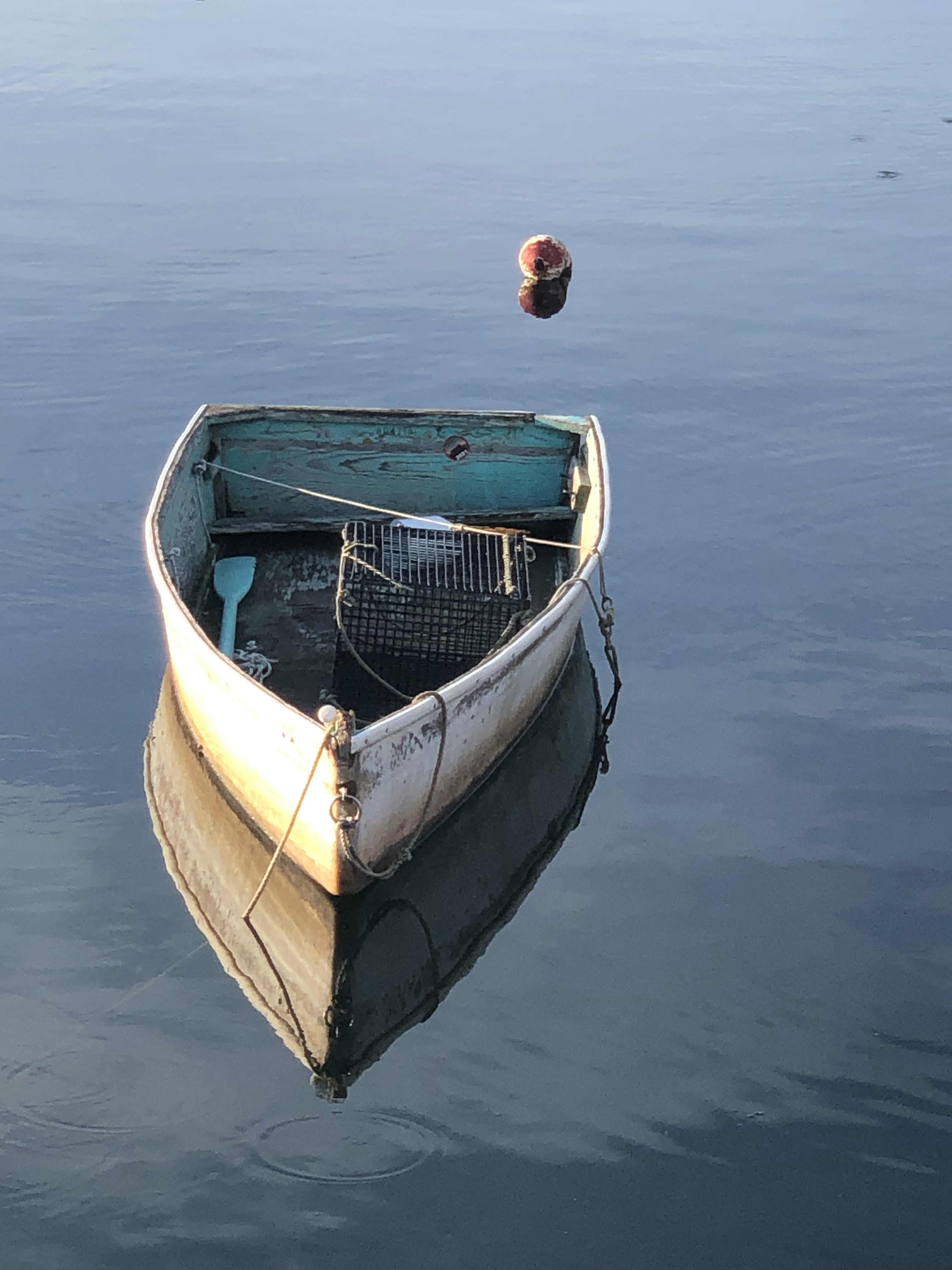
A dinghy moored in Rockport Harbor, October 2021
Having lived in coastal Georgia and coastal South Carolina, I know that shell hunting yields greater abundance on an outgoing tide, and the locals confirmed when I’d asked about the best places to find sea glass that Front Beach and Back Beach were the places to go – – but that I’d have to get there early the next morning on the outgoing tide. I made a note to keep an eye out for aggressive bears as I made my way to the beach.
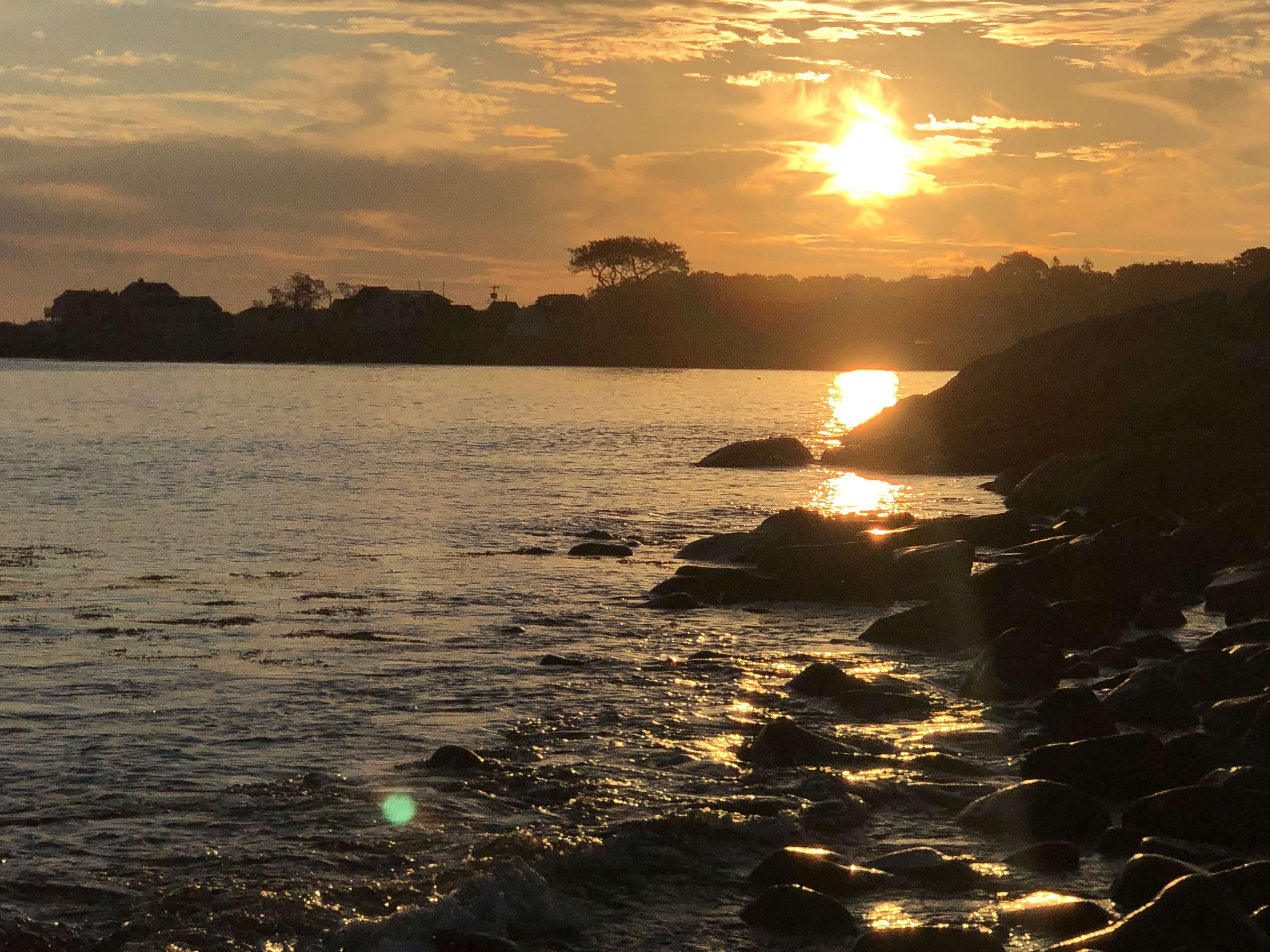
I poured a cup of coffee and headed out before sunrise on a sea glass quest. There were already several seekers with their dogs out at Front Beach, scouring the shore for the bits of opaque glass. A quick walk along this beach told me that I might have better luck at Back Beach, so another few minutes down the way took me to a far rockier beach. The sun was just beginning to peek over the horizon in a vibrant golden color unique to New England beaches, like a pirate’s treasure chest opening in the sky.
I set my coffee cup down. With careful footing on the rocks, I scoured the shore for the tiny bits of glass. While I wanted to take home some sea glass that I had found myself, I realized in those first few minutes that the search was relatively futile. I think I’ll buy myself a bracelet. That’s the only way I’ll be taking home any sea glass, I decided.
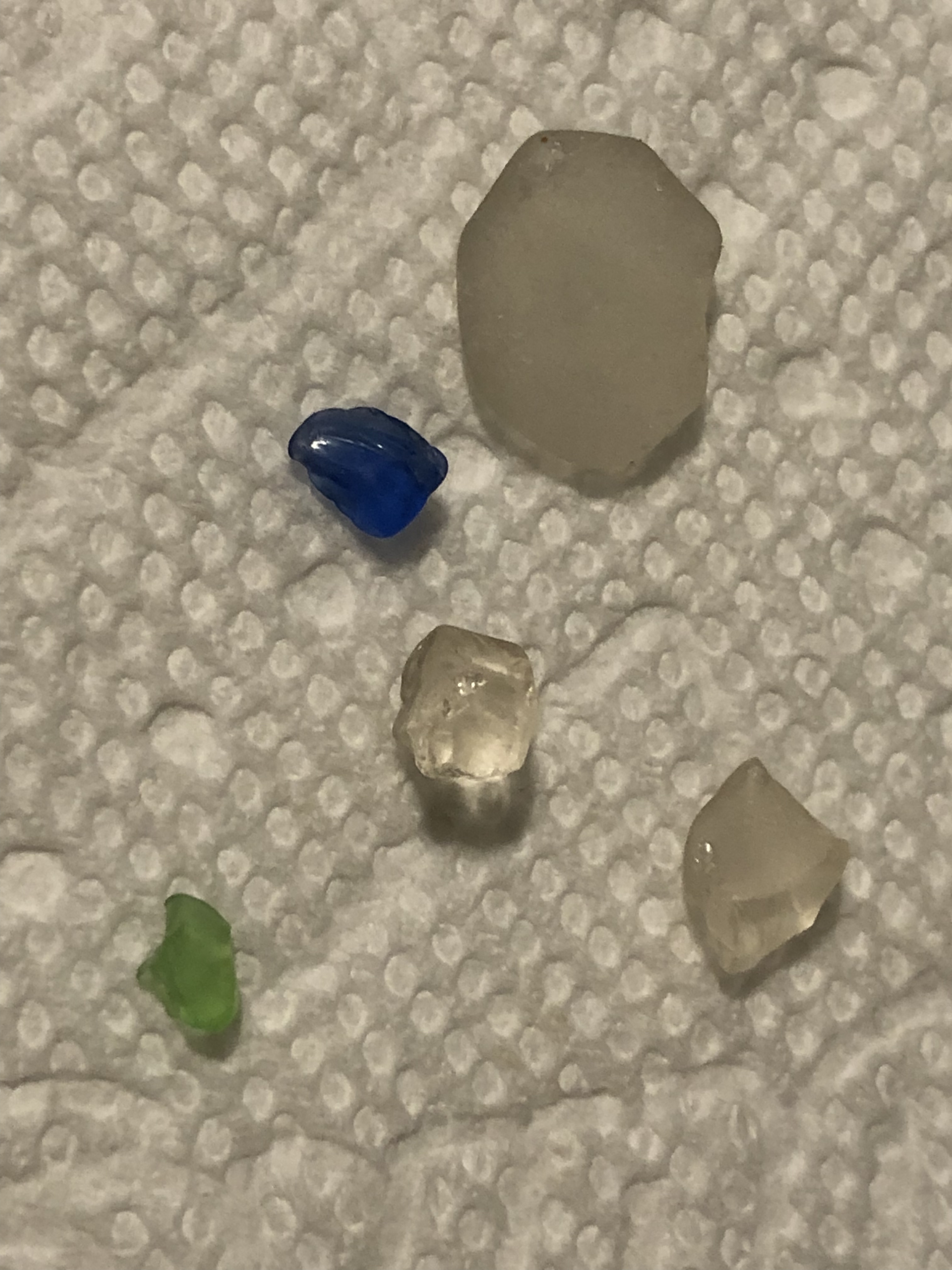
Seaglass found in Rockport, MA, October 2021
And then I got lucky. I changed my search zone and found a few tiny pieces that brought heart-stopping excitement. A cobalt piece, a red piece, a light green piece and a white piece resurrected the same thrill of finding the golden Easter egg one year when I was young. I dumped my cold coffee and used my mug as my collection cup.
There’s a certain slant of light, a gift well known to earlybirds
There’s a certain slant of light, a gift known to earlybirds, that is incomparable to any other time of day. The way the rays hit a window or a rocky shore are breathtaking. For sea glass seeking or sunrise, I’m eager to breathe the morning air, to inhale the salt of the sea, to watch the day begin and know each night that I’ve been a good steward of the beauty of this world!
The morning beauty of a certain slant of light – Rockport, MA 2021
Let the sea roar, and all that fills it; let the field exult, and everything in it!
With special thanks to Two Writing Teachers at Slice of Life for giving writers space and voice
Day 12 of 31 – Journeys (my March theme)
Among my last words to my brother’s dog Feivel in my special dog voice before he’d crossed the Rainbow Bridge was an invitation back to the Johnson Funny Farm, where Poppy and I would be waiting to welcome him. My brother told me that Feivel had raised his head at the sound of my voice across the phone’s speaker in his final moments, so I knew he was hearing…..and listening. I just may not have realized how seriously he was taking me.
Feivel loved the farm where he and my brother lived in Concord, and he loved our farm in Williamson, too. Pike County, Georgia is an hour south of the world’s busiest airport and light years from any town. We are as rural as it gets. We don’t even have curtains in our house. This place is a dog’s paradise – they can chase squirrels and sniff and track the footprints of all kinds of critters, tire out and then bask away the afternoon in the sun. They often find a soft patch of clover and roll over and wiggle-scratch their backs, kicking all four legs in the air in sheer joy and smiling that satisfied upside-down dog grin that reminds us that we, too, should live more fully in each moment.
Dogs here do their favorite country dog thing ever: after a bath or grooming, especially right after a fresh rain, they sniff the wet ground for worms. Dog masters see it happening from across the way and try to stop it, but it never fails – the dog always wins. They hone in on one unsuspecting worm and drop the left shoulder onto the ground before the clover-roll elation begins and all four legs are kicking and thrusting toward heaven with unbridled joy as the dog continues this muddy, dead worm perfuming ritual.
When I left for work on Monday morning after the break, I noticed a tan dog playing by the edge of the road near our driveway. Oh no. It’s gonna get hit, I worried, teary-eyed, as my heart skipped a beat. I need to turn around and see if it has a tag. I need to get it to safety. But it would have made me late, so I kept driving, praying that someone else with time to spare would help the poor baby to safety and that no one would hit it.
I drove slowly, peeking out through my finger-covered eyes on my way home to see if there were any signs of a dog fatality on the road; thankfully, there were none, so I pulled into the driveway, stopped and crossed the road to get the mail, and returned to the car to begin the long crawl up the driveway to the house.
On Wednesday afternoon’s mail check, though, she was there, playing at the edge where I had seen her on Monday. When she saw me get out of the car, she broke out in a full clumsy run toward me, wagging her tail, begging for attention but far too skittish to let me touch her. I coaxed her from the road to the driveway to avoid the cars that fly at high speeds down our road and saw her ribs and felt her hunger radiating.
Hunger was no problem for a sugar junkie! I had a stash of cherry Twizzlers in the console of my Rav, and I unwrapped one and offered it. She would not come all the way to me at first, so I kept throwing out pieces closer and closer, Hansel and Gretel- like, to try to see if she had a tag with an owner’s number that I could call to help her get back home. When I finally lured her close enough, I could see that her collar appeared to be chewed on, and there was no number or tag.
It appeared she’d been dumped.
She appeared to have been dumped.
I posted her picture on every local Facebook pet site I knew: Anyone missing this sweet girl?
I also texted my aunt, who had asked me no fewer than five times in recent months to please find her a dog. Their Lily had passed on, and she was missing the companionship. She’d texted: I want a medium or large dog (Lily had been huge). Nothing little that we might trip over, like yours. If no one claimed this dog, she’d be absolutely perfect for my aunt and uncle!
But her daughter texted me: Mom wants a dog so bad, but I’m not sure that she needs one. I know you understand.
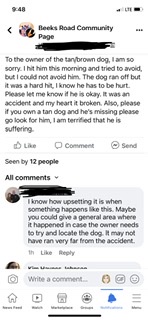
My aunt who couldn’t quit asking for a dog wouldn’t be allowed to have her, and no owner was responding to my posts about a found dog – so the dog continued to sleep on our front porch. When I left for work on Friday morning, she was nowhere to be seen, so I figured she had moved on. As I prepared for a 9:30 meeting that was running late, I checked in to see if there was any news of the dog turning up at another house. A post from our road community page caught my eye.
To the owner of the tan/brown dog, I am so sorry. I hit him the is morning and tried to avoid, but I could not avoid him. The dog ran off but it was a hard hit. I know he has to be hurt. Please let me know if he is okay. It was an accident and my heart is broken. Also, please if you own a tan dog and he’s missing, please go look for him. I am terrified that he is suffering.
The Facebook post that caught my eye on Friday morning
Tears welled in my eyes as I remembered her trying to come in and be part of our family the previous night. She’d waited for her opportunity to bolt in the door, and she’d made it past all efforts to block her. We had to pick her up and put her back outside, and in the process, she’d been so frightened that she’d puddled right on the wood floor. I’d felt so sorry for her – – and now, to know that she’d been hit was just too much.
I responded with a picture of the dog to the woman whose heart was broken, asking if the picture matched the dog she had hit.
I believe it is the same dog. So sorry.
The Facebook post that confirmed my fears
I frantically called my husband at work, and he had a family member ride the roads to see if the picture of the dog matched any dead or injured one on the side of the road. I texted: Start at the house. If she’s injured, she probably tried to get back to where she felt she could get some help. And then I apologized to the man who’d arrived for our meeting and explained my emotional state. Thankfully, he understood and was patient each time my phone dinged.
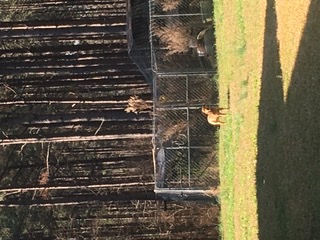
Shortly, I received a text with her picture from our family member checking things out. She was standing out by the old chicken coop in the back yard with her playfully skittish stance, refusing to come close to anyone else, but clearly not dead or injured.
She wasn’t injured or dead but would not come close to the family member checking on her
That afternoon, the brokenhearted driver messaged to see if we had found the dog she’d hit that morning.
She’s fine, I replied, we see no injuries and she’s running around like nothing ever happened.
When I got home, she covered me with dog kisses – grateful to see me. I found it oddly perplexing that she was so skittish of others and so quick to want to love my husband and me. After I’d taken the boys out to do their business, I came back in and sat down to rest from the day and catch my breath. A strange Twilight Zone feeling came over me all at once…..an invitation to Feivel to return to the Funny Farm, where we would be waiting…..a skittish dog quick to befriend my husband and me but no one else……a dog appearing on the Funny Farm, asking to be taken in when no dog has ever done that as long as we have lived here…… a neighbor who’d hit a dog she believed to be this one, now running around like nothing ever happened.
I just wonder.
Luke 10:33-34
33 But a Samaritan, as he journeyed, came to where he was, and when he saw him, he had compassion.
That poet was me. I wrote it on the last morning of my solo adventure trip to San Antonio, Texas (2/25/2022), on the heels of a week spent sightseeing, exploring, reflecting, reading, and writing. A trip that I almost didn’t take – but I did. I learned some history, forged new paths, tasted new foods, and discovered that solo travel has its perks!
I talked to my dad for thirty seconds short of a full hour on the morning of my departure. I’d texted him the day before: Can you send me by text a brief paragraph of your mother’s last words? He’d called to tell me the story – I’d heard it before, but I needed to hear it again.
My grandmother, Georgia Lee Harris Haynes, was born in Folkston, Georgia on April 7, 1920 but lived most of her life in Waycross, Georgia. She lived at Baptist Village in Waycross during the latter stages of Alzheimer’s Disease and died on Friday, March 21, 2003 at the age of 82. My parents went to visit her there one afternoon shortly before she died, where she spoke her last coherent words to them.
Any time her children visited, the nurses were blessed to see “the most wonderful children, the best children ever,” according to Georgia Lee. The nurses said she was always speaking the language of bragging on her children and how proud she was of them – and rightfully so. She’d raised three – a teacher, a preacher, and an attorney who combines his legal knowledge with selling commercial real estate .
When my parents arrived that day, they found her as lucid and as knowing as ever, with a clear memory. She’d had favorite sayings throughout her parenting days – “An ounce of prevention is worth a pound of cure.” As a pastor’s wife, her favorite saying was, “The best thing to do is to preach about God and about twenty minutes.” But her favorite saying of all was, “You never can be too careful.”
As my parents listened to her during that visit, they’d expected to hear some of those favorite quotes that she used frequently with her children. Instead, on that day, her words seemed steeped in deep reflection. “You know, I always worried about y’all…..I’ve always worried too much,” she confessed.
Dad, in his pastorly and good son way, reassured her. “It’s okay, Mom, you’re a mama. That’s just what mamas do,” before the haze returned and the clear memories escaped her. Weeks later, he would preside at her funeral.
Wilson Felix Haynes, Sr. and Georgia Lee Harris Haynes with their grandchildren and great grandchildren, Thanksgiving 1990 in Atlanta, GA
I thought of her words throughout my week, particularly as I wrestled with whether or not I should take a solo trip four states west of my home, on a plane, with just my carry-on and personal bag filled mostly with my new camera buddy – the Canon Rebel. If there was ever a person in the history of the world who never needed a camera with a name like rebel, it’s a preacher’s kid. Namely, me. But we behaved.
I told Dad I’d wanted to hear the story again because it had kept me midway between not being too careful to enjoy life, but being cautious – preventing with an ounce of sense whatever problems I could, to avoid baking a pound of cure. Throughout the week, for example, I’d waved goodbye to an invisible person in front of Uber drivers and others and made fake phone calls to say, “Hey, just letting you know I’m in a gray Mercedes SUV, arriving in 14 minutes. I sent you a screenshot of the license plate on the Uber screen so you can be on the lookout for me.” I’d exited Ubers by greeting walls of buildings and window ghosts with an excited smile and enthusiastic “hello!” I’d watched for families and groups and blended in on the fringes to appear to be one of them as I’d walked the streets of San Antonio all by myself. Somehow, I believed my grandmother would be proud of me for not having been too careful – for straddling the line in the middle of the road, with one foot in the lane of living life to the fullest and one foot in the lane of careful cautiousness.
Dad confessed that he’d worried about me ( it’s in his DNA). “You know, I know you’re smart, but I hoped you wouldn’t do anything dumb being out there so far away, traveling all alone.” I told him how I’d avoided doing something dumb when the opportunity had presented itself. I’d encountered a suspicious Uber driver who had tried to convince me that I should get in his car and let him take me home from the rodeo. He’d pulled up his Uber app attempting to prove he was really an Uber driver and not some phony. I’d prayed up a lot of prayers in anticipation of this trip for safe drivers- especially for a safe one on this late weeknight following a concert on the outskirts of downtown. I didn’t give the obvious phony the time of day, but emphasized my confirmation of an Uber on its way as I kept walking to the Letter C sign in the RideShare zone. A few minutes later as I waited in the wind-whipping cold, a delightful Richard pulled up alongside me. I’d been so relieved to step into his car! I have no doubt that my grandmother and my mother were working as guardian angels to see me safely home – – guiding Richard’s finger as he tapped the screen to accept the job of picking me up and delivering me safely to 423 Blue Star.
And I’d prayed that they’d see me safely from 423 Blue Star to the Johnson Funny Farm as I made my way home to where I belong. One can never be too careful. Travel is an adventure, but at the end of the trip, there’s no place like home!
I arrived at Hartsfield in Atlanta to find that the ground transportation tunnels were lit up with yellow and blue, the colors of the Ukraine Flag. I stood where the yellow met the blue, waiting on my electric blue RAV 4 driven by my husband, to pick me up, thankful to be getting in my own car and not another Uber, thankful to live in the United States of America. Thankful to be back home.
Philippians 4: 6-7
6 do not be anxious about anything, but in everything by prayer and supplication with thanksgiving let your requests be made known to God. 7 And the peace of God, which surpasses all understanding, will guard your hearts and your minds in Christ Jesus.
With special thanks to Slice of Life for giving writers inspiration, space, and voice
Slice of Life Day 10 of 31: Journeys (my theme for March)
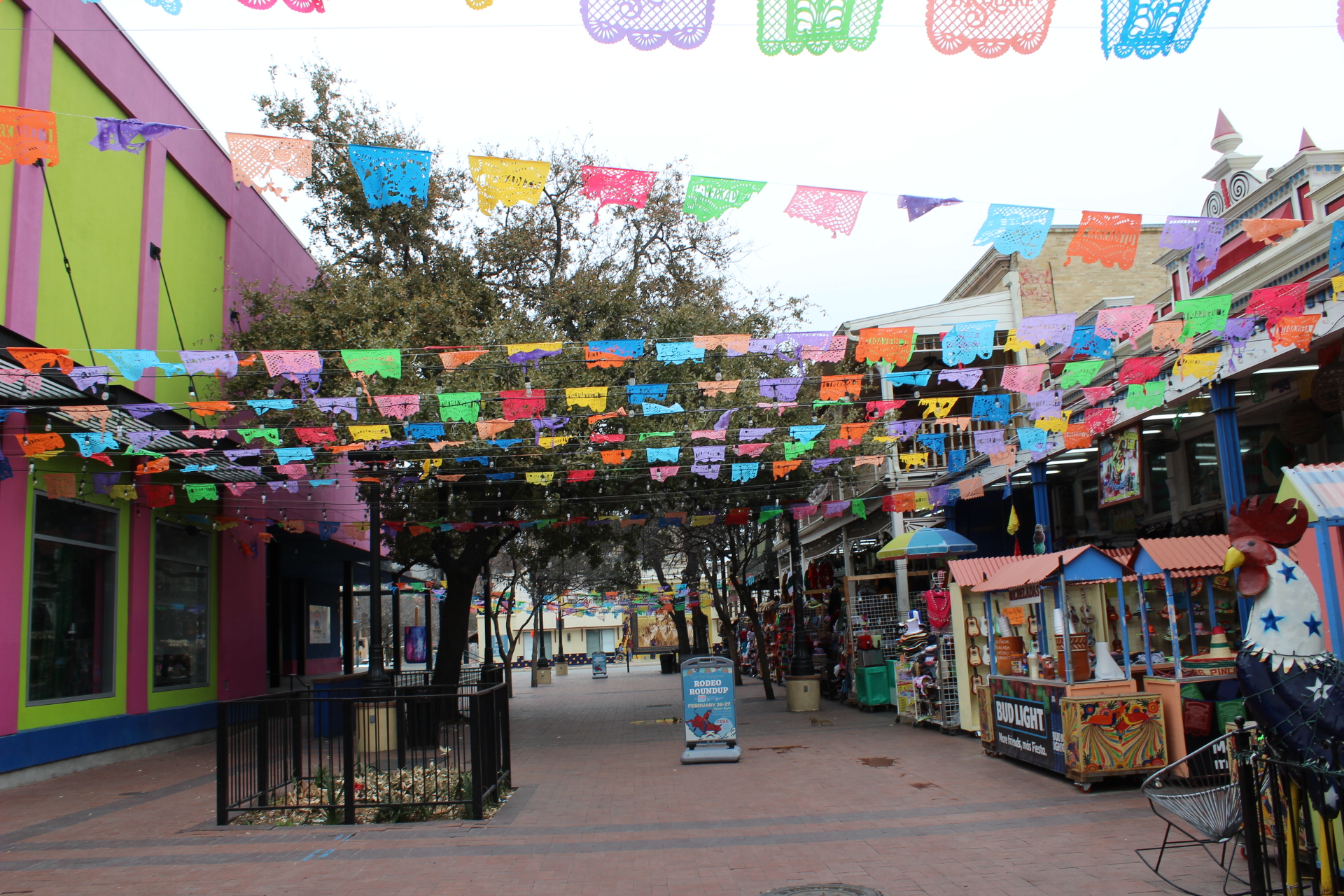
After a bowl of chili for lunch at the Buckhorn Saloon in downtown San Antonio, I ventured over to the Market Square (El Mercado) to continue my hunt for a Texas Bluebonnet bracelet to remember my trip. Shops were lined up clear down the brick-laden path, but they all seemed to have the exact same items: blanket shawls, boots, vests, cowhide leather items, and touristy souvenirs like shot glasses and magnets – not exactly what I was in the market for.
El Mercado
Finally, I saw the sign I’d been hoping to see: Silver Jewelry. I hastened my pace to escape the brisk wind and opened the door to go in, but a police officer stopped me. They were recording something that looked like a commercial or news clip inside, and I could see through the large glass windows a woman with a microphone in front of a big camera, interviewing a man with a giant lizard on his left arm as he stroked the scaly creature from head to tail with his right hand as if it were a napping lab puppy.
In my heart, I heard the good Lord saying, “Not here, not today.” I listened – something I’ve been doing a lot more lately since adopting listen as my one not-so-little word for 2022. The bracelet is still out there, safe and sound, somewhere, until I find it and know this is the one.
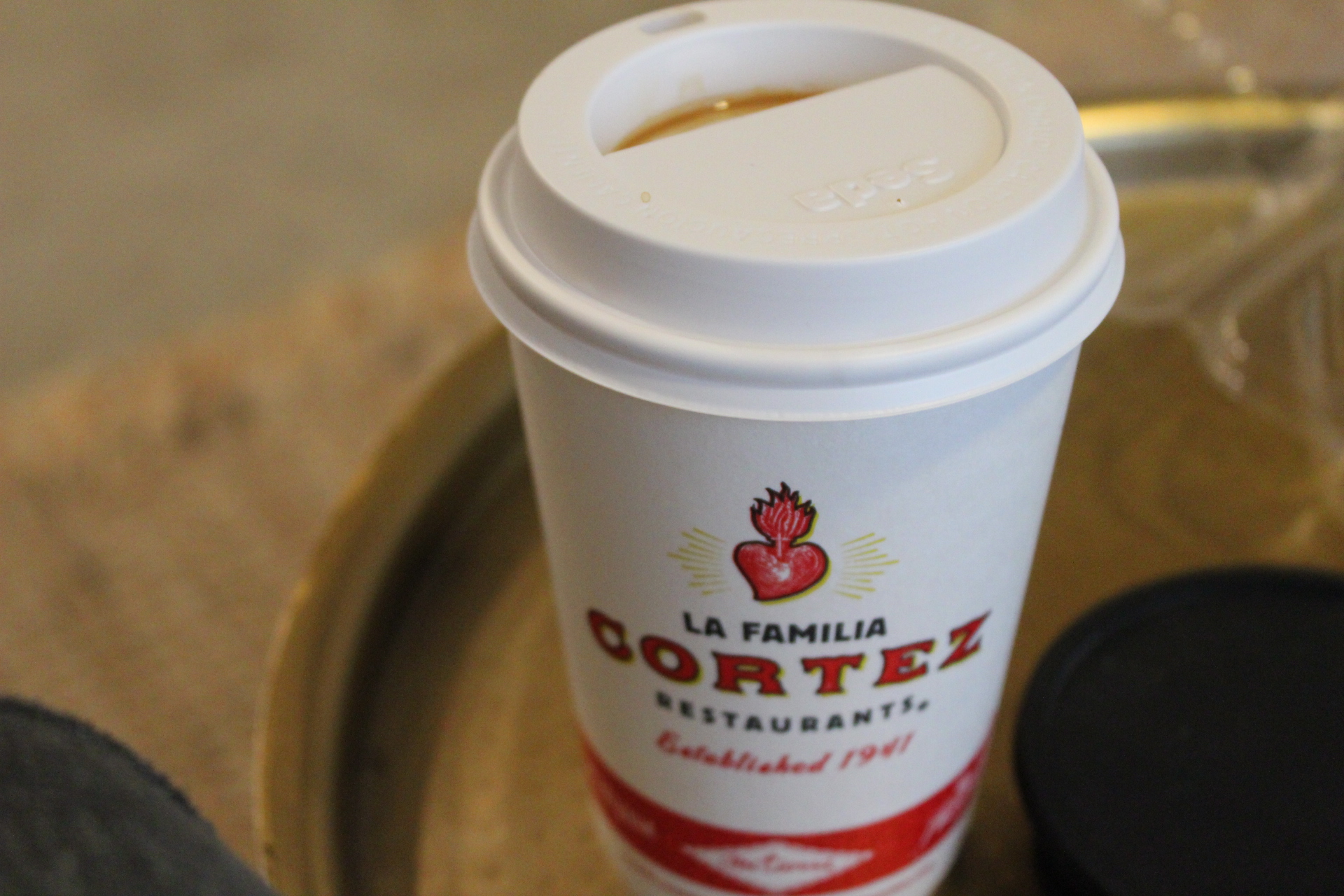
Coffee from Mi Tierra
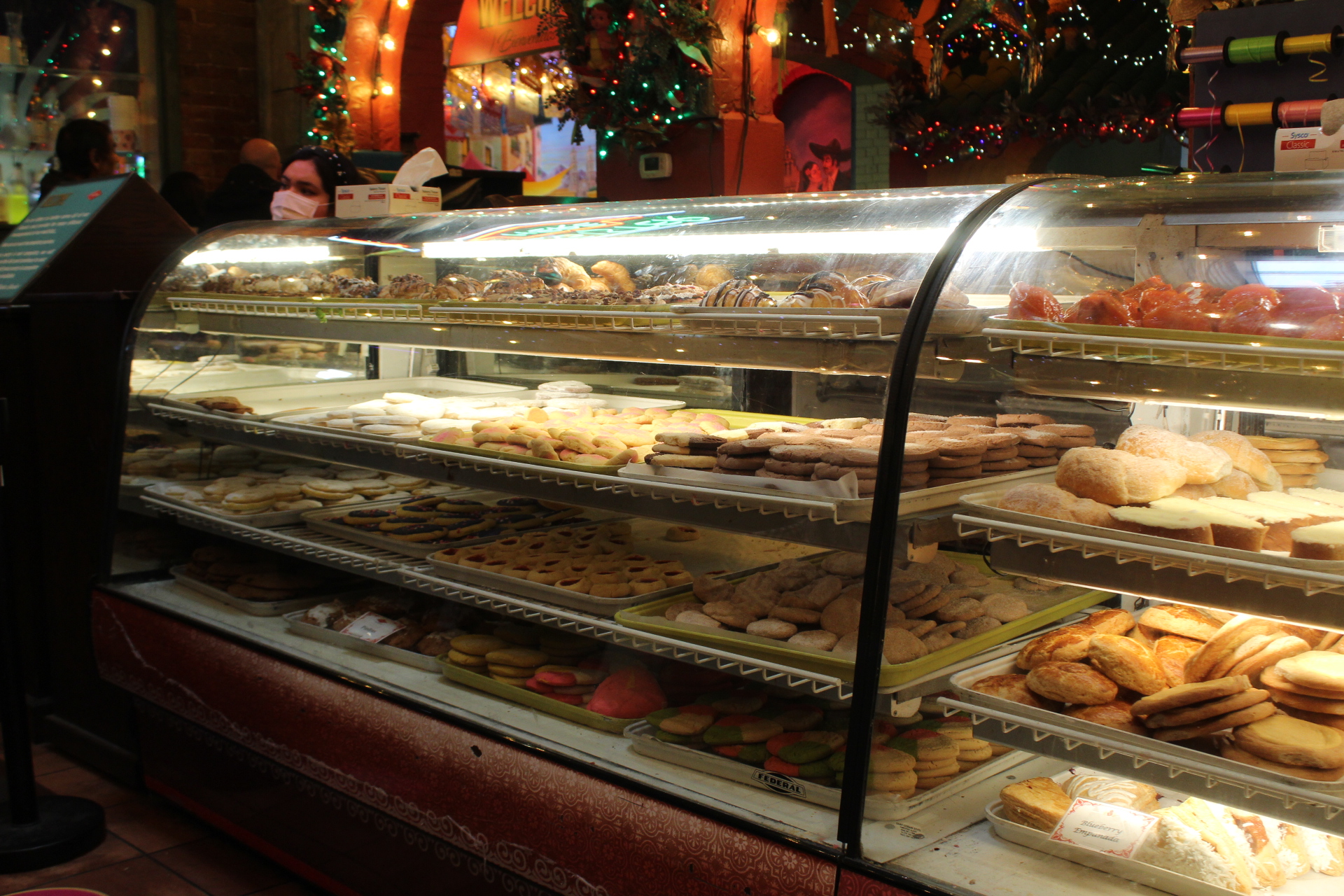
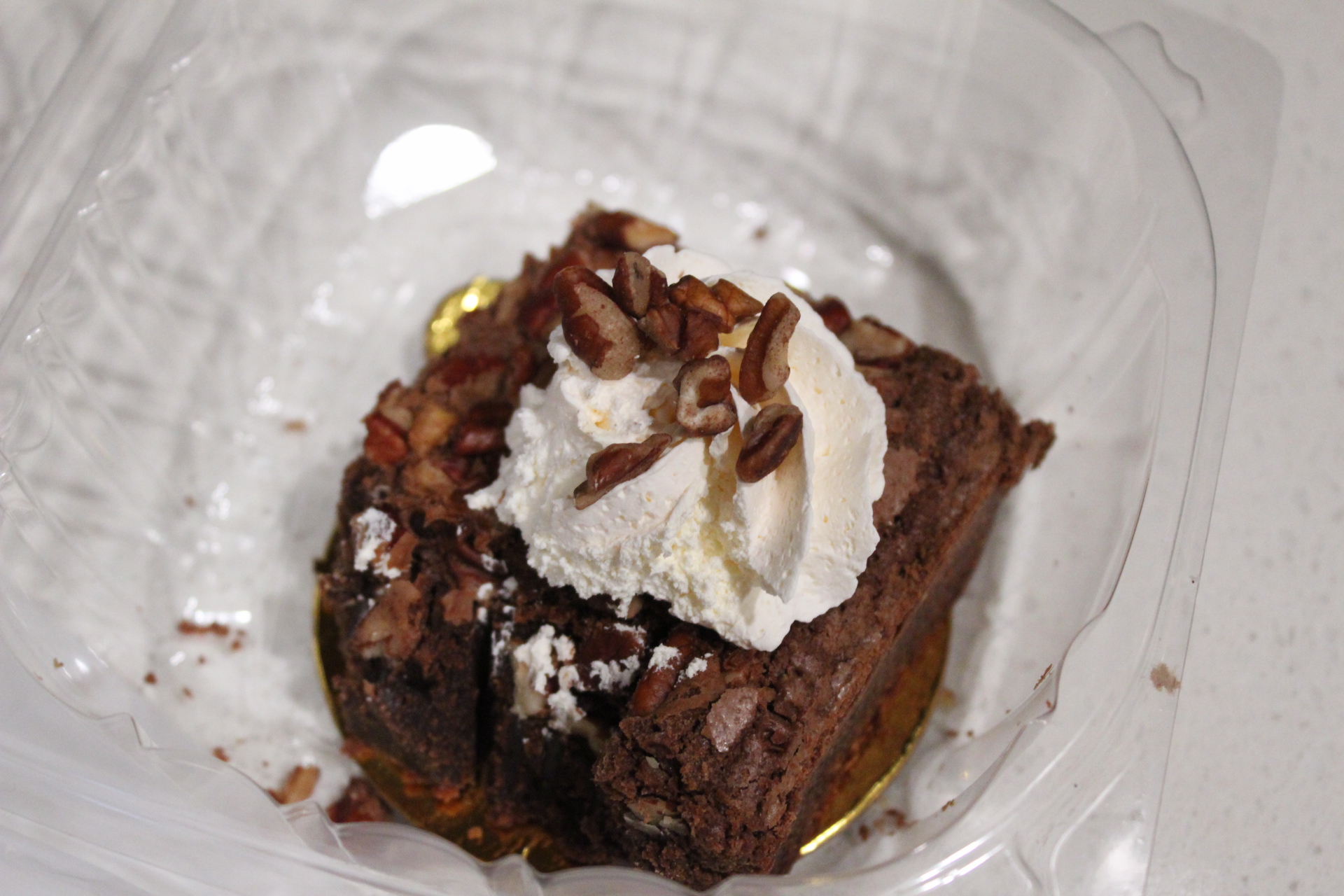
There was a perfect cup of coffee for me, though. I’d heard Mi Tierra was “the best place in San Antonio” to eat authentic Mexican food. Though I’m not a top fan of Mexican cuisine and I had no desire to wait in line for a table, I did brave the long bakery line for a few sweet treats and a cup of coffee to go. I held the cup of coffee in both hands, letting its warmth radiate through me as I made my way back down the wind tunnel alleyway to wait on the bus. In warmer temperatures, I might have visited the Botanical Gardens or the San Antonio Zoo, but these cold and windy conditions prevented any enjoyment of being outdoors. I went back to the room to write for the rest of the day.
Sometimes a discovery comes later, even after the trip is over, as it did when I found a whale’s tail bracelet in Savannah, Georgia to help me remember my trip to Gloucester, Massachusetts. I am holding out hope for a bracelet with a Texas bluebonnet on it, but what I love most is the quest – – having an idea and watching it take twists and turns, requiring my patience, sharpening my observations, heightening my awareness, and then often ending up with something completely different from my initial vision. I usually discover something better. A quest for a bracelet is mostly just an inexpensive, fun travel scavenger hunt that doesn’t require a win, yet it reminds me of all those prayers I’ve ever prayed that took asking and asking and asking and being patient and being patient and being patient and then God revealed a better plan – a gentle redirection that what I’m in the market for is not always what He has for me.
Today, I give thanks that I can enjoy the sights and feel the warmth that can only be appreciated along with the bite of frigid temperatures.
The bakery case at Mi Tierra Restaurant in El MercadoBrownie with nuts from Mi Tierra
Mi Tierra’s festive atmosphere
Job 37:9 “Out of the south comes the storm, And out of the north the cold.
With special thanks to Slice of Life for giving writers inspiration, space, and voice
Slice of Life Day 9 of 31: Journeys (my theme for March)
I’d seen that the weather was supposed to take a drastic turn to cold from the 88 degree highs we’d had Monday and Tuesday in San Antonio, Texas, but I wasn’t prepared for 39 degrees with whipping winds on Wednesday morning (areas just north of me, I later learned, were getting snow). Two days before, I’d had to purchase a t-shirt in the Alamo gift shop to shed my sleeves, and now no amount of layering was warm enough even with every single one of the layers I’d packed. I rolled up tiny bits of Kleenex to stuff in my ears to keep the cold wind out as I waited on the Hop On, Hop Off Bus in what felt like an arctic wind tunnel.
Chili at the Buckhorn Saloon
I set out to have a bowl of hot chili and a longneck (in the name of tradition) at the Buckhorn Saloon, said to be the oldest saloon in Texas, established in 1881 by 17-year-old Albert Freidrich. Teddy Roosevelt recruited the Rough Riders here, and it is also rumored to be the place where Pancho Villa planned the Mexican Revolution. As the chili began thawing me out, I caught a glimpse of movement down by my feet in my peripheral vision. My first thought: Oh no, this place is infested with rats! I took a closer look and discovered there were little birds hopping around on the tiled floor, seeking refuge from the cold, looking for crumbs of food. I threw down some crushed crackers for them, silently humming His Eye is on the Sparrow….and I know He watches me….
Little sparrows seeking refuge from the wind and cold
The bar in the Buckhorn Saloon
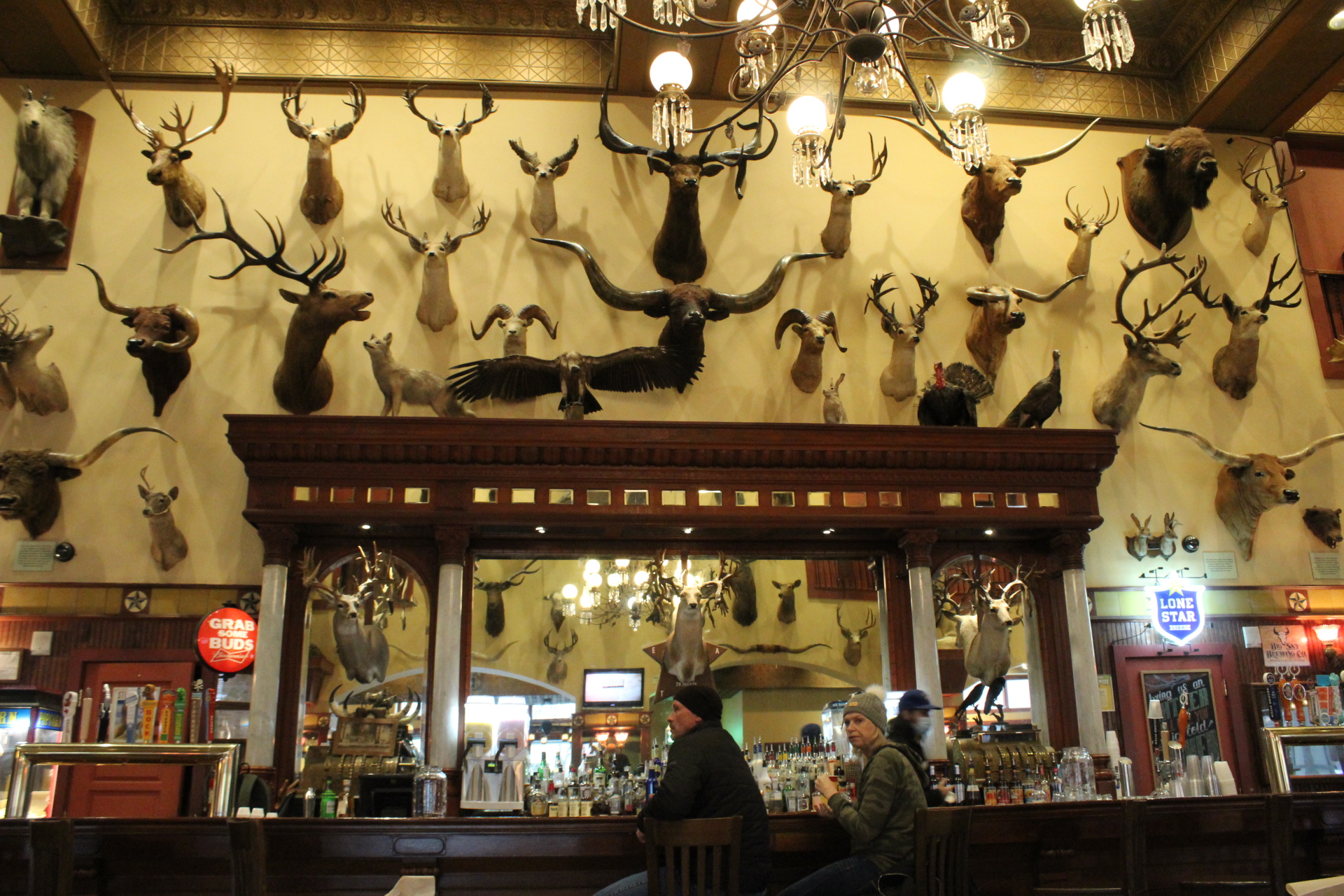
When you enter the Buckhorn saloon, you see taxidermied animal heads and antlers hanging all over the walls and ceiling. Since most travelers of that day didn’t have much money, the young founder started giving beer or whiskey in exchange for antlers or horns or jars of rattlesnake rattles. You can even see that some of the art is designed from rattlesnake rattles if you visit the Buckhorn Saloon museum upstairs. Also, the Texas Ranger Museum is connected, and Texas Bob himself, decked out in full Davy Crockett attire complete with a coonskin cap, will assist you in your ticket purchases at the door.
It’s a sobering experience to stand inches away from museum guns with little placards that tell the history of who owned it and who they killed with that particular firearm – and why, and who killed them in turn shortly thereafter – and why. The west was wild, and the rangers appointed themselves the protectors of the borders back before there was any established law enforcement.
Today, I give thanks for warmth of heat and safety of travel. And the good Lord knows I’m thankful that I didn’t have to kill a bunch of rattlesnakes to sip hops at the Buckhorn.
.
Antlers hang from the ceiling of the Buckhorn Saloon.Zoom in on the deer – it is created from rattlesnake tails. The Buckhorn Saloon Bar
Are not two sparrows sold for a penny? And not one of them will fall to the ground apart from your Father. But even the hairs of your head are all numbered. Fear not, therefore; you are of more value than many sparrows.
With special thanks to Slice of Life for giving writers inspiration, space, and voice
Slice of Life Day 8 of 31: Journeys (my theme for March)
On February 22, 2022 when I returned from Texas Hill Country, I set out for the San Antonio Rodeo. This event held a wonderful new adventure – one that brought back rich memories of my children’s childhood horses and our experiences going on camping trail rides with their grandparents.
The opening dance at the San Antonio Rodeo on Palindromic 2/22/22
Growing up, my children loved camping along the Buffalo River in Tennessee, where the campground offered daily trail rides. Before our third child, Ansley, was born, our son Marshall and daughter Mallory would go out on long, hot days of trail riding with their grandparents – Mallory on her horse Sugarfoot and Marshall on Slick, and come back for kids’ barrel racing and pole racing in the evenings after taking a cooling afternoon dip in the river. One afternoon, their grandfather killed a huge rattlesnake and a fellow camper grilled it and offered rattlesnake tasting. We politely declined. Those days, so long ago, came rushing back as I watched the Xtreme Bullriding events at the AT&T Center Stadium.
Let’s Rodeo, San Antonio!
These young adult men were mostly second and third generation cowboys well-trained in the ways of overtly flirting with belligerent bulls and then managing somehow to avoid the consequences of that kind of danger. Just watching them get their hands roped down tightly to an angry bull and then slung around like a rag doll brought my recent Epsom salt bath to mind to numb the phantom pain I felt for the riders. And the longer I watched, I concluded they’d need some straight shots of whiskey for what they’d be dealing with the next day.
Josh Frost, the winner of Xtreme Bull Riding at the San Antonio Rodeo 2022
I thought of my son, particularly, when the Mullet cam started panning the stadium and Achy, Breaky Heart began to play. I thought he’d been joking when we were visiting in January and he’d told us that mullets were coming back in style and that he was growing one. But he was serious, and I wished he had been sitting with me to stand to the crowd’s wild applause for all the guys all sporting mullets underneath their cowboy hats. These guys are serious about their hair!
San Antonio Rodeo Mullet Cam
Since the event center did not allow cameras with detachable lenses, I managed to fully recharge my cell phone between Hill Country and the rodeo and concert and to conserve just enough power to get an Uber back to the VRBO in Blue Star at the end of the evening, following the rodeo and the Three Doors Down concert. I prayed so hard that I would feel safe as a solo female traveler alone at night, and the good Lord answered by sending Richard, who’d graduated high school in 1978 and who talked music from the good old days all the way back – from Pat Benatar to Earth, Wind, and Fire, Styx, Boston, Kansas, the Commodores, and the Atlanta Rhythm Section. I can’t explain it, but I felt less likely to be murdered with an ax and dismembered by someone who had just sheepishly confessed he’d taken his wife to a Barry Manilow concert the previous decade.
I said a prayer of gratitude when I locked my deadbolt and headed to bed – happy to be back in my VRBO home safely. I counted my blessings for another day of travel and fun as I made new memories.
Three Doors Down in concert at AT&T Center in San Antonio, Texas, February 22, 2022
Job 39: 19-25
Are you the one who gave the his prowess and adorned him with a shimmering mane? Did you create him to prance proudly and strike terror with his royal snorts? He paws the ground fiercely, eager and spirited, then charges into the fray. He laughs at danger, fearless, doesn’t shy away…He quivers with excitement, and at the trumpet blast races off at a gallop.”





















 Common Threads