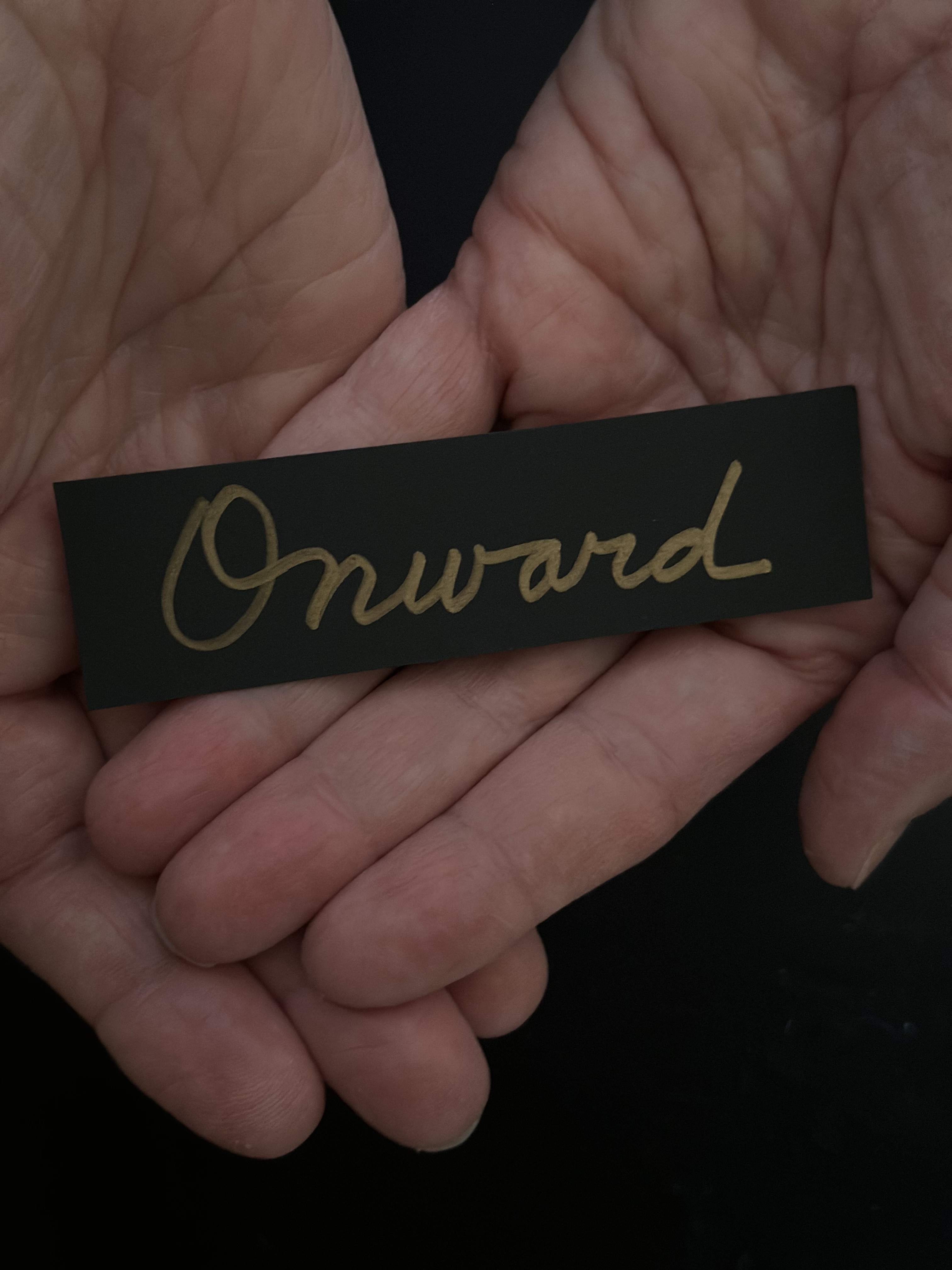
A shadorma poem is one with six lines, in this syllable sequence: 3/5/3/3/7/5. My One Little Word (OLW) of 2026 is Onward!
Onward!
what we bring
into this new year
depends on
what is worth
keeping ~ and having the strength
to let the rest go

Patchwork Prose and Verse
Years ago, Ali Edwards challenged a growing following of folks to choose ONE LITTLE WORD to take with them through the year as a sort of guiding light or inspiration. 2026 will be my fifth year of choosing a word to walk through the year with me. In 2022, my One Little Word was listen. I learned so much that year holding that one word that for 2023, I kept the same word again – listen. In 2024, I chose pray. In 2025, I chose enough – and life has had its way of showing me some ironic twists on that word.
There is power in words – a strange magic. There is killing and healing and nurturing and reassurance and hope. There are dreams and hard realities, wishes and escapes and triumphs and failures. What I’ve learned by choosing my One Little Word is to choose it carefully – because it has its way of revealing its truths and meaning in ways I never expected. This is not just some flippant exercise where people string some letters together and leash them like a stray dog to drag into a new year, hoping the mystery of the universe will reveal itself. I had no way of knowing last year at this time, as I had finished cleaning out a house and barn in 2024 with the dream of getting our belongings down to just “enough,” that Dad would die smack-dab in the middle of 2025, leaving a lot of loose ends untied, including a house and seven storage rooms filled with a lifetime of more than enough. Since June, the weight of these things and their encumbrance has felt anchoring – and not in a healthy or freeing way. There is still much to be done in the two-steps-forward, one-step-back dance of getting rid of things…..and of letting things go (and there is a difference). It takes time, but the important thing is getting through it. Thank God for my brother and sister-in-law, who have saddled the horse and taken the reins. No pun intended.
How does anyone choose a word? Do I choose a word I need to do, like listen or pray? Do I choose a word I want to do, like read or travel? I believe in verbs. They’re actionable.
Enough was another story, though. This word functions as adjective (enough food), adverb (tall enough), pronoun (have you had enough?), noun (there is enough for everyone), and even as an interjection (Enough!). It all depends on the placement of the word in the sentence. But enough does not function as a verb. It’s the most passive word I’ve chosen as a One Little Word (OLW).
So how? How do I pick one word? Am I overthinking all of this? I need to pray, to listen, to do, to plan, to act, to forgive, to express, to read, to write, to diet, to focus, to breathe, to rest, to exercise, to clean, to laugh, to cry, to grieve and to smile. I want just enough, not too much, and not too little. I feel like a character in a cartoon on a journey standing at one of those signs with a thousand arrows in all directions, not sure of which way to go but feeling packed and ready, map of possibilities in full color in the side of my bag, but there is this ball and chain around my ankle. I simply need to get in motion. To amble, to saunter, to skip, to run, to perambulate, to jump, to not sit still, to not stand by, to take action on movement, to leap, to walk. To go in some direction. Onward.
Onward.
Here’s a word to get me through days, through meetings, through books, through situations, through decisions. Momentum to keep turning the pages, to forge ahead into new experiences and new chapters.
Onward.
It’s an adjective, an adverb, and can be an interjection. It keeps moving in a direction, not standing still or getting stagnant, pressing on but not missing the important moments, either – just not getting bogged down and feeling like my wheels are stuck in the mud.
Onward.
Not necessarily forward or backward, upward or downward but whichever direction seems best to choose. Like bedward at 9:00 p.m. Onward, toward or at a point ahead in time or space.
Onward.
For the last six months of 2025, I’ve felt anchored by the weight of belongings and random antiques and collectibles that were not my acquisitions. I’ve felt handcuffed in the anger and sadness of grief. It’s time to cut it loose…..to let it go…..to move….
Onward.
Hermit Crab Poem
Today our hosts for the second day of the August Open Write are Margaret Simon of Louisiana and Molly Hagan of Maine. The Open Write is a place for educators to nurture their writing lives and to advocate for writing poetry in community. We gather every month and daily in April to write together and to share our thoughts on the poems that are born of our shared prompts. Today’s prompt can be read in full here.
My friend Margaret lives on the Bayou Teche in Louisiana. She and I made a presentation at the Faye B. Kaigler Children’s Book Festival at the University of Southern Mississippi in Hattiesburg last April to share prompts from a book we wrote with our writing group – Words that Mend. She writes a blog regularly at http://reflectionsontheteche.com. Molly lives in an old red house, on top of a hill, in a small town in mid-coast Maine. She blogs regularly at www.nixthecomfortzone.com.
These friends inspire us to write Hermit Crab poems today.
They explain: “Hermit crabs are known for creating inventive homes in all sorts of surprising spaces and containers. As writers, we can use the containers of other types of writing to form inventive poetry!” A hermit crab poem takes on another existing form, such as recipes, glossaries, quizzes, applications, etc.
I chose an Amazon Review for my Hermit Crab Poem. I spend time there whenever I’m about to buy a product and thought of how apt it would be to combine the book The Gift of Nothing and an Amazon Review only without the book part. First thing: Pull some of my old Amazon Reviews off of Amazon. I’m sharing them below:
Reviewed in the United States on December 7, 2024
I don’t usually have such luck with earbuds. They don’t stay in my ears, most of them. These have the ear hooks so that they don’t have to shove all the way in to be effective. I can even wear them with my glasses. And the charge life is unreal – it lasts for weeks.
Reviewed in the United States on December 7, 2024
Size: 7.5Color: CharcoalVerified Purchase
I have them in every color. On my feet all day, I find comfort in these shoes that offer support and traction. Having them in every color takes the guesswork out of what to wear. It may seem boring, but there is a lot of reliability in a dependable shoe that doesn’t rub blisters and offers enough support and comfort to get through the long work days.
5.0 out of 5 stars Perfect comfort
Reviewed in the United States on December 7, 2024Size: 7.5Color: Obsidian Verified Purchase
You can’t ever go wrong with a pair of Tevas. They are like a little cloud of heaven to walk on.
Next, I took some of my actual words from these reviews and applied them to a review for Nothing in a prose poem review-style fashion. Here is my Hermit Crab poem, Amazon review style in a prose poem:
5.0 out of 5 stars: Nothing
I give nothing five out of five stars. It comes in every color and brings traction and support. It may seem boring, but there is reliability and dependability in nothing to get me through those long work days. Nothing is something that doesn’t have to get shoved in to be effective – it works with or without glasses, and the charge is unreal – – it lasts forever, practically! You can’t go wrong with nothing – it’s like a little cloud of heaven, and exactly what we’ll all take when we go there one day. So think ahead: get your nothing today – you will be glad you did!
Mary Lee Hahn of Ohio is our host today for the first day of the August Open Write at http://www.ethicalela.com. She inspires us to write an acrostic poem. You can read her full prompt here.
My One Little Word this year is enough. With the recent loss of my father, a collector who kept everything he ever owned and left seven storage rooms and a house full of “collectible” treasures, my brother and I (both minimalists by choice) are using this word – enough– on a daily basis. We’ve had enough! When is enough enough?? So I chose enough as my word for my acrostic.
Enough
Even
Nothingness
Offers
Us
Generous
Harmony

they’re everywhere, these fairies
sprites, gnomes, pixies, elves, imps
even leprechauns
a whole aisle in Ace Garden Center
devoted to miniature magicians
and I’m in trouble, I know
I need to get out of this place
at least off this aisle
because nothing thrills me
more than a fairy garden
and I might spend too much
so I buy two spider plants
the best plants for
improving sleep
for clean air in homes
and leave the fairies
for now….but
I may be back this afternoon
for some of them
who seem to want
to live in my plants
on the front porch
with the others
especially this one leprechaun
who whispers that
he can’t be left homeless
this month, says he knows
I have a shamrock
and promises extra good luck
if he can come join my wonderland
of fairies in my porch plants~
friends of his, he claims
then springs up to my shoulder
murmurs in my ear a well-known
fact: I know your weakness
…..your one little word doesn’t
work on fairies.….
you can never have enough
yes, I’m deep in fairy trouble
because I’ll be back

Unexpected kindnesses can happen anytime, in the most needed ways. A couple of weeks ago, fellow slicer and friend Barb Edler of Iowa reached out to see if I wanted to be part of a small group she was putting together for The Stafford Challenge of daily writers in our second year of writing a poem a day for one full year. Each of us writes in three common writing groups and have met in person to make presentations at NCTE. We keep in touch, and I’ve often thought that my friends in the midwest and west coast and I share deeper connections than friends sitting next to me each day at work – – because we share the bond of kinship through writing. And I’m so thankful for this, because along with Denise Krebs and Glenda Funk, we found we were kindred spirits all seeming to need a lift right about now. Each of us shared a poem via Zoom that we’ve written recently and found a common thread – a numbness, disbelief, sadness about what is happening in our world with its shocking politics, heartbreaking plane crashes, and other woeful wreckage.
There are no words to capture the deep feeling of comfort that comes when you sit with friends, near or far, with a cup of tea and spend time sharing writing. I’m thanking each of you today, because that’s what slicing does, too. It brings us together to share what is foremost on our minds and hearts and keeps us in touch with what is going on in our lives across the globe. I love having my gardening friends, my RV bloggers, my travel buddies, my fellow grandmothers who share amazing ideas, fellow readers and birdwatchers and more. Thank you for being a writer in my life.
I’m sharing my tricube (three stanzas, three lines per stanza, three syllables per line) that I shared last night (below). I’m also making plans for March slicing – – I’ve sectioned out the waking hours of a typical day, and I plan to write a poem for every 31-minute time slot about something happening during that time, just to feel the real-lifeness of each moment, just because there can be deep comfort in things as simple as stirring honey into a cup of hot green tea and accepting that it’s okay not to want to read the tea leaves.

I don’t know
I don’t know
what to say
words fail me
I don’t know
what to do
verbs fail me
I don’t know
what to think
thoughts fail me

I never in a million years would have thought I’d want to move out of a traditional home with central heating and air conditioning into a metal barndominium with alternate sources of heating and cooling, but that is exactly the direction of our dreams – going from 2400 square feet to between 1200 and 1500 – half of the space we have now, only a much bigger workshop space for our cars, camper, and tractor. We started the journey a year ago, our 2024 full year’s mission to clean out the house, attics, and the barn. We’ve pared down to essentials (except for shoes, plants, and books) and have chosen a floor plan and a spot on the back of the farm. Now the task of actually putting the house on the market…….this is the plan for 2025…..to live in a camper while we build a much simpler home.
Here we go, about
to make the dream come alive
…..still biting my nails……

We put on our boots, grabbed machetes
took to the woods to find a spot
for a barndominium
bushwhacked through dense thickets
(probably have ticks)
he found the creek
I watched for
birds to
show
where
because
feathered friends
always know best
where to build a nest
to feel safe and secure
free as a gentle breeze
to come and go as we please
to have the whole world at our feet
in a downsized home, simple and neat

As I continue along the journey of my One Little Word for 2025, enough, I’ve been thinking lately about the stewardship of how I over-own things – do I selfishly trap them and call it collecting, or have I done my part by passing them along when they have lived their best life with me?
I think we all have a tendency to hoard things – to save a penny for a rainy day. But what happens when the collections have taken over our lives and the proverbial pennies are now quarters and dollars, anchoring us instead of freeing us? In 2023, I looked at all the boxes in the loft of our barn and in our attic and stepped back, taking it all in. I hung my head in shame at what I saw. It was like a graveyard of opportunity for still-useful items never seeing the light of day anymore, and I was the undertaker. I was the bad guy in the parable of the talents, burying the promise and potential of what had been entrusted to me. No, I have not been a good steward when it comes to things.
Once upon a time, I heard a saying shared by my father in a sermon. He reminded us all not to be those people who get all we can, can all we get, and sit on our can. At the end of 2023, I realized I’d been sitting on my can. And I needed to take action.
My grandparents grew up during The Great Depression, and learned about their stories when we would go visit them as my brother and I were growing up. My paternal grandparents lived in Waycross, Georgia, and they were the absolute King and Queen of double coupons. I learned a lot about frugality from them – about saving, about the concept of “enough,” and also about the disadvantages of too much. My grandmother clipped those coupons and looked for whatever was free – whether she had a plan to use it or not. At the heart of this was the need for protecting – for providing and provisioning the essential needs of a family, and I began in those days to understand the way that money could be stretched.
I used to hear the water come on, go off, come on, go off – – and years later, I realized that she showered that way. She got wet, turned off the water and lathered, turned it on and rinsed, and repeated. She double-couponed so much that they had an entire storage room of cereals and other dry goods. I was having a bowl of cereal on one visit when I noticed something moving in the milk. On close inspection, I was horrified to discover that I was eating bug swimmers. From that experience, I learned the importance of checking expiration dates.
But I also learned something else: the extreme effort on not wasting water did not transfer to the waste happening when the dry goods spoiled before they could be used. Sufficiency seemed at odds between having too little and having too much – and there are problems on both ends of that spectrum when we forget the importance of fine-tuning our needs to the middle ground of enough.
All this examining things and re-calibrating my mindset about the things I’d accumulated made me think of a childhood story that my mother used to tell me. At one time in my life, I was an aim-to-please rule following preacher’s kid who, in my young child voice, would ask my mother, “Did I bees good?” whenever the stringent need for good behavior in church or at some event, visit, or outing was over and done and I was needing my recognition and report card on my efforts. Likely, I was ready to get back to business as usual with a little badness kicked into gear and let go of the need for my best behavior.
But as I looked at all the things I was holding hostage in my barn and attic, I wanted to re-ask that question through a different lens: Did I bees a good steward of things?
Nearing 60 with retirement dreams of lightening the load to ease the way for RV travel and a significantly downsized house in the near future, I began a quest last year to clean out our home and attic and purge the anchoring cargo of a lifetime of teaching and boxes of mementos and sentiments that have outlived their purpose in my life. It’s time to prepare for the next chapter – whatever that may be. No one can move forward who is so heavily anchored in the past.
I have a question:
Did I bees a good steward of things?
Or did I hoard them?
I read a game-changing book in 2024 by Robin Wall Kimmerer, entitled Braiding Sweetgrass. At several times throughout the book, I found myself silently weeping tears for all of the boxing of things I have done in my life. As I turned the pages of that book, I imagined the life involved in all these items – the trees that once stood tall in the forest sheltering nests of woodland critters – trees that gave their lives to become books and furniture and toys; the plants that yielded cotton and other fibers to become linens and towels and clothes; the hands of craftsmen and seamstresses who shaped the creation of each thing. I was gobsmacked.
In the first month of 2025, I finished Kimmerer’s most recent book, The Serviceberry, in which she discusses the ethics of reciprocity in a gift economy. Abundance and gratitude are at their purest when we understand the concepts of the gift economy as opposed to the market economy. There is life-changing magic in the mindset and understanding that the notions of self-sufficiency and hoarding are at odds with our values and people we hold dear – and may actually be harming them. Her essay that summarizes the main concepts in her book is available here, but I offer this warning: be ready for a seismic shift in your thinking once you read it. It tops any sermon I’ve ever heard on Matthew 6:26, and ironically, birds are at the heart of the Bible verse and at the heart of The Serviceberry.
It begs the cyclical question at the end of each day, each week, each month of striving to live in a more simplistic and abundant way: did I bees good? And at the end of 2024, I could finally say that I’ve moved from being a failing steward of accumulated things to passing with a C. I still have a way to go, but I’m doing the work of managing the mountain by keeping my One Little Word front and center. I don’t buy the extra tube of toothpaste just because it’s on sale – – because I have enough. I leave some for others, and I leave room for honoring the uncluttered spaces and the sense of order. And I can feel it.