
Each month, as part of The Stafford Challenge writing group led by Brian Rohr of Portland, Oregon, I look forward to the virtual writing workshops and visits with poets. Earlier this month, Melissa Helton, Director of Literary Arts at the Hindman Settlement School in rural Appalachia, offered a bonus writing workshop in which she shared several of her favorite poets, their poems, and prompts to inspire us to write our own poems. For the next few days, I’ll share the way she presented the information and the way she led attendees to write poetry using mentor poems.
When we arrived in the session, Brian introduced Melissa, who took us on an exploration of four poets by briefly sharing a little about each. Then, she shared a poem that had stuck with her. She read a single poem by each writer and then gave a prompt, inviting us to write our own poems.
One poet was Frank Walker, who wrote the poem Affrilachia on race and cultural identity. After reading this poem aloud, Melissa invited us to write to this prompt: make a list of all the groups with whom you identify, such as churches, hobbyists, sports, regional affiliates, etc. Then, pick two and write about what it’s like in the intersection where two things are an unlikely crosspoint. I thought of the ancient Chinese game of Mahjong, which I have recently begun playing, and how it has now become Americanized and even theme-based.
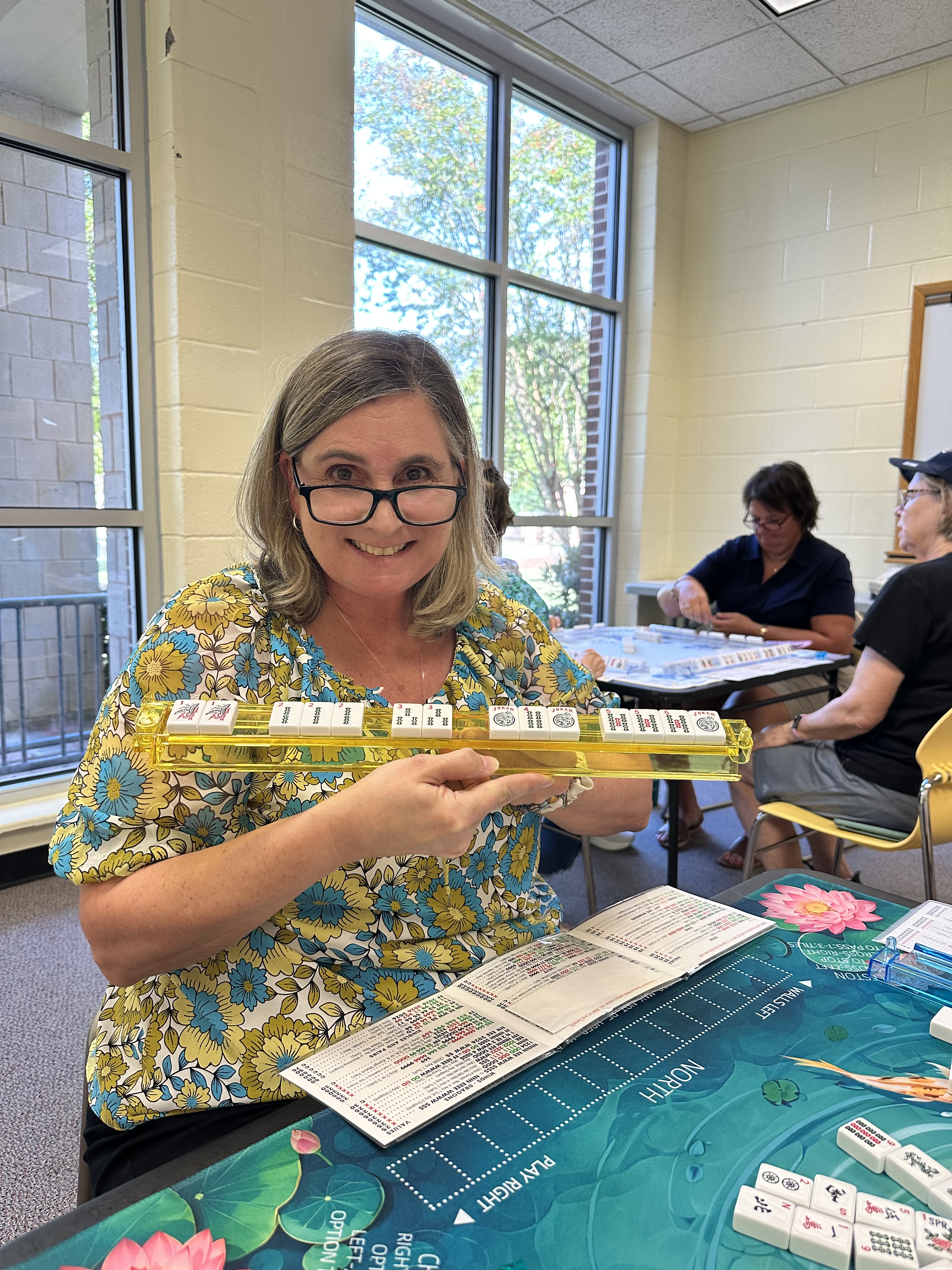
Mahjong’ing in Georgia
it’s not just traditional ancient Chinese
Mahjong anymore ~
it’s modern Americanized
even Christmas’ed and Halloween’ed
but you can still pick
your game version
your year
your card
your neighborhood
your street
sit with your friends on a
2026 or 13579 or 2468
even a consecutive run
or quints
or winds and dragons
to the theme of coastal vibes
with lobster crack dragons
or garden themes
with butterfly jokers
and western themes
with cactus bams
Native American themes
with corn kernel dots
and these winds of change
(dreamcatchers)
just keep coming,
and dot dot dot
dot dot dot
all these dot peaches
here in the heart of Georgia


Kim, your poem is a perfect intersection poem for the two versions of Mahjong AND the vast variety of themed tiles! Wait until you play Chinese Mahjong…it’s so simple compared to the American rules! I like them both!
LikeLiked by 1 person
Debbie Lynn, I do hope to play the Chinese version once I have played this way awhile. A lady came to the group the other day and mentioned how much she also loves Chinese Mahjong (it’s so much easier, she assured us all). I remember that you shared that groups are welcoming when you have traveled. So when I went to the mountains this past week, I found a group in Blairsville, Georgia and discovered the same. They welcomed me and even let me pick a tiny seal to go with my little duck from the trinket box when I mahjong’ed. I can’t wait to learn even more variations. Currently, I’m attempting mastering Messy Mahjong so I can play alone or with up to 4 in case our table isn’t full. Thanks for reading!
LikeLike
I love reading about your new Mahjong journey and seeing the same excitement in you that I have for the game. I actually enjoy Messy Mahjong when there are less than 4 players. I met a lady at the welcome center where I stayed this summer and asked if she knew where I could play. She directed me to the senior center and then asked if I would teach her and her friend…and thus, two new friends were born! I now know several ladies in that town and look forward to my return next summer. 🙂 Mahj…On, Kim!
LikeLiked by 1 person
Thank you for sharing about playing in other places! Because I’d remembered you writing that in a comment, I reached out to someone in a nearby town while we were camping and found out that a group played each Wednesday afternoon at their subdivision clubhouse, and they invited me to play. You are right – – I felt very welcome as a visiting player. Thanks for sharing your experience – – I would have never thought to reach out if it hadn’t been for you!
LikeLiked by 1 person