
It’s the 4th day of the 19th Annual Slice of Life Challenge at Two Writing Teachers’ website, and I love starting my day with posts shared by writers across the globe who offer a glimpse into their daily lives. This month, I’m featuring a living poet each day and creating a Cento poem from the poems in their collections. You can read more about Cento poetry here. Today, I’m featuring Sandra Cisneros as an author I have long admired for her short stories. She’s also a poet! You can read more about Sandra Cisneros at her website. Here writing themes offer a glimpse of her cultural heritage. Im using Woman Without Shame to inspire a cento.
I’m adding an additional step-by-step photo process to my post today, since a couple of readers reached out wanting to know more about my process for writing Cento poems – and teaching students to write them. I’ll share in photos why even the most reluctant writer in your class might catch a case of poetry fever – without ever lifting a pencil.
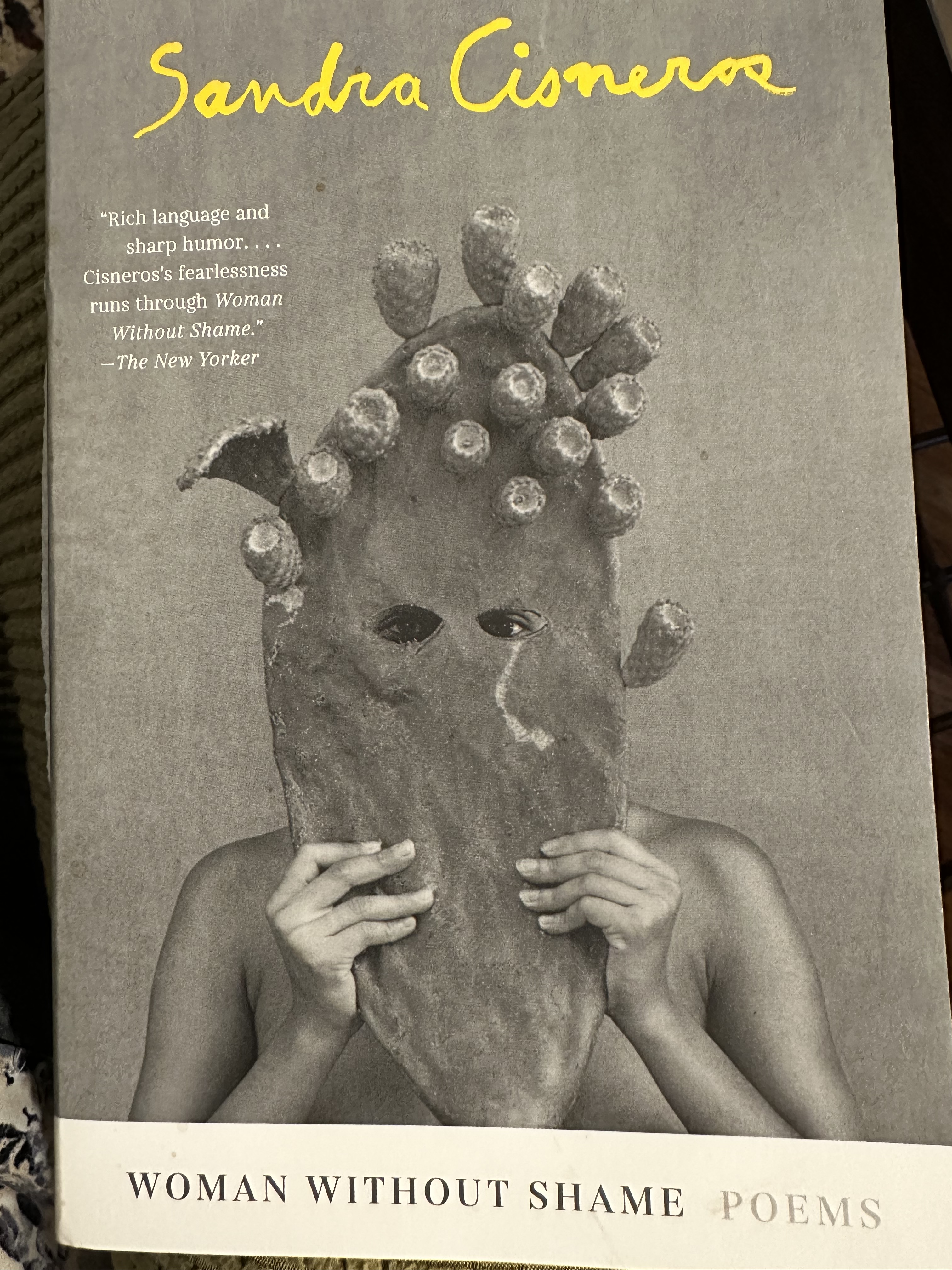
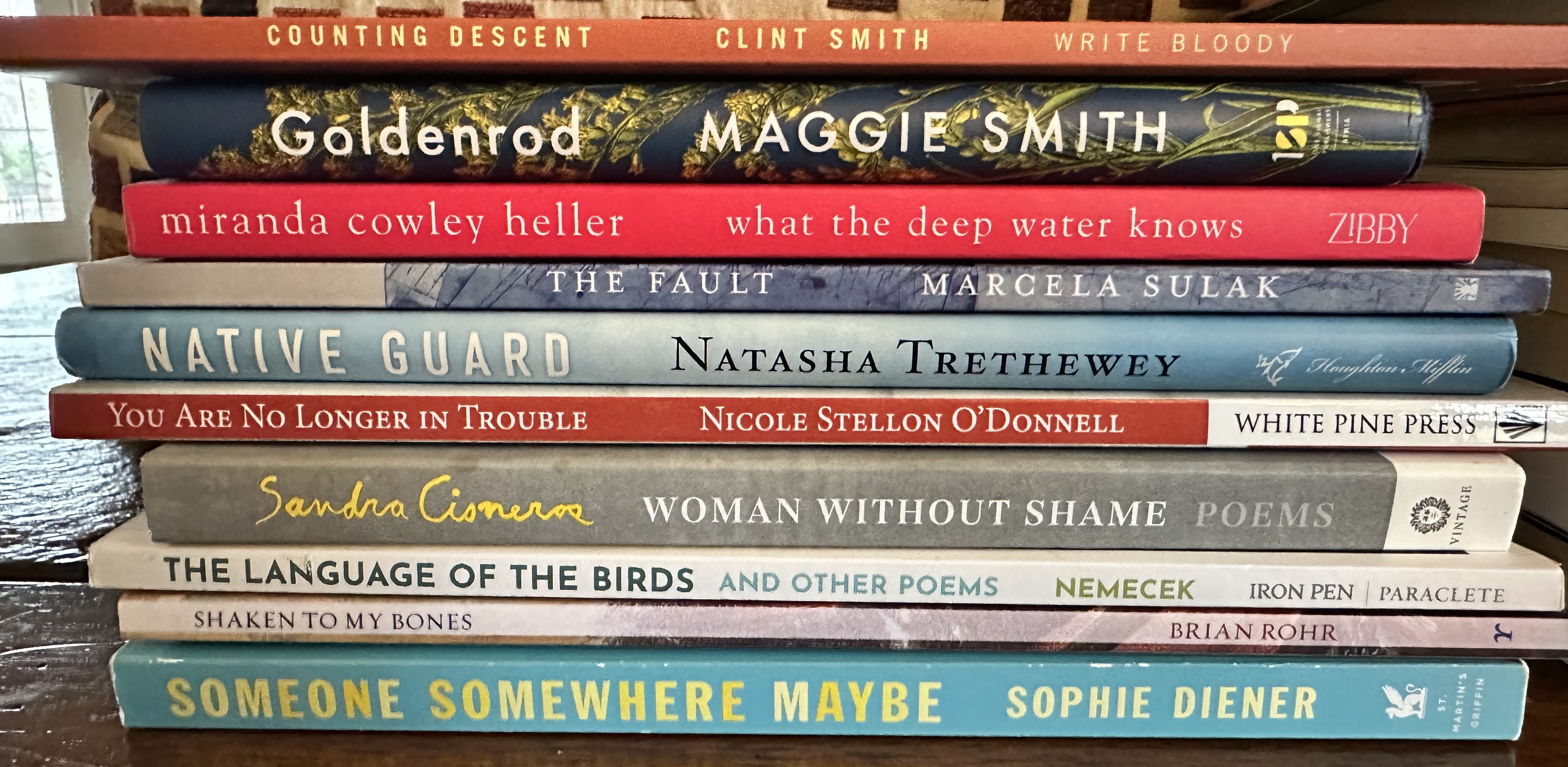
Start with a favorite poetry book – or a stack of them.. Today, I used this one.
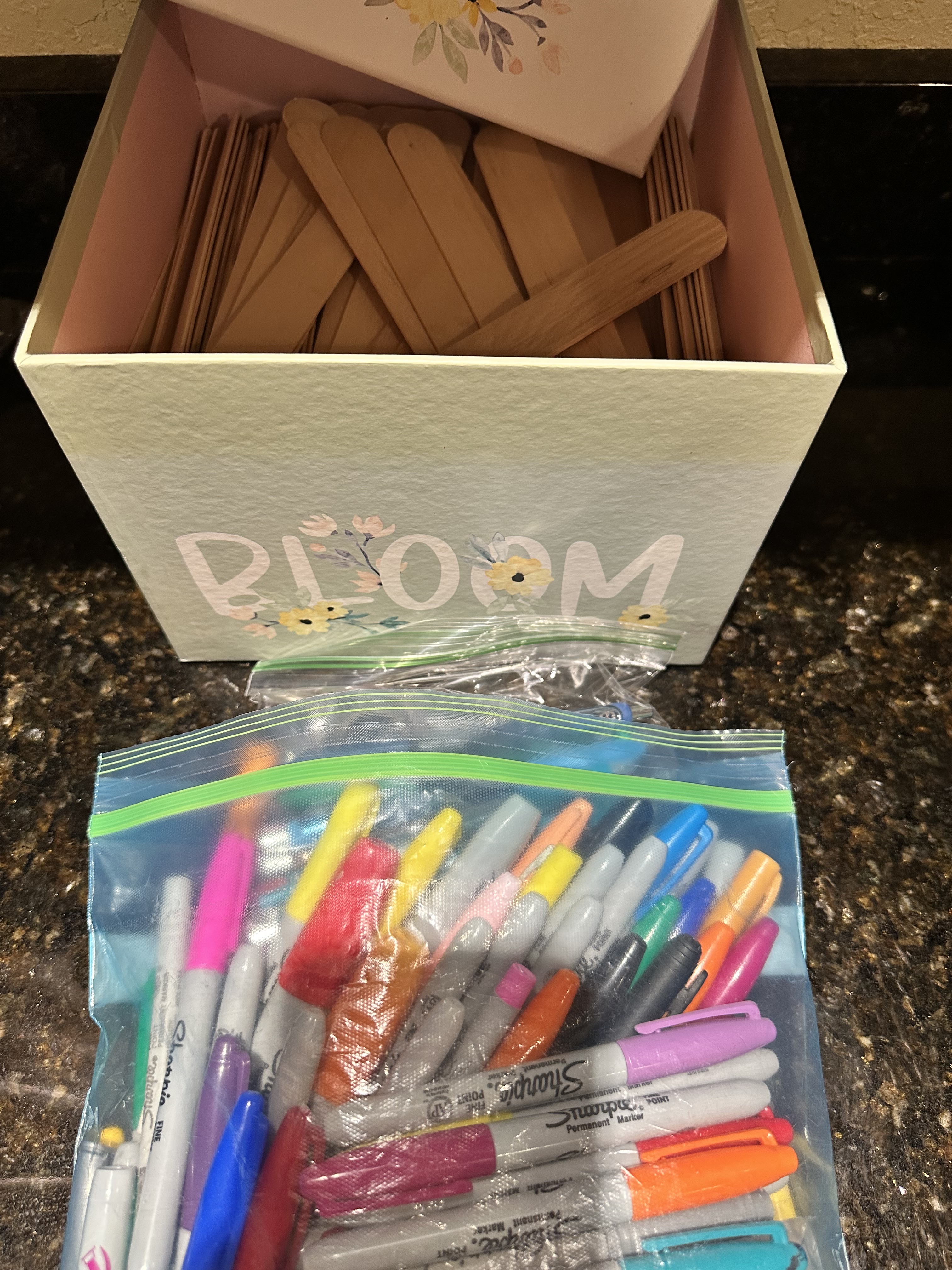
Next, gather some blank tongue depressors and a variety of Sharpie markers.
At this point, it’s not too late to turn back. This kind of poetry is highly contagious, and once it settles into your soul, you can’t escape.
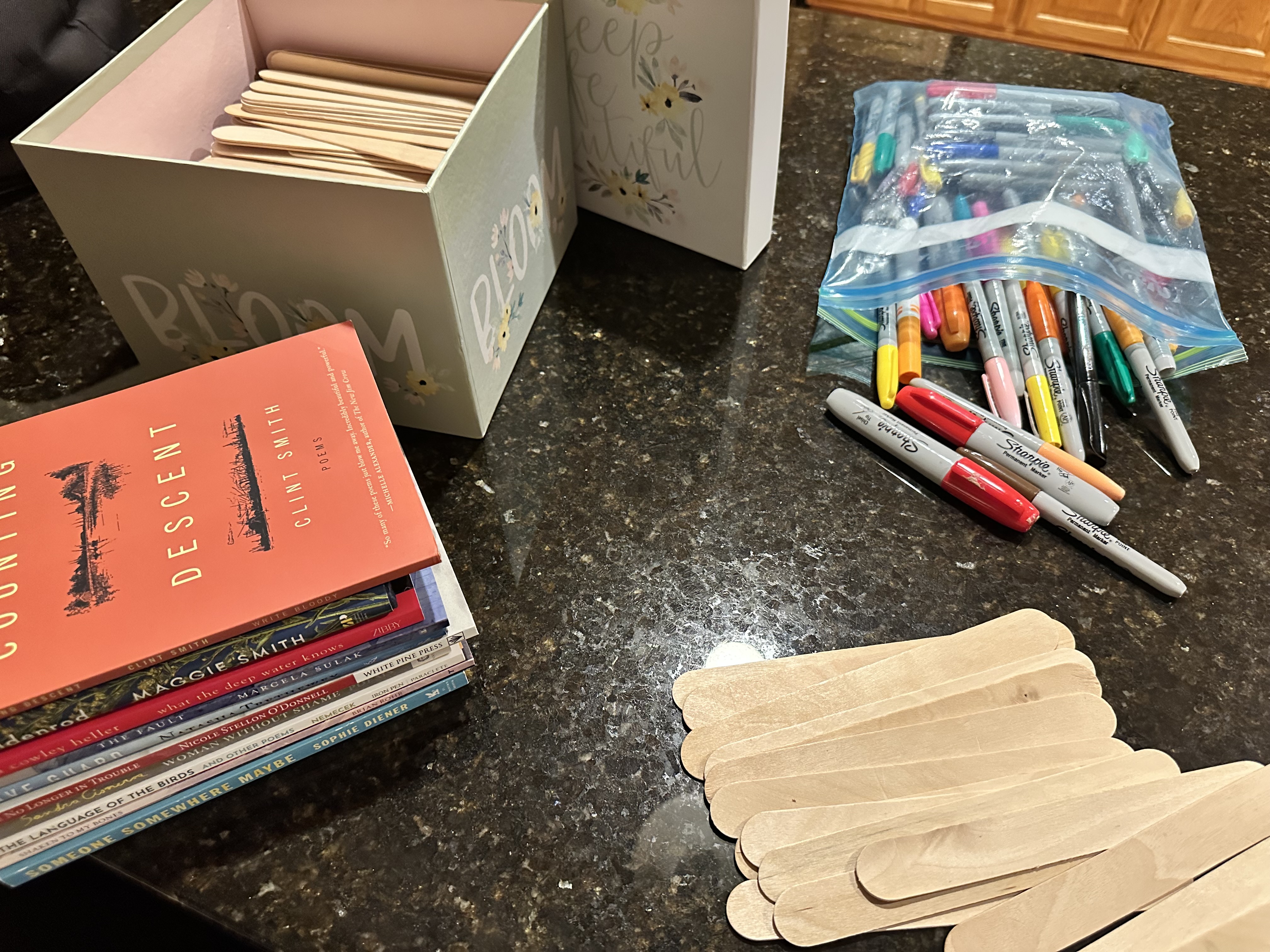
But now that you have come this far, begin choosing favorite or random lines of poetry and writing the line on one side of the tongue depressor and the title of the poem and the poet’s name on the other.
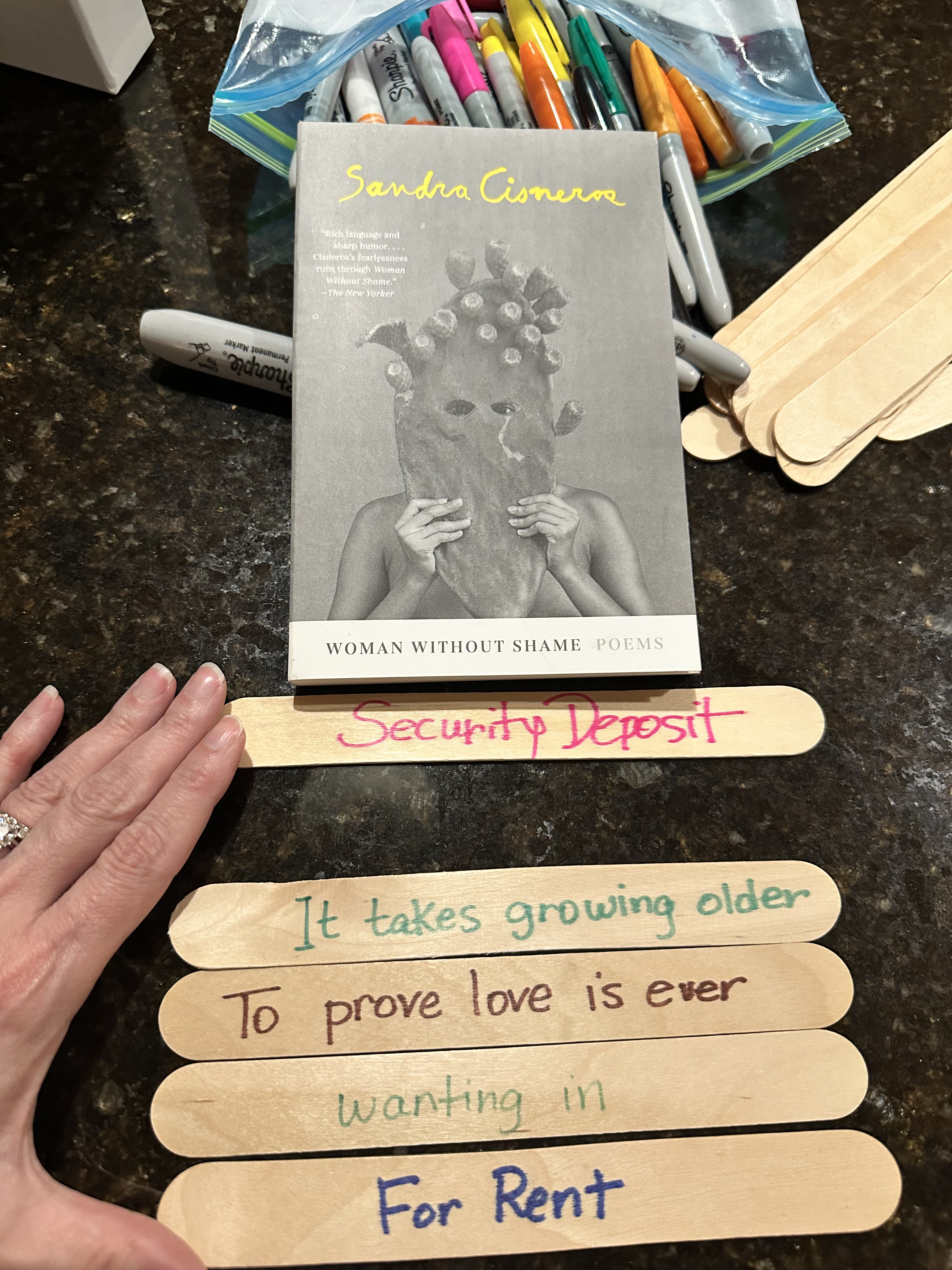
Once you have a bank of lines, arrange them and rearrange them until you find the sweet spot of the poem the way you like it. Moving the sticks around, you’ll see how just one move changes everything – like a game of chess. But once you have it, you’ll know. At that point, add a title. In the illustration above, I titled mine “Security Deposit.”
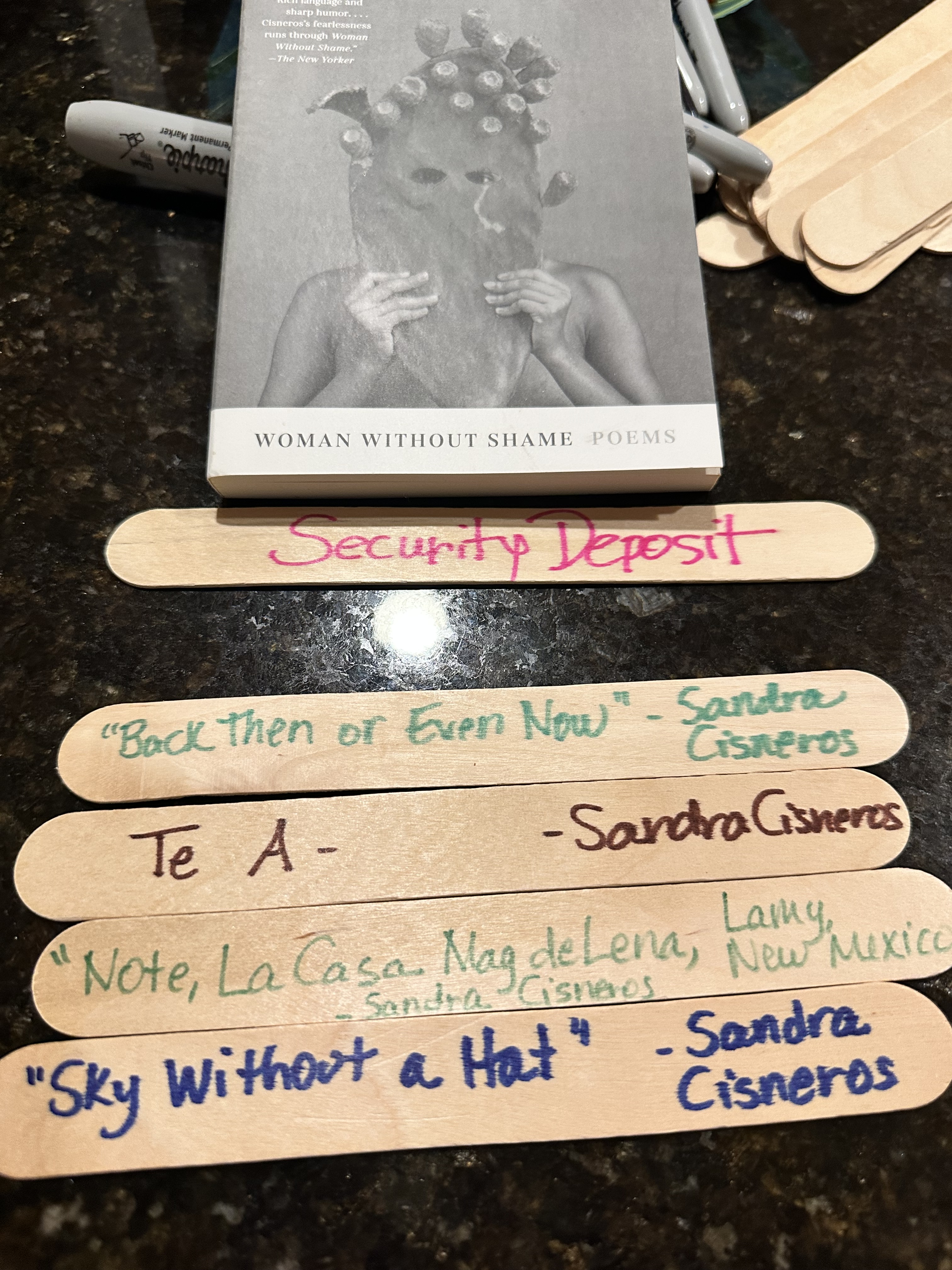
Take a photo of the lines, and then – – very important – – flip them in order from top to bottom so that the poet is credited and the line order is preserved by poem title. Take a photo of the back, too, emphasizing to students that this credits the original poet.
If you don’t have tongue depressors, you can use strips of paper or cardstock. Or just write it out, like this:
Security Deposit
It takes growing older
To prove love is ever
wanting in
For Rent.
My Cento is taken from lines in these poems, in this order: Back Then or Even Now; Te A-; Note, La Casa Mag de lena, Lamy, New Mex; Sky Without a Hat.
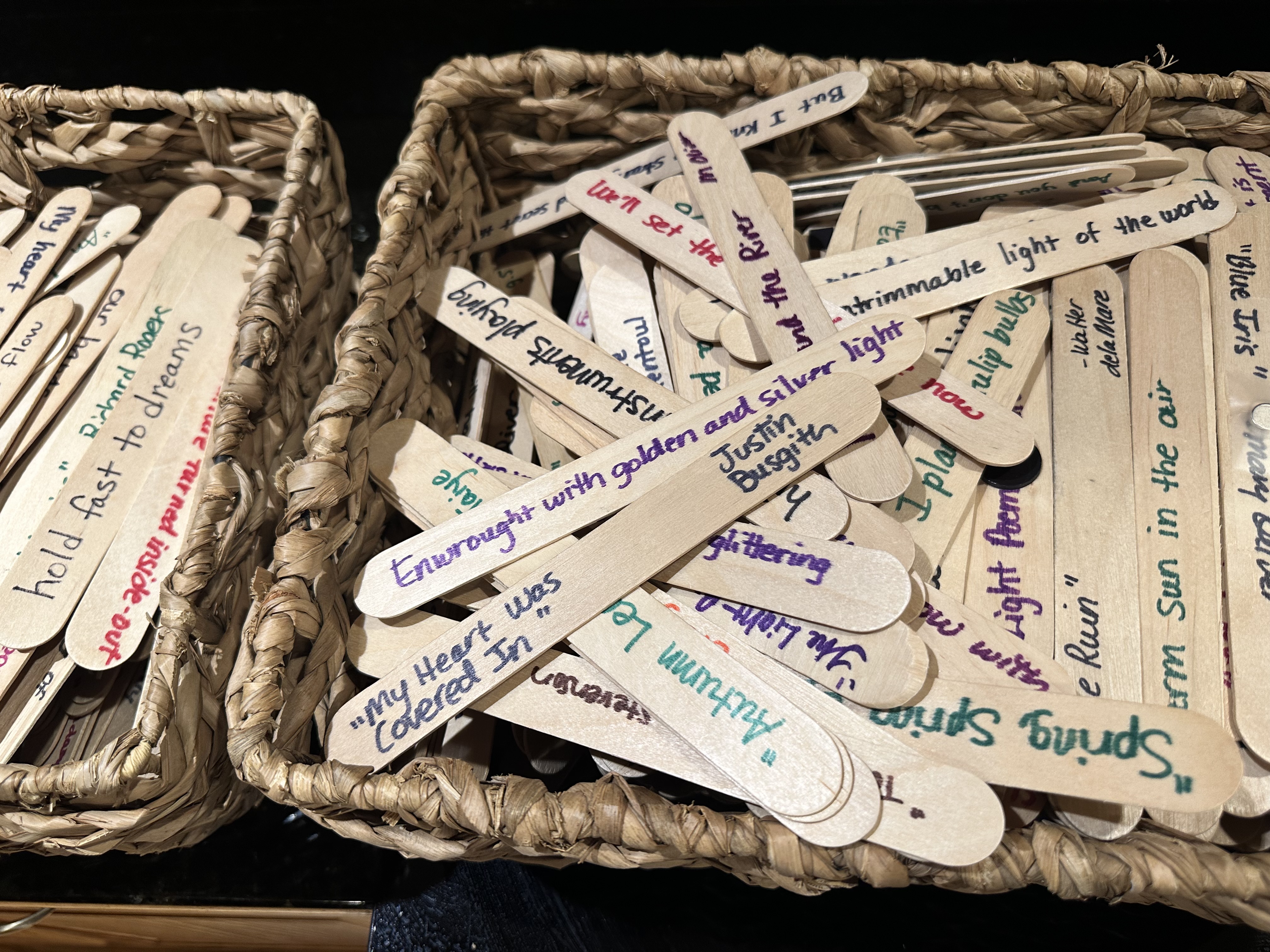
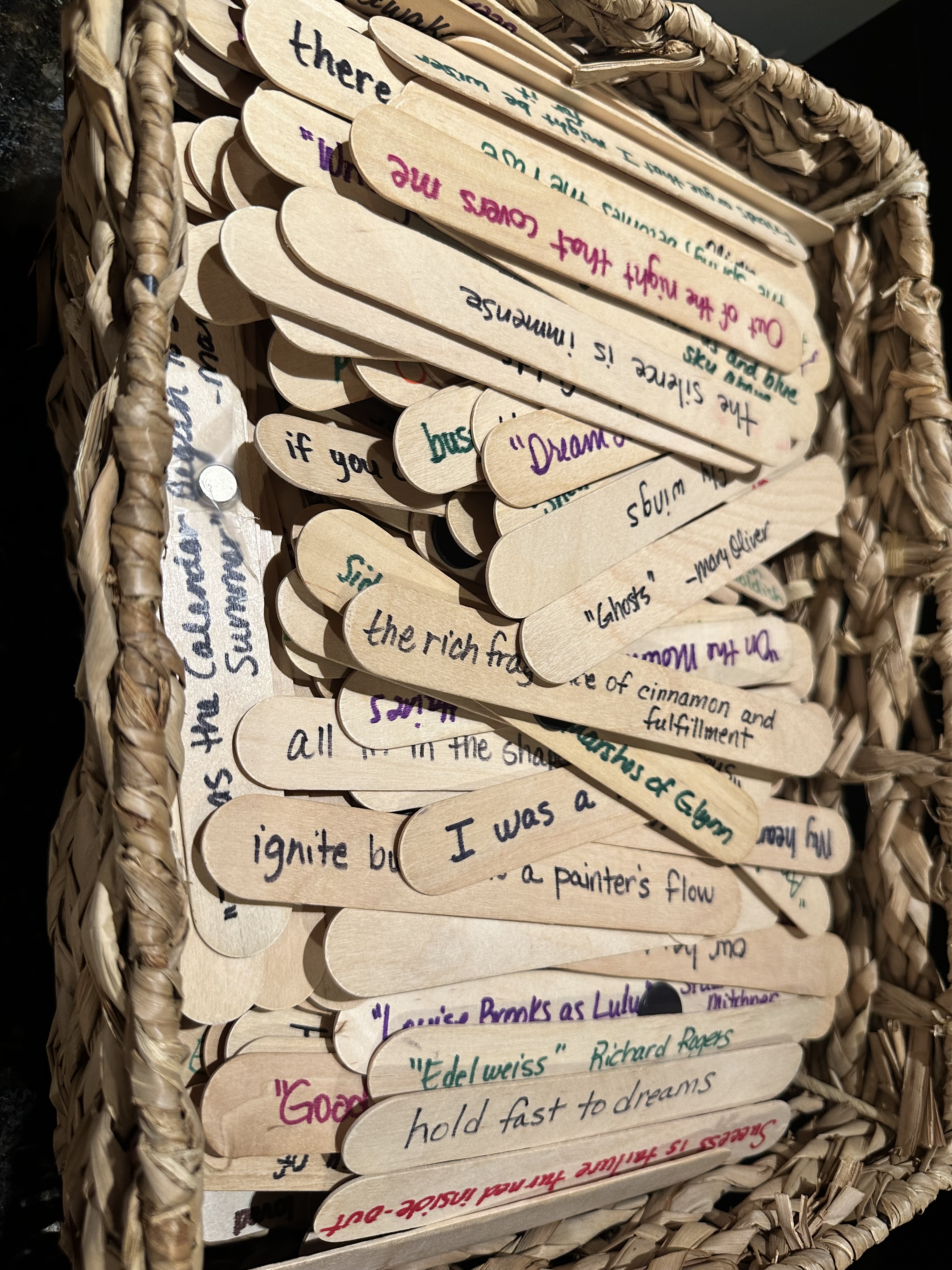
Once the contagion has set in, you’ll soon have baskets and baskets of poetry lines. You may even decide to put magnets on the backs of them so students can use cookie sheets or magnetic boards as pop-up poetry stations. You might even find that you create collections to organize by theme of units or poets of a particular era. The possibilities are endless. Don’t be surprised if students themselves start checking out poetry books and asking to add lines to the bank of sticks. You may want to keep a healthy stock of supplies – because this will grow and grow and grow until you have a Poetry Wonderland of lines growing like kudzu vines!
Students will beg you to let them write poetry, and you can create a community Padlet for them to upload their poems by scanning a QR code to upload pictures of their poems in sticks.
They will do this because they are now poets who can’t wait to share their creations.


 Common Threads
this is SO cool, I love this. My ELD classes will likely have poetry units in the spring and this is such a neat visual, thanks for sharing!!!!
LikeLiked by 1 person
Thanks for reading, and I love the way poetry speaks in the springtime!
LikeLike
Your Cento poetry lesson makes me wish I was back in the classroom so I could share this idea with my students. I will give it a try myself, though. Thanks for sharing the steps. 🙂
LikeLiked by 1 person
Debbie Lynn, here’s the funniest part: I left the classroom in 2017 but I took my poetry sticks so I can use them at home – – and I go back into classrooms just to write poetry with teachers who want me to come in to write with their students. I couldn’t give up my sticks! 🙂
LikeLike
Oh my gosh, I love it! One, that you are retired and took some of your favorite resources, but especially Two, that you go back into the class to teach your love, poetry. 🙂
LikeLiked by 1 person
Actually, I’m not retired…..yet…..still working on that, but I do work in the system in a position that allows me to visit classrooms.
LikeLike
Kim, this is a really great idea for those “reluctant” to put pen to paper! Even if you don’t put them into one poem, you could create a collection and “pull” just one or two as seed ideas for poems. Thanks, lots
LikeLiked by 1 person
Anita, thanks! Yes, the sticks can be used as starter kits : seed- starting poems. Or endings. Or magic wands.
LikeLike
Thank you! for the poem and the idea itself. The fourth graders in our school are writing poetry right now. I think this will be great to share. Have you done Counting Descent yet.? I know I could look. I’ll check back
LikeLiked by 1 person
I would love to see what fourth grade does! Counting Descent will be Day 10 – I love Clint Smith, and his whole collection is so moving.
LikeLiked by 1 person
Kim, thanks for planting this seed. I have poetry books and a bag of sharpie markers. Now, I will gather the craft sticks and be on my way to use this with students. Thanks!!
LikeLiked by 1 person
Thanks, Julie! I would love to see what they create!
LikeLike
This is so awesome! I wish I’d known about this type of poetry when I taught poetry units. I can definitely see how addictive this would be for students — how “easy” it may seem, but how much thought and work is going into it!
I loved this line: “This kind of poetry is highly contagious, and once it settles into your soul, you can’t escape.”
LikeLiked by 1 person
Thank you, Amy! I think the creativity and the cerebral energy ignite a part of the brain that charges students and gets them into deep reflection mode. Thanks for reading and commenting!
LikeLiked by 1 person
WOW!!! As I read your stpes, I thought how this is so filled with PLAY! I am heading to the craft store for sticks and will definitely give this a try. And you are right – no paper and pencil is needed. Just time to play with published poetry books, flairs and sticks! Thanks for sharing the step by step!
LikeLiked by 1 person
Sally, thanks so much! The younger the students, I observe the more they “discover” their poems. The older ones tend to do more thinking about the arrangement and changing things around. Enjoy!
LikeLike
Thanks for the process! So much easier than I thought. Tongue depressors are teachers’ friends.
LikeLiked by 1 person
Yes Margaret, they sure are! Thanks so much!
LikeLike
What a fun way to “poetry”! I’m taking this to my grown up poetry group!
LikeLiked by 1 person
Diane, I hope they love it as much as I do. You’d think this idea appealed just to students, but it’s as much fun for adults!
LikeLike
Since I don’t have a classroom now either, I can’t do this with my own group of kids. But I am going to share it with some of my teacher friends. And, if they decide to use this, maybe they’ll need help on that day!
LikeLiked by 1 person
Linda, I push in as well where teachers invite, and I’m always so happy with the writing time!
LikeLike
Where was this idea when I was teaching. It’s fabulous and such a bonus for those students who don’t know where to start and do well with physical objects to aid them. Thanks, Kim. Your students are lucky to have you.
LikeLiked by 1 person
Rita, thank you so much! I enjoy going into classrooms to write poetry with students!
LikeLike
Oooo! I might try this with my Rilke poems. I think it would help in the construction process. Thank you!
LikeLiked by 1 person
Oh, Rilke would be amazing to do a Cento! I love it!
LikeLike
I never thought of using tongue depressors! Very cool and fun! Love your cento, too!
LikeLiked by 1 person
Thanks so much, Barb!
LikeLiked by 1 person
Oh, Kim! Thank you for sharing this cento alchemy! I hope you will link to it in all your future March posts, in case others missed it here today. Love, love, love all those huge baskets of sticks.
LikeLiked by 1 person
Thank you, Denise! I’ll try to link it in a few of the future ones!
LikeLiked by 1 person
Kim,
This is a fun, tactile project. Now you’ll have lines to mix and create lots of new poems w/ poets in conversation with one another. Another idea is to have students work i. groups w/ each randomly choosing a line and creating a skit w/ those lines. This works well w/ poetry that’s intimidating and less accessible to students than some contemporary poems.
LikeLiked by 1 person
I seem to remember being in an NCTE session with you where we acted out the WCW poem and recorded it in iMovie! What fun!
LikeLiked by 1 person
Thank you for sharing your “how-to.” And thank you for sharing the picture of each step. I will definitely use this strategy. I like how you keep track of matching the line chosen with the poet and poem. It takes a bit of time but it is important if you want to reuse a line to write a different poem. I like the craft sticks because they would be easier to handle and move around. And using baskets to store the sticks creates a great resource. I used a similar strategy to create a poem from my slice titles (“Slicing Titles Make a Poem” [2017]) and also to create a poem from blog names of slicers (“The Gossip of SOL17”).
LikeLiked by 1 person
Thank you, Alice! I love the blog slicer name idea!
LikeLike
Thank you! I love that you posted how you do this. Such an engaging way to create a poem!
LikeLiked by 1 person
Thank you so much!
LikeLike
This is such a cool idea! Thanks for sharing your process with us. Love your poem too by the way! I’m definitely adding this one to my toolbox.
LikeLiked by 1 person
Thank you so much!
LikeLike
Those tongue depressor pictures are gold! I love the idea of growing a collection of favorite lines together. Thanks for sharing your process.
LikeLiked by 1 person
Thank you, Molly!
LikeLike
Kim,
This is so fun! Will have to try this on my own or with my writing group since I no longer have easy access to students. I’m going to pass it on to some friends that are still teaching.
LikeLiked by 1 person
OMG! This is amazing Kim! I particularly like the move around possibilities. Now to see what this might look like with first graders…
LikeLiked by 1 person