A Calm Christmas: After Christmas

An easier 7 foot pencil tree

This December, I’m slowly making my way through Calm Christmas and a Happy New Year by Beth Kempton (2019), and in Part 3 starting in Chapter 7, she presents ways to preserve the quiet times by savoring the “hush.” She encourages time to reflect on Christmas and suggests ways to avoid stress during the week between Christmas and New Year’s Day.

I’m particularly excited for the moments of hush this year. My youngest daughter is scheduled to be induced two days after Christmas. She’s pregnant with her first child, a son, who will be named Silas. This gift of a new family member is the most precious gift of all, and while the moments of hush will be few and far between with the constant needs of an infant, the moments of watching a baby sleep will bring deep peace and joy. I plan to be there to celebrate the birth and get to know this new little one.

Indeed, a baby changes everything – especially at Christmas!

The relaxed pace of the week after Christmas affords down time for many, where the world takes a deep pause from work to play and spend time with family. Many businesses in our area are closed from Christmas until New Year’s Day. It’s the perfect time, Kempton writes, to take stock of your house, take mini-breaks, reflect on the past year and plan for the new, to write, and to engage in other creative projects. She encourages us to take a digital detox day by turning off all electronics and not checking email. In fact, she suggests that a day in nature is a great way to hit the reset button for deep thinking that is free of distraction. The chapter is loaded with specific ideas such as hibernating with hot chocolate, flipping mattresses, taking blankets outside to watch the moon and stars, taking mini-trips to local places such as museums or movies, and flying kites on the beach.

The week between Christmas is the best time to reflect on the past year, and to begin thinking about the One Little Word to guide the next year. I’ve loved the power of the word for the past several years, and while I’ve kept the word PRAY for the past two because I can find no better word, I will take a second word for next year because one is calling to me. I’ll keep PRAY as my guiding word, but there will be another that will travel with me through the year as well. I’ll think of them as the focal and diopter lenses on a camera. One big word, and then a refining word. More on this later.

Here are some questions Kempton urges us to consider for reflection between the week of Christmas and New Year’s Day:

When did you experience joy?

What was especially tiring?

What was magical?

What was calm?

Whose presence was challenging? a delight?

Which of your efforts were appreciated, and which felt like a waste of time or energy or money?

What was your single most favorite memory this Christmas?

Which preparations did you enjoy the most?

What would you like to do differently next Christmas?

I already know that putting up the smaller tree was a good move for us, given that I got sick before Christmas and battled an upper respiratory infection that left me fatigued. We were late putting up the tree and figured that since we would have minimal activity in our own home to celebrate, we didn’t want a lot of decorations. Still, we love the lights of a tree for ushering in Christmas Spirit first thing in the morning and in the evenings while we are home, so we pulled down the 7′ pre-lit pencil tree requiring no assembly rather than the 12′ pre-lit tree that goes up in three tiers and requires ladders and three full boxes of ornaments. And we are enjoying it just as much. It may be the new standard for us. Already, I’m not dreading having to “take down Christmas.” It’s simpler this year, and it feels more manageable, allowing me to look forward to less work in the aftermath of the holidays.

And there will be fresh. pumpkin bread, a treat I reserve for Thanksgiving and Christmas and that has been the trademark bread in my home since the mid-1980s when I got the recipe from a cookbook at a bridal shower. Everyone loves this recipe, and I’ll link the recipe here.

Try a loaf for your family. Have a cup of coffee by the tree in the early morning with dogs piled in your lap next to the fireplace, and feel the comfort and warmth of fresh bread before the rest of the household rises. It’s a magical treat.

A Calm Christmas: Honoring the Melancholy

Photo by Julia Ustinova on Pexels.com

This December, I’m slowly making my way through Calm Christmas and a Happy New Year by Beth Kempton (2020), and in Chapter 6, she presents ways to honor the melancholy – reaching out with invitations, volunteering, and setting a place at an empty chair can be forms of honoring those we have lost or sadnesses we acknowledge. She urges us to reach out to others, whether we feel up or whether we feel down. Either way, we combat the loneliness and sadness when we feel this sense of purpose and connection.

I saw a meme last week. It said, “I agree with keeping Christ in Christmas, but I’d prefer it if we could keep Christ in Christians.” And I nodded in wholehearted agreement. All too often, I hear people grumble about helping the needy, reasoning that they will only spend the money on drugs or alcohol.

There are ways of meeting specific needs without unknowingly contributing to another’s addiction, though. I have made a practice of keeping some spare change and dollar bills handy in my pocket for the seasonal charity bell ringers, but I also enjoy keeping gift cards to local fast food restaurants as well – for those who are hungry. I feel a sense of responsibility to give, and assurance knowing that the need that will be met is hunger – – not a way to drown problems in alcohol or running the risk of making a situation worse for any children who may be dependent on the person receiving the assistance.

There are ways to make a difference in small increments, and even if the goal is to help one or two people a week, that is a step in the right direction – at least for me.

That is why I couldn’t get peace while drinking my seasonal peppermint milkshake in Chick-Fil-A last night. We’d gone to have a bowl of chicken soup for supper, and I’d noticed an older lady wheeling a full-size suitcase up to a table before getting in line to buy food. She’d spoken to an older gentleman and gestured to her suitcase, so I assumed she was an acquaintance. Since we are a short distance from the Atlanta airport, the suitcase didn’t seem at all unusual.

Until it did.

When she returned to sit down, she sat at the table behind the gentleman to whom she’d spoken. I started putting the pieces together when I I saw her mumbling to herself, carrying on a full-blown conversation on her own at her table. I surmised that she’d asked the man to keep an eye on her suitcase while she stood in line for food. When she moved her jacket hood up over her head, I had the opportunity to take a longer look, unbeknownst to her.

That’s when the suitcase became no ordinary suitcase but a way to set up house for the home she didn’t have. To endure the frigid night ahead, somewhere on the streets of the city.

She’d tugged at my Christmas spirit in such a way that I had to take some kind of action to help this human soul. I could see the struggle – it was visible to me since homelessness has affected someone near and dear to my heart, and all the telltale signs were evident – right down to the mental instability. This was someone’s daughter, and perhaps someone’s mother, sister, aunt, friend. There was no denying the truth that any help would be appreciated.

As we finished our meal, the line that had been forever long the whole time we’d been eating had miraculously disappeared. I was able to slip over to the register while my husband cleared our table. I purchased a gift card enough for a few meals and asked the Chick-Fil-A employee to deliver it to the woman for me to lessen the attention and avoid any embarrassment. Sure enough, the high school-aged boy took the gift card to the lady in the blue jacket with the hood up over her head with the suitcase propped at the end of her table.

And in this way, witnessing someone without a home at Christmas, I thought of the deep need to become a better steward of blessings. Certainly, one small act cannot meet the depth of need that is evident if we only look around, but a collection of small acts by those who are attuned to others around them can add up to make a notable difference.

I don’t share this story to bring attention to my act of giving, but to share the bittersweet joy that one small act of care can bring for both giver and recipient, even as we wish we could do so much more. Indeed, more is needed – we witnessed two more clear situations on the way home where needs were evident. I share this story to bring appreciation for the shelter and food that we do have and how so often the basic needs we may take for granted are brought into focus when we bear witness to those for whom the provisions of shelter, warmth, and food are only the dream.

After all, this is one small way to honor the melancholy and to make a difference in the season when our blessing deserves to be spread around for others to realize moments of comfort – and above all, to know that someone cares. Honoring the melancholy is not a comparative act, or one of positional self-worth or more-fortunate-than-thouness-so-let-me-toss-you-a-scrap. Honoring the melancholy is staying attuned to the rhythms of life with the understanding that these situations and emotions do not discriminate. Melancholy and adversity come alongside all of us throughout our lives in different ways – and if we are to be blessed in our own times of need, we must bless others in theirs.

Photo by omid mostafavi on Pexels.com

A Calm Christmas: Heart and Hearth

Photo by Vlad Vasnetsov on Pexels.com

This December, I’m slowly making my way through Calm Christmas and a Happy New Year by Beth Kempton (2020), and in Chapter 5, she considers reflecting on where the heart is and what the heart needs in celebrating. She encourages us to contemplate the gatherings with a mindful spirit for how we spend time and what we do with others to celebrate. She reminds us in Chapter 5 that “time-honored traditions are only worth maintaining if they honor your time and bring you pleasure.”

This may be my favorite chapter yet. Kempton opens with a reflection of a Christmas Day moment from her teenage years, providing a snapshot frozen in time to show her grandmother, her parents, her siblings, and herself gathered in the midst of Christmas dinner. She illustrates it so well, it’s reminiscent of a Hallmark ad or a Publix commercial. And then comes the sobering reminder: things will not always be this way.

She redefines what a calm Christmas means: A calm Christmas does not have to be a small Christmas or even a quiet Christmas. Rather, it is one where you remove your own stressors, let go of perfection, and focus on what really matters to you. She then takes us through a process of re-imagining how we gather, how we gift, and how we gambol.

Each year, my father has traditionally given me a box of books. He’s a book collector, so he thinks mindfully about what I will love. He knows my unique and quirky reading personality and what will be meaningful for me. Among my treasures throughout the years are a first edition copy of To Kill a Mockingbird, signed by Harper Lee herself; a very old copy of A Christmas Carol by Charles Dickens, Travels with Charley by John Steinbeck; and an assortment of Gladys Tabor books, including Stillmeadow Sampler, Stillmeadow Calendar, and Stillmeadow and Sugarbridge, three of my absolute favorites. Oh, the joy they bring to me as I sit and read and re-read and re-read again. These gifts are mindful, meaningful, and they matter – the hallmarks of great gifting.

Most of my writing circle of friends know that my father is undergoing chemotherapy for colorectal cancer. It leaves him fatigued and weak, so we have decided to postpone our gatherings this year to allow him to rest and to minimize his exposure to large numbers of people who bring risk of germs to him in his state of weakened immunity. We won’t gather until later in January, and the gathering will be simple when it happens – a few hours, a meal, and a time of reflection and togetherness.

Meanwhile, to keep Dad’s spirit of Christmas book gifting alive and well, my brother and I found the perfect gift for him. It’s a Simplay 3 Little Free Library that he can put on the corner of his yard at the intersection on the south end of St. Simons Island, Georgia. Even though he may not be able to share books with me on Christmas as he has done in the past, he can certainly find the joy in sharing books with others this Christmas season and feel the warmth of spirit as he watches folks consider the collection of books he curates to go inside. He has always had a mountain of books to pass along, and while some are collectible, others are modern bestsellers.

Book gifting is a tradition that matters, and my brother and I know all too well the joy our dad finds in sharing his deep love of reading. Books make a difference in how we see the world, and Dad is a perfect reader/book matchmaker. We have been matched! We can’t wait to see the next great matches he makes!

A Calm Christmas: Celebrations During Christmas

Photo by Element5 Digital on Pexels.com

This December, I’m slowly making my way through Calm Christmas and a Happy New Year by Beth Kempton (2020), and in Chapter 4 which begins Part 2, she presents ways to consider mindful giving as we celebrate during Christmas.

Kempson says, “Mindful giving comes down to three questions: whether to give, what to give, and how to give.” She goes on to explain that sometimes, the best gift of all is the gift of nothing (there is a child’s picture book title by that name) – that the social contract of giving is often felt most strongly this time of year when the release is there to simply forego gifting. In fact, she provides a statistic that 60 million gifts in 2018 in the UK were unwanted, according to one study, and that another survey found that six out of every ten gifts given to a sample of 2,000 adults were unwanted. Before giving, she offers 3 questions to guide the gifting: is it mindful, is it meaningful, and is it memorable?

Our office holds a gift exchange, and while it’s fun, I’d lay a wager that the numbered gifts fall into the statistics above. For this occasion, I look at the dollar value and either go with wrapped cash or a gift card from a certain huge retailer named after a river in South America. Everyone participating seems to like this option so they can either use it to further their own Christmas shopping or personalize a gift for themselves – from someone who doesn’t know any of them well enough to give a one-size-appeals-to-all gift in this eclectic mix of personalities that would satisfy whomever ends up with it. And it works like a charm.

For the smaller department sector, I set out to answer the age-old question about the best gift for all ages. Everyone loves it. Everyone needs it. Everyone uses it. No one expects it.

And I came up with the answer to this universal question by looking deep into my own soul and asking: what does everyone need that everyone probably already has but could use more of, where size, age, gender, religious affiliation, and political persuasion does not matter? And a clear answer rose to the top.

Chapstick.

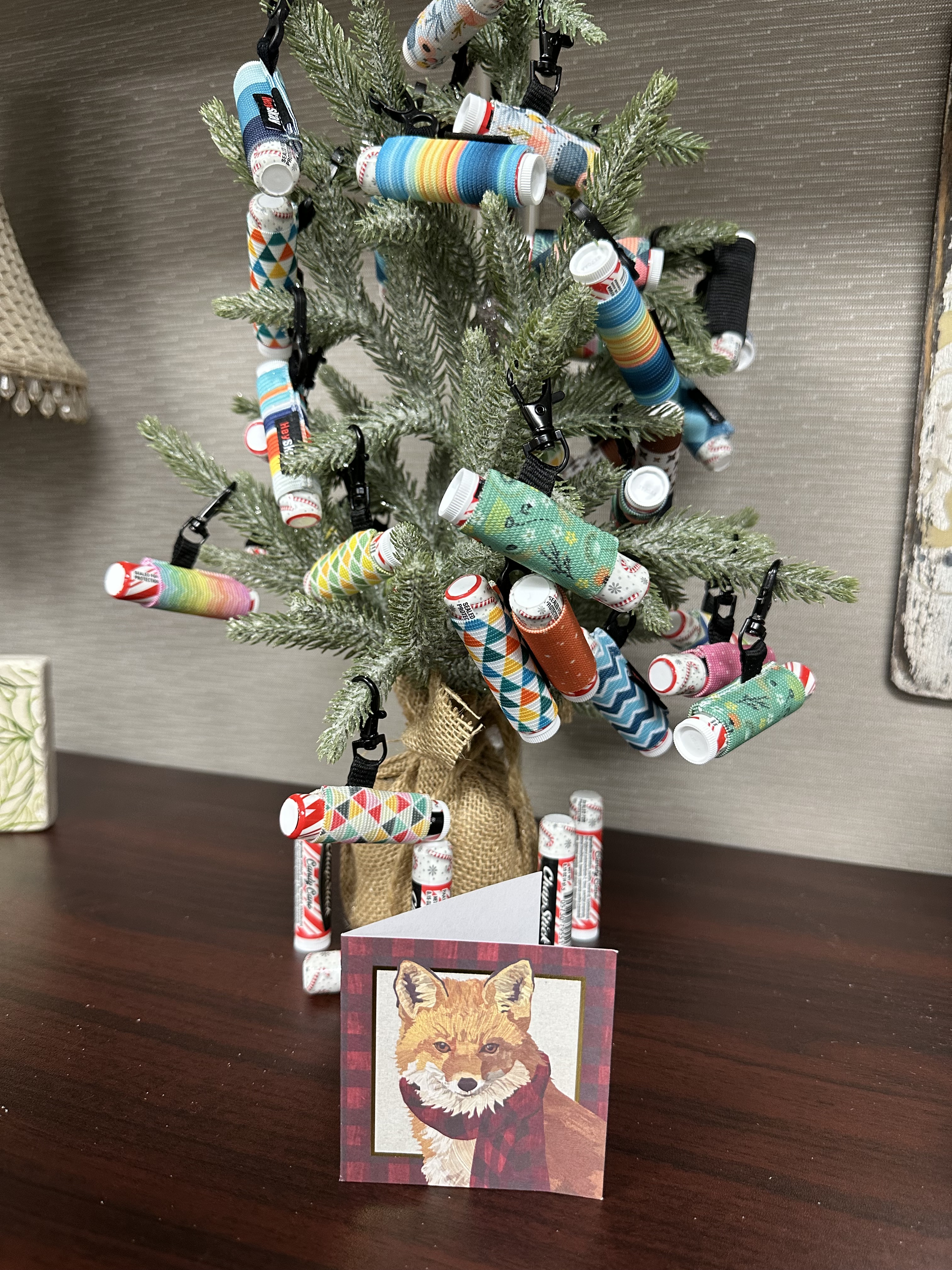
I ordered three dozen tubes of Candy Cane Chapstick, along with a supply of clip holder sleeves I’d seen on a travel blog recently. The sleeves have a clip that allows users to attach the tube to a lanyard or a purse loop or backpack strap so that the tubes don’t end up in pockets, either lost through holes, melting with body temperature – or worse, going through the washer and dryer and staining clothes with petroleum spots like I’ve done so many times.

I grabbed a tabletop tree from Hobby Lobby and festooned the tree with the best guard against bitter winter wind that exists – this universal tiny tube of lip bliss. And here is what I discovered: you can’t go wrong with a candy cane Chapstick tree. It’s mindful, meaningful, and (hopefully) memorable – at least for a season.

Even with all of the thanks and appreciative conversations with people asking for the links to be able to re-create the idea at their family gatherings this year, the thrill of giving something you know people both need and want far outweighs the joy of receiving. It’s the greatest feeling in the world!

A Calm Christmas: Mission Christmas Constellations!

This December, I’m slowly making my way through Calm Christmas and a Happy New Year by Beth Kempton (2019), savoring every chapter like it’s a rich dessert, drizzled with all the best chocolate, caramel, and whipped cream. In Chapter 2, Kempton presents ways to reflect on and consider various aspects of Christmas and what they truly mean to us. We take the scores of importance from Chapter 1 to create Christmas constellations and consider ways to reduce tension and enhance the holiday season, especially when comparing our rankings with those of a spouse.

I completed my Christmas Constellation by graphing, in rankings of importance on scales of 1-10, the areas of faith, magic, connection, abundance, and heritage as they relate to what Christmas means to me. I examined my completed graph and imagined what I might call my constellation in the clear, cold night so brightly shining. The reclined reader. The image is vividly there as I look at the outline of the recliner with my head propped back, my feet up on the footrest of the chair, flanked by three warm schnoodles and a book in my hands.

Truth. That’s me in the night sky in my own personal twinkling constellation. Exactly as I would want to be, right there on a red line stretching out between the star dots.

Imagine my surprise when I went back through Chapter 1 and asked my husband to share his personal 1-10 rankings of these same parts of Christmas in the quest to create an overlay. I hadn’t revealed my rankings to him when I asked him to share his. I jotted them down, then flipped the chart to rank his in green.

Here are our overlaid results:

Just as Kempton intended, I’m sure, this led to some deep conversation about our Christmas ideals and values. Out of 50 possible perfectly matched points, we were 2 1/2 points divergent: a half point off on heritage, one point off on faith, and one point off on connection. Magic and abundance were matched exactly, at 6 and 5 respectively.

We talked about the things we noticed and wondered, most notably that we were curious if the loss of our mothers impacted our seemingly low rankings on heritage. Perhaps some of the traditions felt “less” now that they were no longer here – or too painful to continue. We also talked about what made sense as we worked our way through the discussion points. It makes sense that we both ranked faith the highest, since church has played a tremendous role throughout our lives. It makes sense that abundance, to us, means that we have just enough – without living lives of excess. It makes sense that we value connection with others since we have family and friends with whom we enjoy spending time at holidays. It makes sense that the magic of Christmas still hangs in the air as wonder and belief that unseen guests and unexplained events can be seen and felt more strongly at Christmas than any other time.

Three hours later, we were still sharing Christmas memories and reasons we believe things are the way they are now in each of these areas. Kempton noted that these rankings can change each year -and we both agreed that five or ten years ago, our rankings would have been different in most categories. I think what we both enjoyed more than anything was the evening of deep conversation with dogs piled in our laps, instrumental Christmas music playing softly in the background as we shared favorite times and reflections.

The upside is that our values are similar enough that we aren’t likely to disagree or argue about the way things should be done. The downside is that where rankings seem they may be perceived as weak, there isn’t a higher ranking in the other to pull either one of us up on the scale where some areas might generate more “Christmas spirit” if they were higher.

That fine line between Christmas spirit and stress, though, is a reflection for a later chapter.

The shared perspective is that right now, we’re exactly where we want to be.

A Calm Christmas: Magic

This December, I’m slowly making my way through Calm Christmas and a Happy New Year by Beth Kempton (2019). In Chapter 1, she presents The Five Stories of Christmas that focus on faith, magic, connection, abundance, and heritage. Today, I’m remembering the magic of Christmas I felt as a child.

Kempton asks us to reflect: Where did your ideas about Saint Nicholas/Father Christmas/Santa Claus come from? Did you enjoy other magical stories as a child?

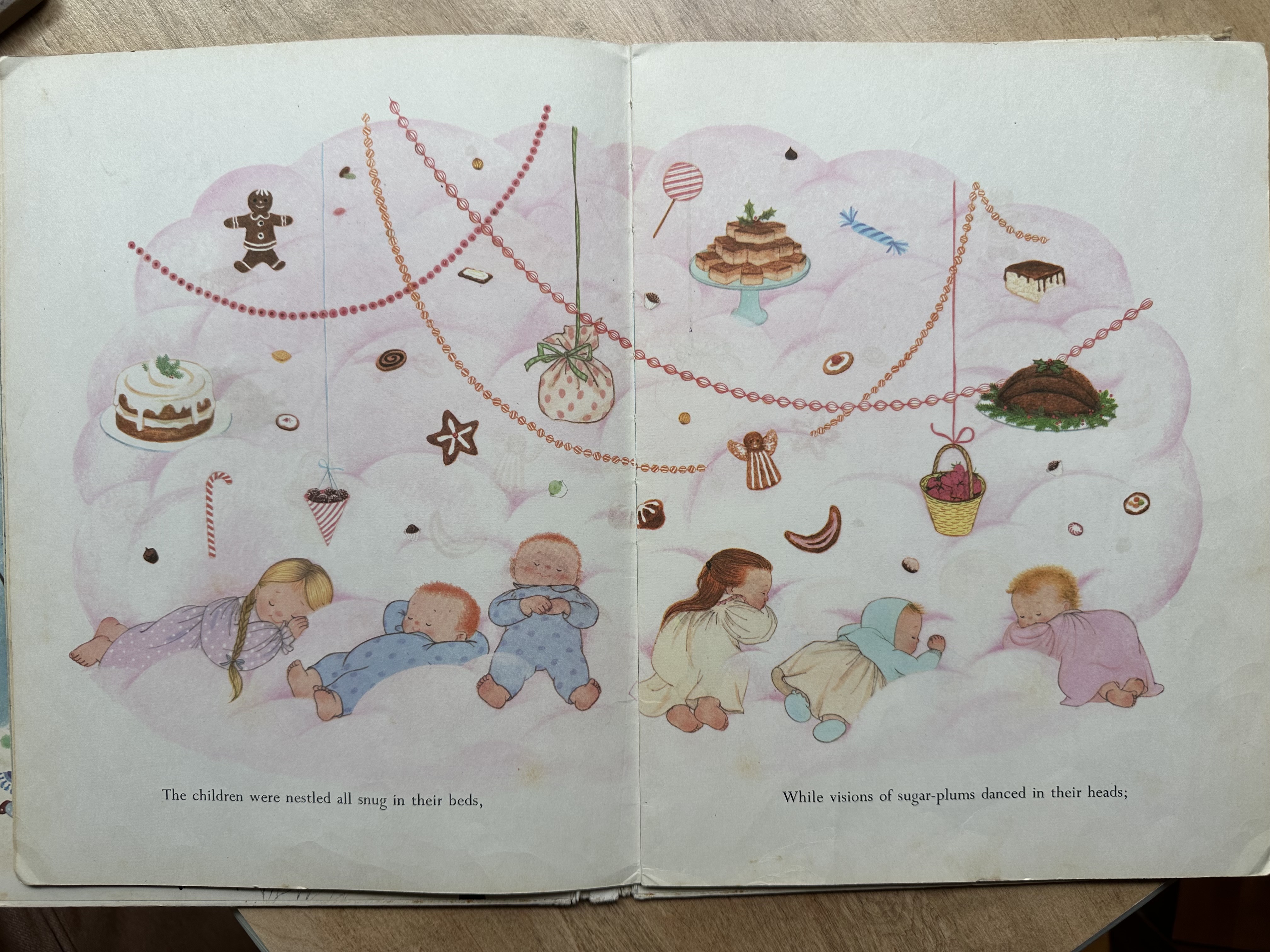
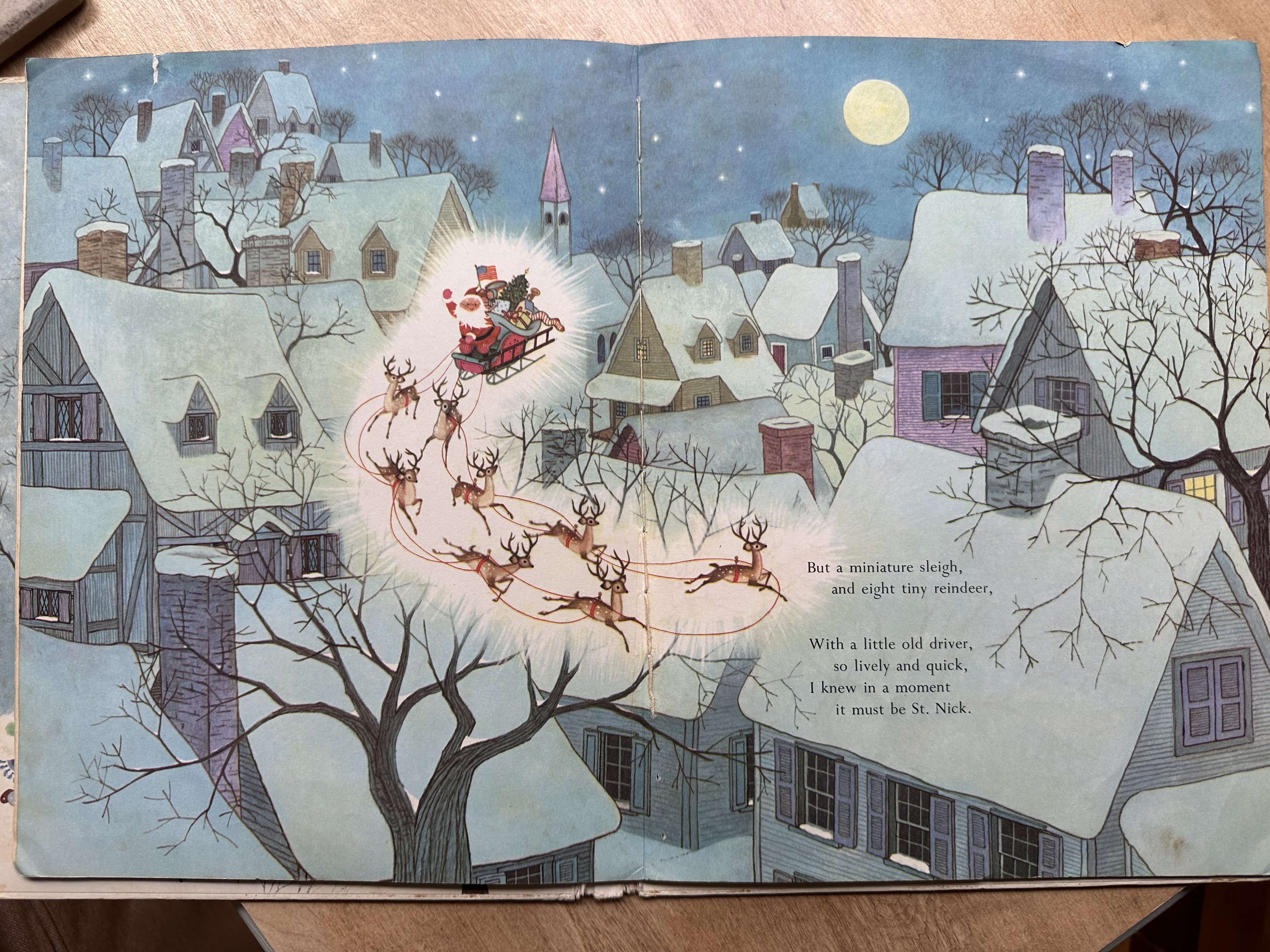
There is no question about where my idea of Santa was rooted. I still have my favorite version of The Night Before Christmas, illustrated by Gyo Fujikawa. Though it is in poor condition from being loved on so much, it was the one my mother read to me over and over and over again, and the one that still comes to mind on every mention of Clement C. Moore’s Letter to Saint Nicholas. The sugarplum illustration is my favorite one in the entire book. The art of the bygone era appeals to me.

Of course, there was other magic. Rudolph’s red nose and a team of flying reindeer were captivating images filled with magic. Frosty’s magical topcoat that brought him to life – and then couldn’t keep him cold enough to survive – still brings winter wonderland feelings even through the tears of a melted snowman.

Magic Acrostic

Merry Christmas

And Happy New Year

Going on 59 times now ~ and

I still love the magic of

Childhood at Christmas

On a scale of 1-10, rating how much magic and wonder are important to me at Christmas, I’d rate them a 6.

The Real Age Test

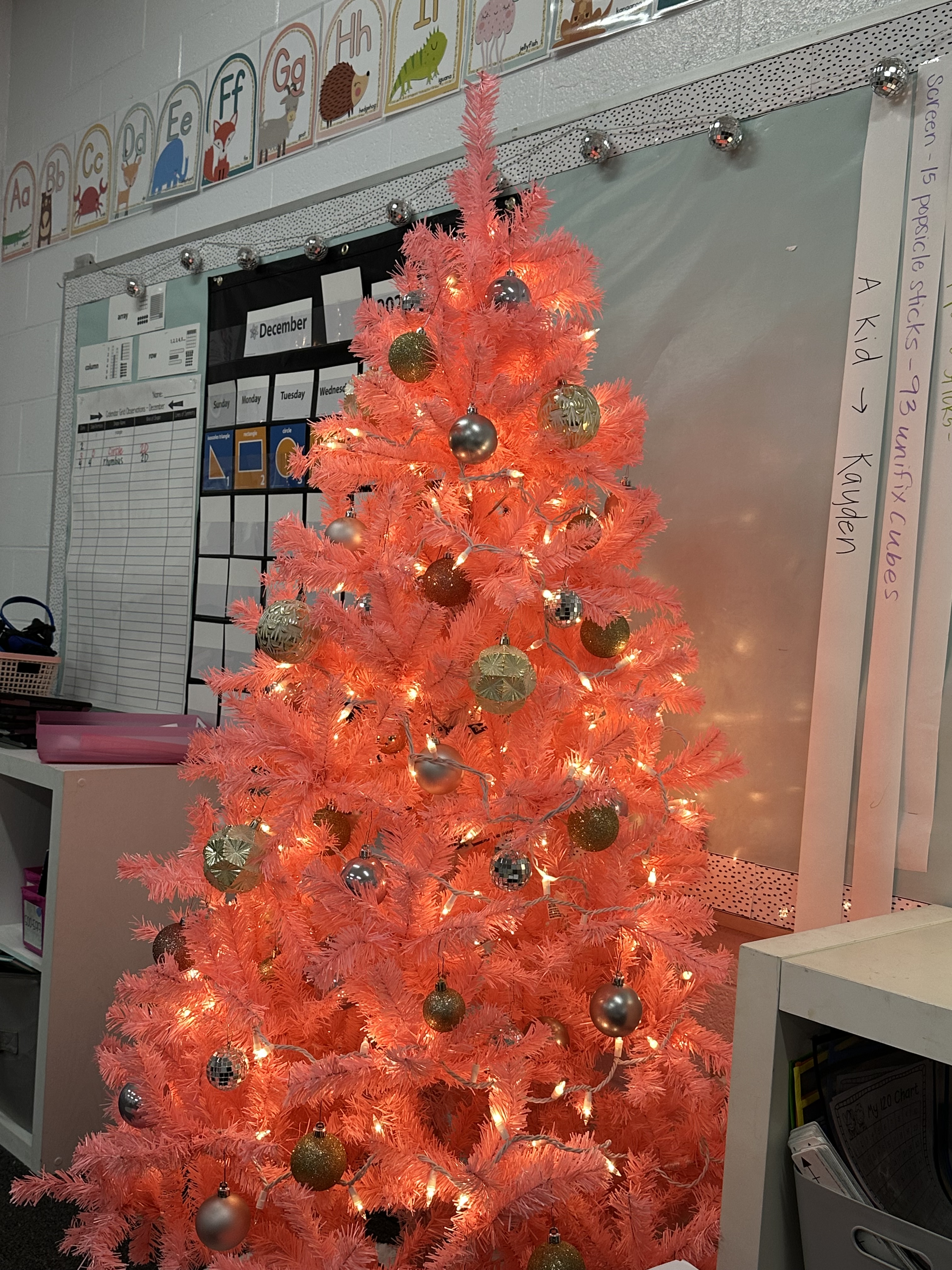
The pink Christmas tree in one class I visited this week

I had the privilege of visiting three second grade classes this week as teachers in our system complete their Science of Reading modules required by the State of Georgia under its new legislation.

In the first class, one student asked, “Have you ever been in a classroom?”

That should have been my first sign.

I replied that I had, and it all started once upon a long, long time ago and lasted for many years.

She looked at me suspiciously, then asked with a hint of sass, “So you can handle us?”

Oh, the joys of second grade. They tell it like it is, and nothing gets left unsaid.

Forget any “Real Age Test” your insurance company has ever asked of you. There’s a real-er one, and here’s all you have to do: step into a primary school classroom for three hours. Three hours is all it takes to get yourself into real trouble, as any of the guests aboard the SS Minnow would remind us. Ironically, being shipwrecked on a desert island seemed it would be paradise by the time I slugged back out to the parking lot each morning.

How did I ever do this when I started teaching in the late 1990s with a full class of second graders, three children and a husband and so much laundry at home, when one played soccer on a travel team and we traveled most weekends as a family and stayed in hotels AND I didn’t have Clicklist at the grocery store where I could click my order in and pull up and wait for them to come running out with the cart and load me up?

How?

HOW??!!

This, my friends, is the Real Age Test. I passed with flying colors as someone who is really aged.

I slumped back into the driver’s seat, one building away from my office and allowed myself five minutes’ peace, hoping no one walked by and saw me in such a state. I wrapped my arms around the steering wheel and let my head rest on my forearms. I prayed. I prayed I hadn’t pulled a muscle bending over to sit down in the tiny chairs or, more likely, hefting myself up out of them. I prayed there were still 19 heads to be counted in the room I’d just left and that there were not a few running loose in the building somewhere and that I wouldn’t get a phone call shortly, asking about any missing children.

The Real Age Test. Like cheese, I’ve discovered my moldy edges and the holes I didn’t used to have. My denial has come to an end, and I have accepted that I am truly aged.

I feel it in my bones.

But I did take away a great compliment: when I was doing a read-aloud, they were mesmerized. They said, “You do it so good.” Apparently, I sparkle as a picture book reader. And that makes it all worth it.

Spiritual Journey – December 2024


Scrolling in search of the next book to read on an upcoming flight, my right thumb becoming numb, I came to a screeching halt on Wintering: The Power of Rest and Retreat in Difficult Times by Katherine May.  

This, I nodded approvingly to myself, thinking of all the exhausting change that 2024 has brought.  This may be just the medicine my soul needs right now.

Many of the changes life has brought throughout the year are positive ones, but even good change requires a period of adjustment.  The not-so-good changes, even more so.  

I clicked the Kindle sample download and examined the Table of Contents, organized in chapters by the seven cold months of the year starting in October and ending in Late March.  I read the reviews on Goodreads and delved into the sample text, asking at each decision point whether this would be the best investment of my time and cognitive energy – since both are forever fleeting.

After finishing the sample, I knew this was the book for me.  I downloaded the full book.

I realize I’ve struck book gold when I find a book that has me hanging on each sentence, savoring its power and meaning as I apply it to my life and feel the peace it brings.  Each thought, it seems, fits like a glove when I’ve found the right book for the right time.  It’s like a medicinal salve, like Candy Cane chapstick on parched lips whipped sick by the wind.  

All at once, my breathing deepens and my heart slows from its racing pace.  I feel my tongue stop pressing against the roof of my mouth in its usual stress-pressure position.  My shoulders drop and my neck muscles loosen.  I read May’s soothing words as I consider the approaching winter break: 

“Winter is when I reorganize my bookshelves and read all the books I acquired in the previous year and failed to actually read. It is also the time when I reread beloved novels, for the pleasure of reacquainting myself with old friends….In winter, I want concepts to chew over in a pool of lamplight—slow, spiritual reading, a reinforcement of the soul. Winter is a time for libraries, the muffled quiet of book stacks and the scent of old pages and dust. In winter, I can spend hours in silent pursuit of a half-understood concept or a detail of history. There is nowhere else to be, after all.”

And in this, I can rest with full hope and anticipation that the gas logs and my heated throw will bring needed warmth.  My dogs will bring peace and deep comfort as they vie for snoozing position next to me, and my books will bring the golden silence and space my heart needs as I sip a cup of honeyed hot tea and reread: …. there is nowhere else to be, after all.  

My next book will be Calm Christmas by Beth Kempton. What will you be reading, dear friend, in the sweet, snug nook of home, in the nestled bliss of nowhere else to be?

********************************

Please link your blog posts in the comments below, and thank you for reading today!