Birding at Flat Shoals
Seven new species today!
Peaceful excursion


Patchwork Prose and Verse
Birding at Flat Shoals
Seven new species today!
Peaceful excursion

After walking my 3 Schnoodles along the back loop of F. D. Roosevelt State Park and recording 15 species of birds singing from trees, flitting from post to post and diving for food in the grasses and shrubs, I resumed my Global Big Day bird count at the top of Dowdell’s Knob on Pine Mountain in Georgia overlooking the valley below. The dense fog was beginning to lift, making it possible to see more of what I was hearing. I was thinking of my friends who were also out participating in this event – Fran Haley from North Carolina, who was out looking for eagles at a dam with her husband on her birdday birthday, and my colleague Dawn Lanca-Potter and her son Grayson, who were out observing in Pike and Upson Counties in Georgia.
After completing my eBird Essentials course and researching the local hotspots for bird activity, I chose Georgia’s largest state park, F. D. Roosevelt State Park just outside Warm Springs, for my birding adventure. I was excited to live these opportunistic moments observing the plethora of species in this biodiverse area in close proximity to Callaway Gardens. My mother, who had been a lover of birds her entire life, was close – I could feel her spirit in the breeze, her presence in the harmonious, sweetly chirping birdsong.
I had no idea that she would make her presence more even powerfully known in such an unquestionable way.
But that’s exactly what happened.

In 2008, I’d applied for a teacher scholarship to spend a week learning alongside scientists in the field at the Jones Ecological Research Center near Albany, Georgia. Four courses had been offered, and we could pick two of the following: wildlife, aquatics, forestry, and plants. I chose wildlife and plants and completed both of these sessions the first year. I returned the second summer to complete the other two. As part of the grant that funded our teacher scholarships, we received copies of Janisse Ray’s Ecology of a Cracker Childhood, a memoir about the author’s days growing up in poverty in Baxley, Georgia and learning all aspects of the Long Leaf Pine ecosystem; and Aldo Leopold’s A Sand County Almanac, which is in my top three favorite books of all time. I savored these pages, and I return to them often still. They teach me a lot about plant and animal species – especially the rare and dwindling ones, like the Red-Cockaded Woodpecker and Bachman’s Sparrow.
I turned on my Merlin Bird ID to figure out which species were in the area, and I used the tone sensor to figure out where each bird was located in proximity to me. My strategy was to let Merlin’s unmistakable expertise lead, and then to photograph and audiorecord and count the species as I encountered them.
I’d complete a checklist in one spot and move on to the next, all along the mountain. I almost didn’t stop in one particular spot, because the motorcyclists were out on rides in large groups and had a substantial gathering in one of the overlooks as they took a lunch break; I was thinking the noise would deter any birds, but as the cyclists began to leave, I changed my mind and decided to do an observation in this spot.

I sat on a rock and started the checklist. 12:54 p.m. I was hot and tired. I took a long swig of icy water and tapped into my buddy Merlin, who had already led me to Indigo Buntings, Summer Tanagers, Great Crested Flycatchers, and a long list of other birds not too difficult to spot once I knew they held presence in an area.
Northern Cardinal, Pine Warbler, Black-and-White Warbler, Eastern Towhee, Chipping Sparrow, Bachman’s Sparrow……
Bachman’s Sparrow!
No way. This one has to be a mistake, I thought. I watched the tone sensor. These are rare birds, far too shy and rare for a mountainside full of motorcyclists vroooming around.
I thought of Janisse Ray’s chapter on Bachman’s Sparrow. Bird-artist James Audubon discovered the sparrow in 1832 while exploring near Charleston, South Carolina, and named it for a Lutheran minister he had befriended on the street and with whom he was staying, John Bachman. Bachman’s Sparrow has declined since the 1930’s at a stunning rate. It is streaked buff-gray, with a shadowy bill and a long, dark-brown, rounded tail. It measures six inches from bill to tail tip, about the size of most sparrows, and has been called the stink-bird by quail hunters because its ground dwelling can throw off the dogs hot on the trail of a bevy of quail.
Sure enough, Bachman’s Sparrow appeared and continued to light up in yellow highlighting as I searched the trees and located a group of sparrows – and while I never could tell which sparrow was Bachman’s through the high-powered lens focused in the trees down the bank on the side of the mountain, I knew that at least one of these elusive birds was somewhere in that mix. Right there in that tree. Right near me, singing its cheery greeting, lighting up a few times on the app.
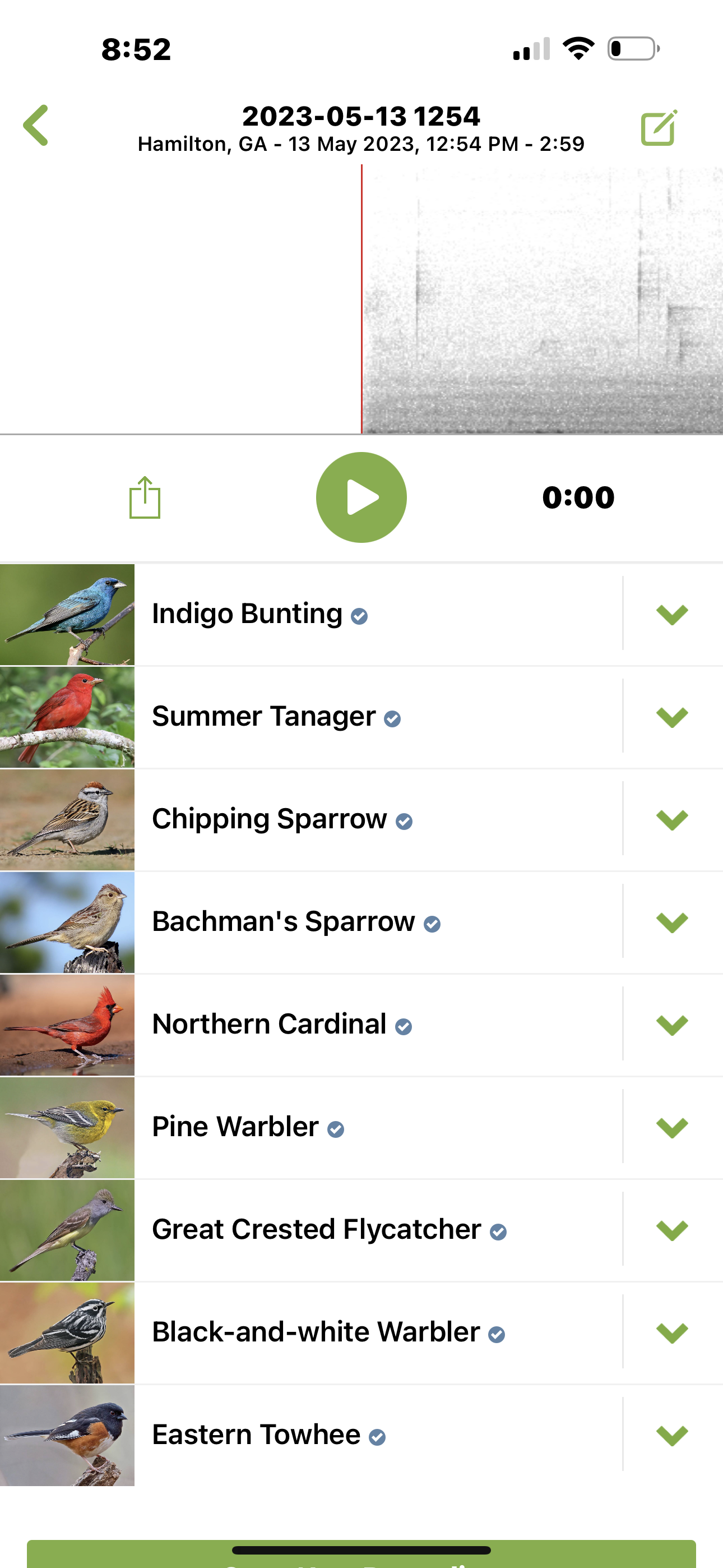
On Global Big Day, that Bachman’s Sparrow was my mother reaching down from heaven for a tight hug on Mother’s Day weekend, letting me know she is watching over me, reminding me to be strong in my faith: many times, we can’t see something that we KNOW without a doubt is there surrounding us, and these things are forever real.
God, mothers in heaven, birds. Ever present, forever real.

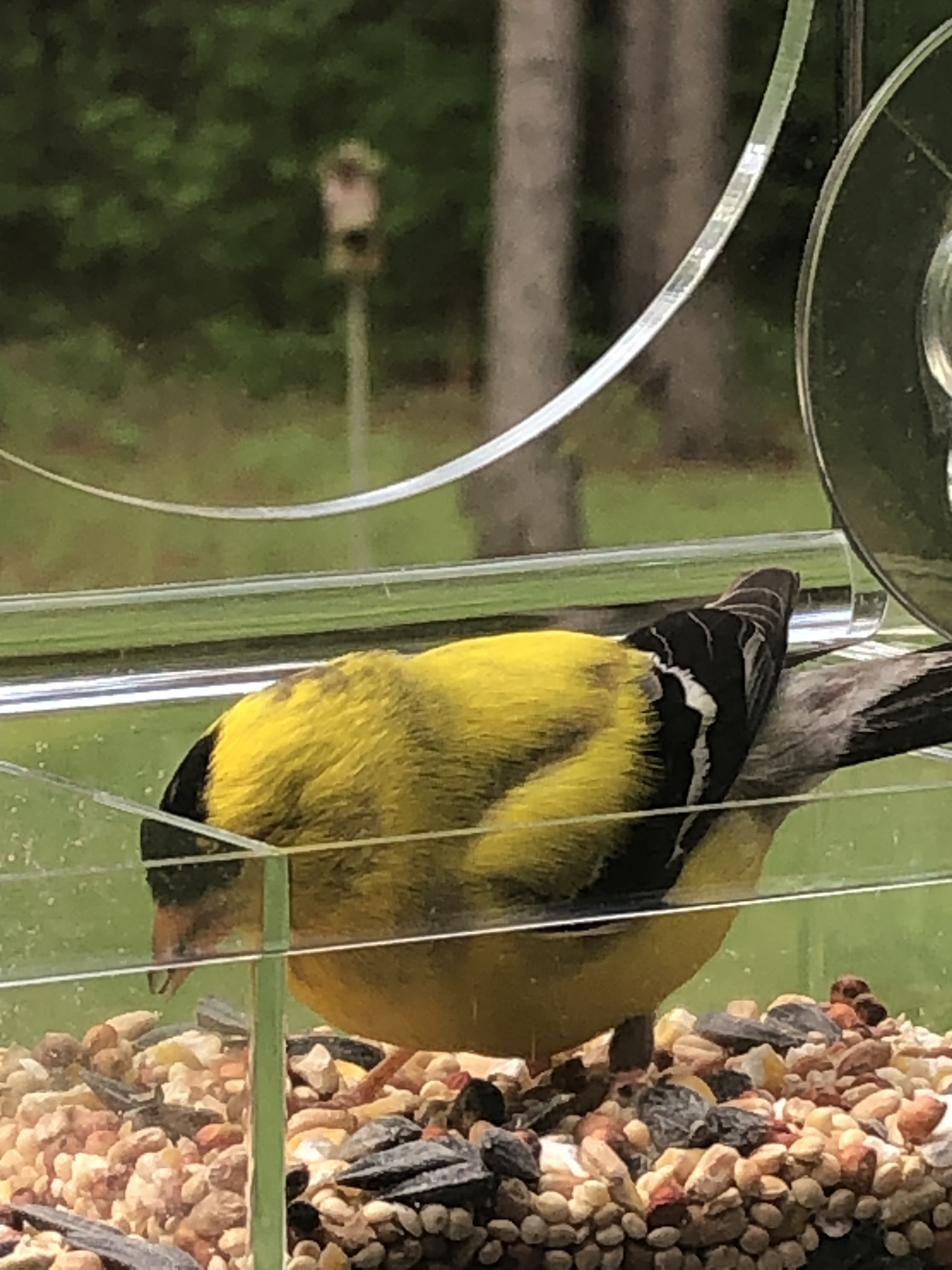
One of the greatest pleasures in my life here on the Johnson Funny Farm in rural middle Georgia is birdwatching from the comfy chair by the window in my reading room. Each spring, we deep clean our feeders and add a new type to the all-you-can-eat bird garden buffet. Two years ago, I added four clear acrylic window feeders – and now we each have a coveted seat right by the window, with a front-row view.
The American Goldfinch is one of my favorite visitors. We also have Cardinals, House Finches, Pine Warblers, Indigo Buntings, Black-Capped Chickadees. and different varieties of nuthatches. sparrows, and wrens who love these smaller covered feeders. When it rains, they like to sit “inside” like the kids in The Cat in the Hat and look out their “window.”
We can get so close to our birds that we can see if they are missing any feathers or tell if they might have been in a fight. If we had ever wondered whether birds have tiny teeth, we could tell that, too. We ease up to the window and take a mannequin stance, careful not to throw our breath fog on the glass. The reflection from the outside makes it easy to remain undetected for long periods of time, watching our little frequenters blissfully fill their bellies with seeds, nuts, and berries.
A wide variety of birdseed mixes brings the fanciest charms and flocks and hosts and herds (I’m including a fuller list of specific bird group names at the bottom of this post). I found a chart at Pike Nurseries that has been helpful in matching seed, feeder: and bird type to maximize our traffic. For example, I look at the foot perch size, the encased wire openings for smaller birds, and the opening sizes where the seeds come out. All of those, along with location of the feeders, make a difference in all the species we have been able to attract. When Ace Hardware has a Buy One, Get One Free sale on brand-name birdseed in my small town, they know I’ll be there to get a cart full.
And these winged angels sing the most glorious songs of food blessings to their creator that I want to name them all Little Tommy Tucker!
If your mother doesn’t have a window feeder for the birds, it would make a lovely gift next weekend, along with a variety of seeds! I’ll be filling my feeders and remembering my mother, who shared with me the sheer joy of bird watching.

List of bird group names retrieved from: http://birding-world.com/names-bird-groups/

Aerie of hawks

Band of jays

Bazaar of guillemots

Bevy of larks

Bevy of quail

Bevy of swans (when in flight)

Boil of hawks (when in flight)

Bouquet of pheasants

Brace of grouse

Brace of pheasants (when dead)

Brood of chicks

Building of Rooks

Bunch of ducks (when on water)

Bunch of waterfowl

Cast of falcons

Cast of hawks

Chain of Bobolinks

Charm of finches

Charm of hummingbirds

Cluster of Knots

Colony of gulls

Colony of vultures

Company of parrots
Squadron of pelicans

Company of widgeon

Concentration of kingfishers

Congregation of plovers

Constable of Ravens

Convocation of eagles

Covert of coots

Covey of grouse

Covey of partridge

Covey of ptarmigan

Deceit of Lapwings

Descent of woodpeckers

Desert of Lapwings

Dissimulation of birds

Dole of doves

Drift of quail

Dropping of ducks (when on water)

Exhaltation of larks

Fall of Woodcock

Flamboyance of Flamingos

Flight of cormorants

Flight of doves

Flight of Goshawks

Flight of swallows

Fling of Dunlins

Flock of birds

Flock of birdwatchers

Flush of Mallards

Gaggle of geese (when on ground)

Gathering of birdwatchers

Gulp of Cormorants

Herd of cranes

Herd of Curlews

Herd of wrens

Horde of crows

Host of sparrows

Huddle of penguins

Jubilee of eagles

Kettle of hawks

Kit of pigeons (when in flight)

Knob of waterfowl

Murder of crows

Murmuration of Starlings

Muster of Peacocks

Muster of turkeys

Mustering of storks

Mutation of thrushes

Nye of pheasants

Ostentation of Peacocks

Pack of grouse

Paddling of ducks (when on water)

Parliament of owls

Parliament of Rooks

Peep of chickens
Chattering of Choughs

Pitiousness of doves

Pitying of turtledoves

Plump of waterfowl

Plump of wildfowl

Quarrel of sparrows

Raft of coots

Raft of ducks (when on water)

Raft of loons

Rafter of turkeys

Richness of Purple Martins

Rookery of penguins

Scold of jays

Sedge of Bitterns

Siege of Bitterns

Siege of cranes

Siege of herons

Skein of geese (when in flight)

Sord of Mallards

Spring of teals

Stand of flamingos

Strand of Silky Flycatchers

Sute of Mallards

Team of ducks (when in flight)

Team of geese (when in flight)

Tiding of magpies

Tittering of magpies

Trembling of finches

Trip of Widgeon

Trip of wildfowl

Trouble of hummingbirds

Unkindness of Ravens

Volery of birds

Walk of snipe

Watch of nightingales

Wdge of swans (when in flight)

Wedge of geese (when in flight)

Whisper of snipe

Whiteness of swans (when in flight)

Wing of plovers

Wisdom of owls
 Common Threads