Warning: Photos of dead bobcat in photos at end of post. Do not read further if this makes you uncomfortable. It saddens me, but country living is full of both delights and horrors, and I take the bad with the good.
At 7:52 a.m. yesterday when I pulled into the parking lot at work, I reflected on my morning. Already, I’d seen a dead bobcat, two rabbits (one alive that ran in front of my car, and one dead that didn’t make it when it ran out in front of someone else’s), a squirrel, a large buck and small spotted deer. I’d heard the calls of the Downy Woodpecker, Eastern Phoebe, Blue Jay, Carolina Chickadee, Ruby and Golden-Crowned Kinglets, Carolina Wren, Eastern Bluebird, American Robin, Pine Siskin, Chipping Sparrow, Eastern Towhee, Northern Cardinal, and Orange-Crowned Warbler. I’d walked our three schnoodles and discovered a new scratched-up area in the ground cover along the woods of the driveway, showered, dressed, and had my mushroom coffee and protein shake.
Ollie checks out a new ground scratching
I’d been in the shower when I heard the phone’s text ding. I saw it was my husband, so as soon as I was reasonably dry, I read the text: Please call me before you leave for work.
He told me he thought he’d seen a dead wildcat on the side of the road where the neighbors with the black Suburban live. “Take a look when you drive by, and let me know what you think it is. It might be a bobcat.”
He knew I wouldn’t be able to wait on fixing my hair, clothes, and makeup. So off I went in my robe to see this creature whose fate had been determined somewhere between 10:30 Thursday night and 6:00 Friday morning.
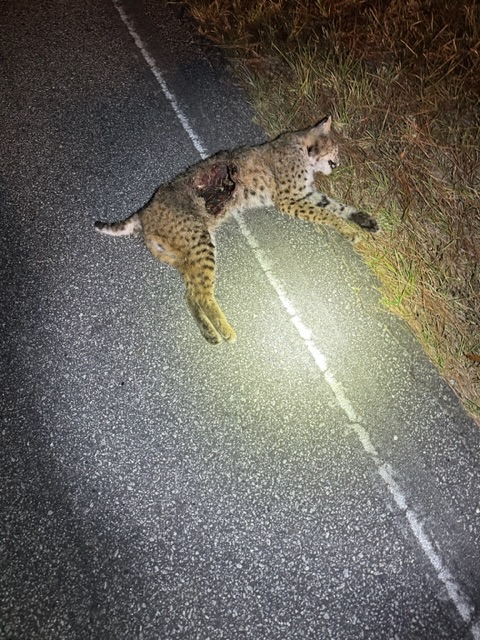
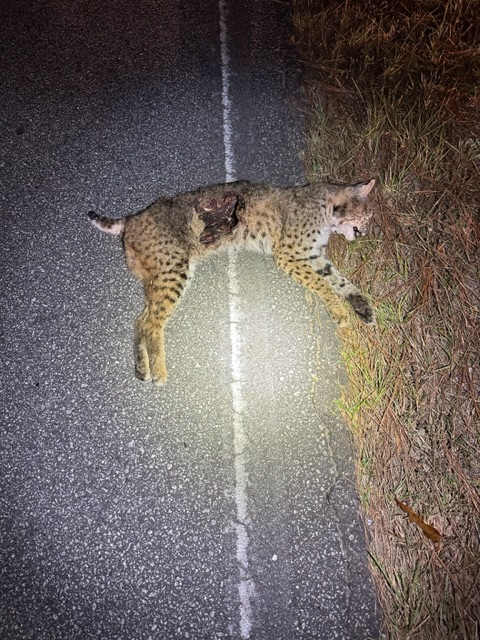
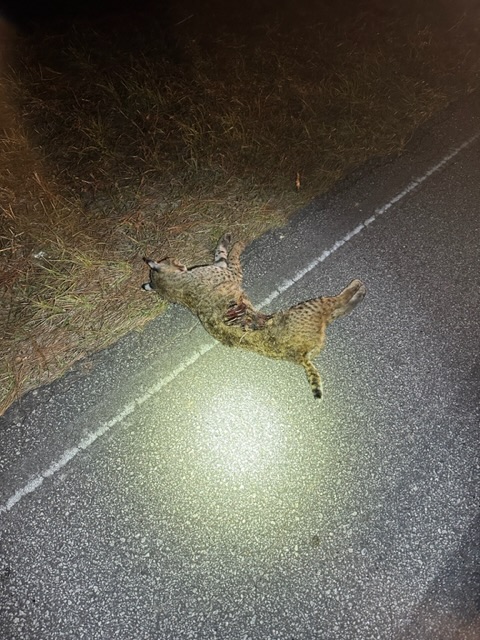
I stopped the car in the road and turned on the flashers, got out with the flashlight, and made pictures. Sure enough, it was a wildcat. Its gut organs had been eaten, but the rest of it was still in fairly good condition for something that was hit by a car going the speed limit on Beeks Road. I didn’t think a car had done this, or at least not the blood and gut part.
I made some pictures to help me in my research and theories about what happened. Imagine: a half-clad, robed wildlife crime investigator out on a rural road before daybreak, wet hair, no makeup, snapping photos of a dead animal carcass. That was me.
I mourned the life of this cat for a moment, despite the fear its kind evokes in me each time I take my dogs for a walk. Moments like these are powerful reminders of why I believe strongly in keeping my dogs on a leash at all times. People think it strange that I live on a family farm in the country on the backside of nowhere and leash my dogs. This is why: bobcats, foxes, coyotes, owls, red-shouldered hawks as large as the Great Horned Owls, rogue dogs, wild boar, cars, venomous snakes, and hunters. Not to mention those who believe that every dog they see off a leash needs rescuing, posting on social media for three days, and then rehoming (a/k/a dognappers who believe they are fully justified). Ours are chipped, but walking unleashed in our neck of the wilderness simply isn’t worth the risk.
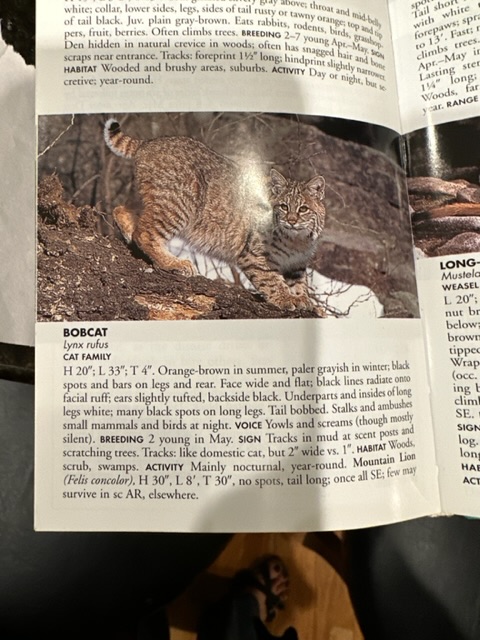
I raced back home to pull my Audubon book out and make a 100 percent positive identification on the bobcat. Check.
Then I began the investigation. “Hey, Google. What are a bobcat’s natural enemies?”
Google rarely lets me down. “The most common enemy of bobcats is man, but they also have other predators, including owls, eagles, coyotes, and foxes, mountain lions, and wolves.”
I looked closely at the photos and observed that this bobcat appeared to be in good shape except for the gaping gut hole that had been devoured by something. I also noted an odor that suggested the bobcat had been dead for longer than a couple of hours, even though it wasn’t there the night before. It seemed odd it was in the road smelling of decay already, and not fresh-since-last-night meat. It was also on the edge of the road where it would have likely been hit a number of times by texting drivers who failed to see it in time and move over a little.
A pack of coyotes would have picked this bobcat clean and torn its limbs apart, so I ruled them out. I have never seen a wolf here, and it’s been years since anyone has seen a wild boar on this property. A fox lingered for a passing thought, but one predator emerged as the prime suspect. We have three active culprits, and they’re nocturnal. The Great Horned Owl.
Most people would shake their heads and dismiss this possibility. No way an owl would kill a bobcat.
Here’s a way: a bobcat is struck by a car and crippled but not killed. It languishes for several days in the brush, and finally succumbs to its pain and lack of food or water, probably realizing that whatever animal stumbles across it will consider it a gourmet meal.
I believe it was the Great Horned Owl who watched to see that the bobcat was alive for a time, and then when it knew this creature was too weak to fight back, but probably still alive, it swooped in for the feast. I believe it dragged it to the road for a better angle and strategically placed the stomach organs on the line in the road where the elevation dips back down so it could get to all the good meat in much the same way we invert the yogurt lid to lick the top, and I believe it ate the stomach organs and the eyes.
I believe all of this because I have seen over the years how the Great Horned Owls prefer organs. They eat the heads of rabbits, taking out the brains and leaving the rest. This carcass destruction made sense to me.
I can’t imagine the sheer shame of the bobcat spirit in bobcat heaven, reading the Georgia Rural Wildlife newpaper obituaries about his tragic end:
Robert W. Cat died Friday, November 10, 2023, killed by a Great Horned Owl with a five-foot wingspan. His friends all believed that he was the fiercest of his kind there in rural Georgia but report they had noticed a slip in his swagger in the days preceding his death. His wife reported she had heard rumors he was out running around on her with his sly catlike ways, and moved on just hours following her husband’s death, noting simply, “I hope he was in life number nine. He was a real animal.”
He explains: “Every April, during a six-week unit on poetry in Kentucky, I’d assign students to think of a person, place, or thing worthy of a poem, and write it as if you are gifting random thoughts/ideas/verse or insight for another. We began calling these ‘poetic drive-bys’. Students loved this, often chalking poems on a neighbor’s driveway or creating one to hand to strangers at the mall (a few even ‘tagged’ abandoned buildings with their writing and one young man drove around handing what he wrote to fast food employees working in drive-thru windows). Write a poem for the boy who bags your groceries, or the sidewalk where you walk, or for the stranger you see in the park.. The goal is to craft a poem that you can leave for another to find (maybe a specific someone or maybe not — make it a poem to be discovered or gifted.”
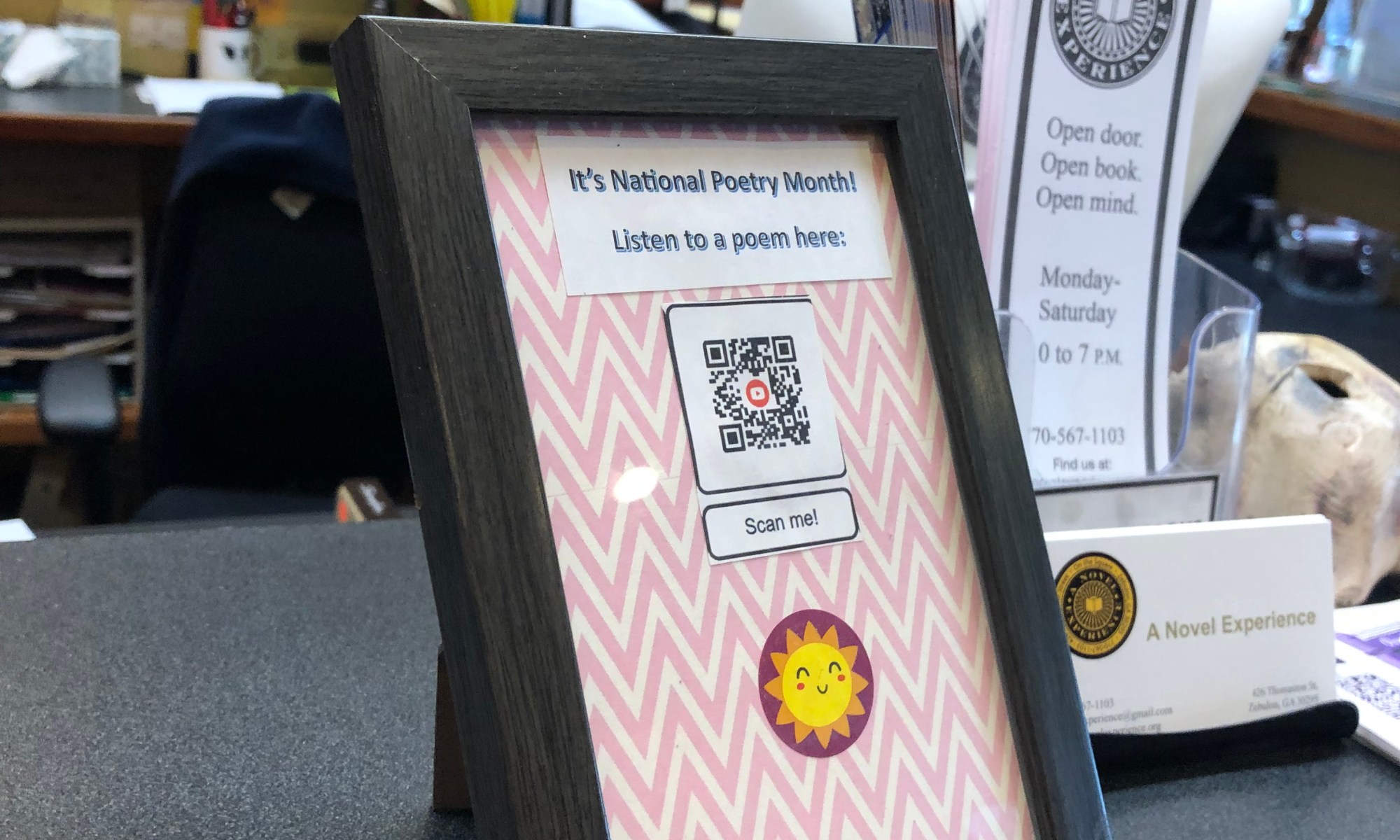
In my county in middle Georgia. I’m leaving QR Codes with poetry videos throughout the square. Below is an example of one. I’m reading here with Ethan Jacobs, whose book Dust will be available on Amazon this spring. This is for YOU, dear reader:


 Common Threads