November Tricube

Sometimes when I tap my pencil or my fingers, I feel the rhythm of a poem I hadn’t planned on writing. It’s like hearing music and wanting to dance, only there’s no music and I don’t want to dance. I think this might be like the call of the spirit wolf to the cub who spent hours on end reading poetry with a flashlight as a child and has now grown up – – and something rhythmic this way comes on a howling wind outside. Or something Iike that.

One of the poets in one of my writing groups – I believe it was Denise Krebs – introduced us to the tricube form a few years ago. It’s three stanzas, each with three lines,

each with three syllables. The rhyme pattern is a,b,c,a,b,c,a,b,c, and the meter is trochee with stressed/unstressed/stressed. These are just fun to write, especially using seasonal words. Try one today!

November Tricube

turkey stew
pumpkin spice
gravy boat

fireplace flue
windshield ice
hooded coat

vibrant view
saffron rice
.....did you vote??....

A Challenge for the week:

Fellow blogger Anita Ferrari inspires a new poem today. One I have not yet written. She writes of the six seven syndrome going around. You can read her post here. This week, I’m going to try several variations of six seven poems – – poems with six syllables on one line, seven on the next. Poems with six words, then seven, and even six stanzas and then seven. I’ll post them this week and then one again next Tuesday. Anyone up for the challenge?

Let’s write six seven poems this week! Who’ll join me??

Thanks to Two Writing Teachers at Slice of Life

November Shadorma

November Shadorma

go ahead

eat the pumpkin pie

before the

turkey comes

out of the oven all browned

is there a main course?

……and just like that, after Halloween candy and football player costumes and all the fun of fall festivals including a hayride around the campus at work, we are thrust unmercifully into the Christmas season. The candy at Dollar General is half price, and the one seasonal row they’d already dedicated to Christmas has expanded to three. It’s the season of eating, and no one is waiting on anything.

Today’s poem is a shadorma, a form similar to Haiku in syllable pattern. This form has six lines, and the syllable count on each line, in order, is 3,5,3,3,7,5. I’m a fan of eating dessert first, so I’m urging all pie lovers to take full advantage of throwing out the rules and questioning whether there is really a main course.

For me, it’s the pie.

Gladys Taber and November

Indian Pudding

a new recipe to try

for Thanksgiving Day

My father, an avid book collector, introduced me to Gladys Taber’s writing years ago, and I fell in love with her instantly. He has always had the uncanny knack of matchmaking book lovers with books that become favorites.

Sometimes I like to go to my collection on the shelf of my reading room and pull a Taber book and read random passages. Many of her books are organized by month or season, so I find that no matter where I land in her seasonal offerings that mirror mine on our farm in Georgia, I am there – right there with her – in Southbury, Connecticut.

From Still Cove Journal: November

“November is a month when the chill blustery days and long cold nights are hard on dieters. Green salads are fine on hot summer days. but the very sound of the wind from the Atlantic against the big window makes me think of a real breakfast of sausage and buttermilk pancakes with first-run golden maple syrup. By suppertime I forget I am a non-dessert eater, and when I go out to eat, I often order Indian Pudding. I have had many very fine puddings, but almost never an authentic Indian Pudding. So I like to share the recipe my mother and grandmother used:

Bring 4 cups of milk to a boil in the top of a double boiler. Gently stir in 1/3 c. yellow cornmeal and cook 15 minutes. Add 1 cup dark molasses and remove from heat. Add 1/4 c. butter, a teaspoon each of salt, cinnamon, and ginger and 1/2 c. seedless raisins. Place the batter in a greased baking dish. Then pour 1 cup cold milk over it. Bake in a slow oven for 1 1/2 to 2 hours. Serve with hard sauce or cream or even vanilla ice cream.

The main thing about the real Indian pudding is the cup of cold milk poured over…..”

I’ve never made Indian pudding, but it sounds divine. I’m making a shopping list now to try it, perhaps for our Thanksgiving lunch at the office a week from Tuesday. There’s something magical about an old recipe that seems to conjure up the spirits of those long dead and welcome them back to the present. If we ever do discover time travel, I’m fully convinced that the portal will be through an old recipe box, long forgotten, hidden in the corner of an attic, and one that comes alive like Frosty the Snowman’s magical hat.

A Hygge November

A few years ago, I began reading more about the Danish concept of hygge and learning about the ways to create comfort – at home and in life. Ambient candlelight, toasty socks, hearty meals of soups and stews, warmth of fireplaces, soothing sounds of music, and coziness of blankets and sweaters. The enjoyment sitting by the fire with the dogs as I write and sip hot tea. These small measures of comfort go a long way in self-care.

One author who brings all the feels of hygge is Gladys Taber. This morning, I read about November long ago from her book Stillmeadow Sampler, published in 1950. This book was a gift from my father last Christmas, and is signed by Eugenia Price in 1977 as a gift to Lady Jane.

Below, I share an excerpt:

Now, toward the end of November, rain falls steadily and it is a chilling rain. The bare branches look black and the browns in the meadows are deepened. The pond’s level rises and we can hear the water pouring over the dam and on into George’s brook. The small-paned windows of the house are a wash of silver. The lamps go on early in the day.

When we go out to do the chores, the air smells of wet fallen leaves. It is a curious musty smell, but pleasant. Jill brings in an apple log from the woodpile and the fire burns brightly. The Cockers and the Irish doze on the warm hearth. It’s a good time to have Brunswick Stew, that delectable combination of chicken, tomatoes, lima beans and corn simmered with seasonings in the old iron soup kettle.

When the rain finally ends, usually at dusk, the whole world looks polished. The horizon has a rosy glow. The air is like vintage wine, properly cooled. When we open the door, the dogs rush out and dash around the house. Rain’s over, rain’s over, they say, barking happily. Inside, with the rose-colored light coming in the windows, the house takes on new life. The milk glass gleams, the brass and copper shine. And the soup kettle is ready to be lifted from the crane, the popovers are hot.

“Next thing we know,” says Jill, dishing up the stew, “it will be snowing.”

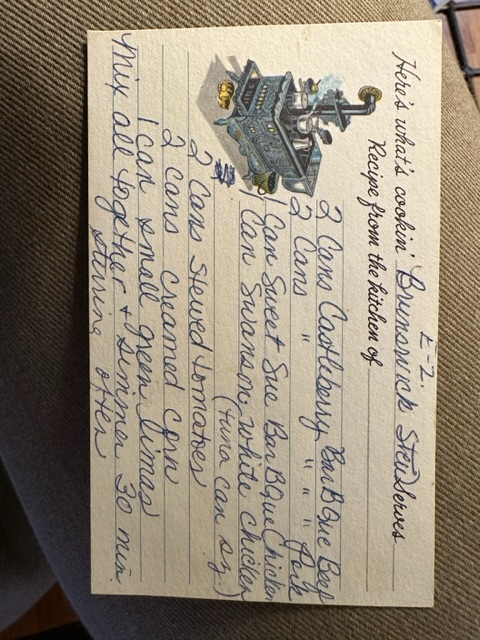
I glance over at my dogs, deep in a morning snooze, and glimpse my mother’s rippled swiss dot milk glass on the kitchen counter. I think of her recipe for E-Z Brunswick Stew, and I take it from the recipe box to share with you today. Though Mom is no longer here with us, her legacy lives on through her recipes and memories.

This is hygge in its finest form.