I sit in a rustic green rocker on a porch facing the Rough River in Falls of Rough, Kentucky this morning with a cup of coffee. A thousand birds are worshiping their maker in glorious song, competing with the heater that sits adjacent to the front porch. Here is my list of choir members so far:
American Robin
Belted Kingisher
Northern Cardinal
European Starling
White Throated Sparrow
Yellow-rumped Warbler (butterbutt)
Song Sparrow
House Sparrow
Tufted Titmouse
Mourning Dove
Carolina Wren
Red-tailed Hawk
House Finch
Blue Jay
American Crow
Ring-billed Gull
Canada Goose
It’s the robins who are leading in worship here this morning. They all are competing for the title of soloist extraordinare. In the distance, I hear a woodpecker, but he is beating the drum and not singing, so I cannot tell what kind he is.
The river is still, smooth as glass and muddy. and of the ten or so cabins in this remote area, only one other is occupied. There isn’t another soul outside, so I hold the only ticket to this private concert-for-one.
At least for now. The boys will be up shortly.
OOh, ooh – and just now, the woodpecker flew across the river to a hole in a tree, and I can see that it is one of the smaller varieties. And then it attempts its own clownish note, and Merlin declares it is a Northern Flicker.
The sky is a steel gray with morning clouds supposed to burn off by mid-morning. We came in after dark last night and can hear the falls rushing under the bridge we drove across, but that will take a walk or ride to see them.
for just this moment
the rest of the world stands still
I bask in birdsong
Then, all at once, every bird ceases to sing, as if their concert has ended with one Amen in unison, and they have other things to do, other places to be. I am left alone in the silence of this porch, where three small noses are sniffing under the front door to take in the world here outside and to remind me that they, too, have their own offerings to give. That’s my beckoning to get up and help Briar walk them on their leashes down to the water’s edge and hold on tight, at least where Fitz-the-brave-hunter-of-anything-that-moves is concerned.
I can see how Ada Limon, the U.S. Poet Laureate who lives in Lexington, Kentucky, finds her writing groove here in this state. There is magic in the air for those who take the time to notice.
Later today, at 2:00 Kentucky time, I’ll attend my grandson’s first birthday party. He’ll be one tomorrow, and what a joy he is! In the flurry of activity and excitement, I will think back to this porch and all its lack of demands and be thankful that God gives us children when we are young, so that in our golden years we can fully appreciate the power of the front porch.
Dr. Sarah J. Donovan is our host today at http://www.ethicalela.com for Day 2 of the May Open Write. She inspires us to write poems of our heritage through place and culture. You can read her full prompt here.
As our birds return in greater abundance making their way back from their winter in the south, I again find the deep peace of birdwatching on my front porch in the early hours of the day. It really should be called birdlistening, I’m convinced, as the sound leads the way to the sights. The breaking sunrise that shows up for work each day, combined with the gratefulness of birds singing praises, brings joy!
I return to work this morning after a quiet, uneventful fall break. We’re having an emergency drill today, so the inner peace will not fade throughout the work week but instead will be pumped out as adrenaline and action and what ifs replace the echoes of birdsong and back porch swing chains. My brother and his girlfriend came to visit, we arranged some furniture to make room for a few new pieces from my dad’s house, and we sat outdoors by the fire pit, roasting marshmallows and talking into the night.
As I was taking the dogs out for their final evening walk one night, I did what I always do – – I shone the flashlight all along the edge of the woods to see if there were any eyes shining back at me. Out here, we have everything from coyotes to field mice, and I’ve learned that I can never be too careful.
Sure enough, there was a tiny pair of eyes looking at me, about fox height. It had a black, bushy tail with a triangular-shaped face. We had a stare-down for a full minute at least before the animal disappeared around the tree, its tail curving along the trunk as it slunk off into the forest.
I walked the dogs, thinking it was gone, and mentioned it to my brother when I came back inside.
“Really?” he asked. “Let’s go check it out.”
I grabbed the light and off we went, back to the tree, where the two eyes sat just a foot behind it, shining back at us. The brush was thick, so we stared at it for a few minutes trying to figure out what it was before it hopped off through the dense thicket and went on its way.
I Googled and concluded that it may have been an oddly-shaped fox squirrel. We’ve had a black squirrel for a long time on this farm, and perhaps this was the great great grandson or something.
The shape of that head, though, perplexed me. I kept returning to the idea that it wasn’t a squirrel when it hit me: it might have been a skunk.
Just like my brother and me to chase a stripeless skunk into the woods, but I think that’s what happened.
If I’d had any doubt, my husband took the dogs out early yesterday and returned to bed, noting, “There’s a slight skunk smell out there.” I hadn’t told him that I had toyed with the idea that this had been a skunk.
Now I’m sure of it.
Skunks, dogs, birds, fireside pits, porch swings, and Hallmark movies all week- – and today I leave you with photos of peace taken last week. Happy Monday!
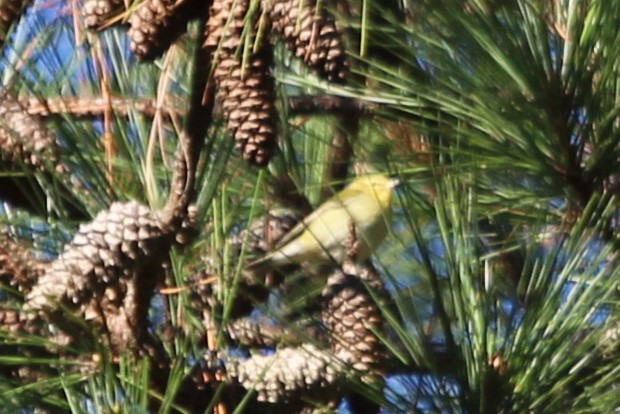
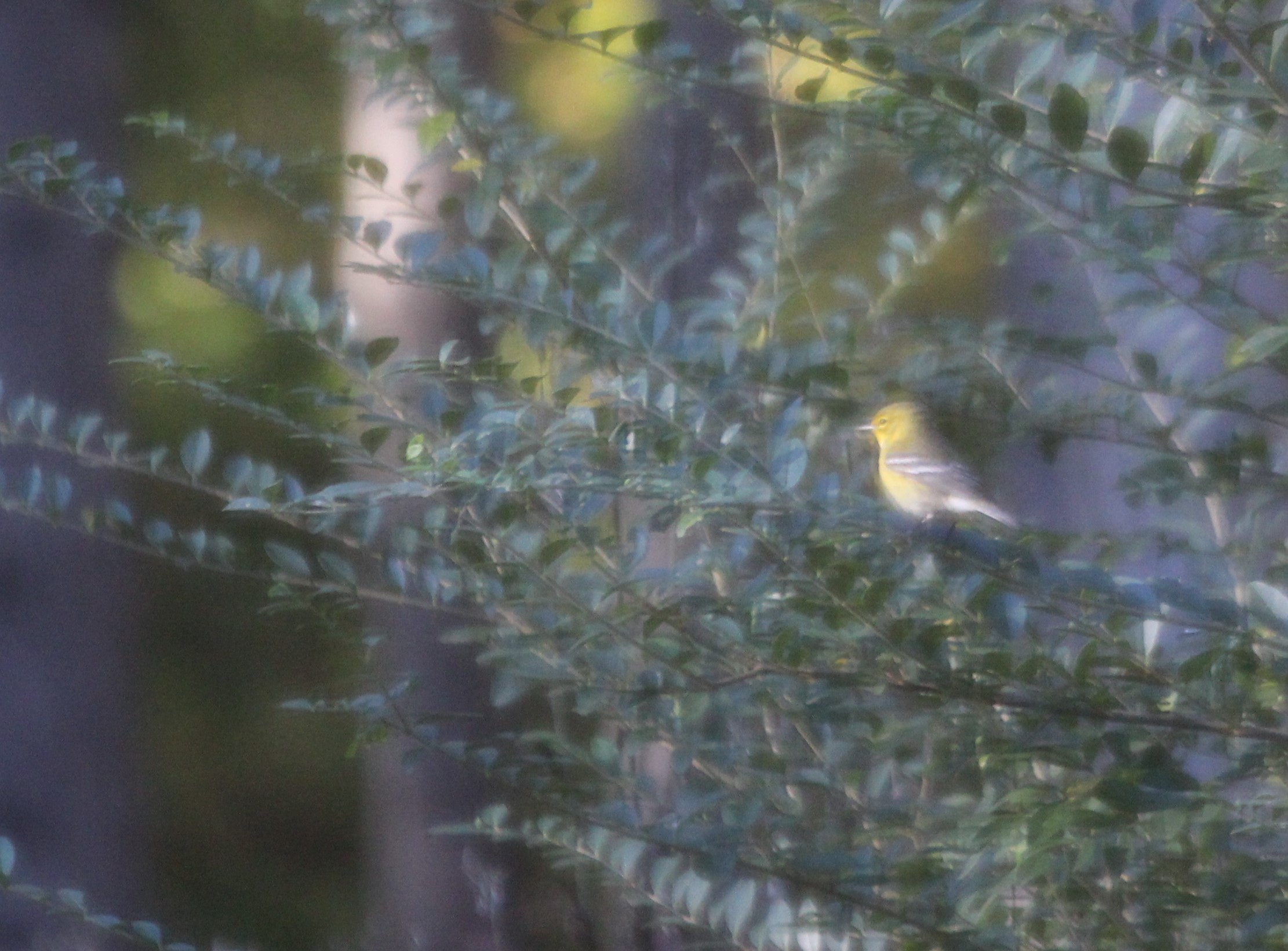
Leaves are turning, becoming more colorful by the day in my county.A pair of finches on the roofA pair of cardinals in the treeA tufted titmouse scratching an itchtufted titmousepine warblerpine warblerA tufted titmouse takes flightI’m photographing this tree as it loses its leaves, every few days, so I can see the change shot by shot
A couple of autumns ago, I found some summer patio furniture on a ridiculous clearance sale and bought two loveseats and two coffee tables for the front porch.
I knew I’d like them, but I had no idea how much peace they would bring to my life. As an early riser, I can sit outdoors in the morning in the most extreme heat of the summer, before the sun comes up, to begin the day writing and listening to the treetop concert of the Johnson Funny Farm.
I rise at 5 each morning. I shower, get dressed, put a little color on my face, and brew a cup of Eight O’Clock coffee in the Keurig. From there, I take my computer, phone, and lap desk out to the porch to savor my morning writing time.
Most days, I also do a little birding in the mornings. I listen as much as I watch. We have two Great Horned Owls who chat over their coffee, too, back and forth across the east side of the farm. I like to try to spot them through my binoculars when the sun is high enough to see through the shadows of the Loblolly Pines. So far, they are winning our game of hide and seek.
The woodpeckers are a different story. They put on a show most mornings. We have Pileated Woodpeckers, Downy Woodpeckers, Hairy Woodpeckers, and Red-Bellied Woodpeckers. I keep watching for a Yellow-Bellied Sapsucker, but they keep not showing up. On any given morning, there are as many as 25 species of birds flitting through the trees, singing, and bringing joy to the start of my day.
The Ruby-Throated Hummingbirds dart around, squabbling over whose feeder is whose and avoid mid-air collisions at every turn, even though I don’t see how. As much as I anticipate the cooler weather of fall, I’ll be sad to see them move on, especially the ones who like to hover two feet from my face – the only birds who take the time to look me in the eye and thank me for the all-you-can-drink nectar. This month, they will begin their migration to Florida for the winter, like so many people who seek the same warmth.
Others are here with us all year and have no travel plans in the coming weeks – the Northern Cardinals, the Carolina Wrens, the Blue Jays, the Tufted Titmouses, and the Mourning Doves. We’ll wave goodbye to our summer guests soon, and stand ready to welcome the whole fold back next spring.
And perhaps it’s a little extra, but I can’t help worrying about my little hummers. I want to pack them a picnic for the trip and ask them to text me when they arrive safely and put a little teeny-tiny GPS tracker on them to see where they go for Christmas.
Somehow, I think they know I’ll be watching and waiting for them from my front porch seat, coffee in hand, ready to greet them next April and celebrate their long-awaited return.
Jennifer Jowett of Michigan hosts today’s Open Write at http://www.ethicalela.com and offers us a compelling prompt about the future of our world today. Her prompt is one we dance along the periphery of in so many of our countryside drive discussions, wondering about the future of our county, heartsick over each new development, each new killing of droves of trees that were once home to birds, deer, foxes, squirrels, bees, chipmunks, raccoons, opossums…..it breaks my heart for the wildlife and for the future of our grandchildren.
Dowdell’s Knob, a favorite place of President FDR for hosting cookouts and picnics
After walking my 3 Schnoodles along the back loop of F. D. Roosevelt State Park and recording 15 species of birds singing from trees, flitting from post to post and diving for food in the grasses and shrubs, I resumed my Global Big Day bird count at the top of Dowdell’s Knob on Pine Mountain in Georgia overlooking the valley below. The dense fog was beginning to lift, making it possible to see more of what I was hearing. I was thinking of my friends who were also out participating in this event – Fran Haley from North Carolina, who was out looking for eagles at a dam with her husband on her birdday birthday, and my colleague Dawn Lanca-Potter and her son Grayson, who were out observing in Pike and Upson Counties in Georgia.
After completing my eBird Essentials course and researching the local hotspots for bird activity, I chose Georgia’s largest state park, F. D. Roosevelt State Park just outside Warm Springs, for my birding adventure. I was excited to live these opportunistic moments observing the plethora of species in this biodiverse area in close proximity to Callaway Gardens. My mother, who had been a lover of birds her entire life, was close – I could feel her spirit in the breeze, her presence in the harmonious, sweetly chirping birdsong.
I had no idea that she would make her presence more even powerfully known in such an unquestionable way.
But that’s exactly what happened.
Male and Female Summer Tanagers on pine branch overlooking Pine Mountain Valley
In 2008, I’d applied for a teacher scholarship to spend a week learning alongside scientists in the field at the Jones Ecological Research Center near Albany, Georgia. Four courses had been offered, and we could pick two of the following: wildlife, aquatics, forestry, and plants. I chose wildlife and plants and completed both of these sessions the first year. I returned the second summer to complete the other two. As part of the grant that funded our teacher scholarships, we received copies of Janisse Ray’s Ecology of a Cracker Childhood, a memoir about the author’s days growing up in poverty in Baxley, Georgia and learning all aspects of the Long Leaf Pine ecosystem; and Aldo Leopold’s A Sand County Almanac, which is in my top three favorite books of all time. I savored these pages, and I return to them often still. They teach me a lot about plant and animal species – especially the rare and dwindling ones, like the Red-Cockaded Woodpecker and Bachman’s Sparrow.
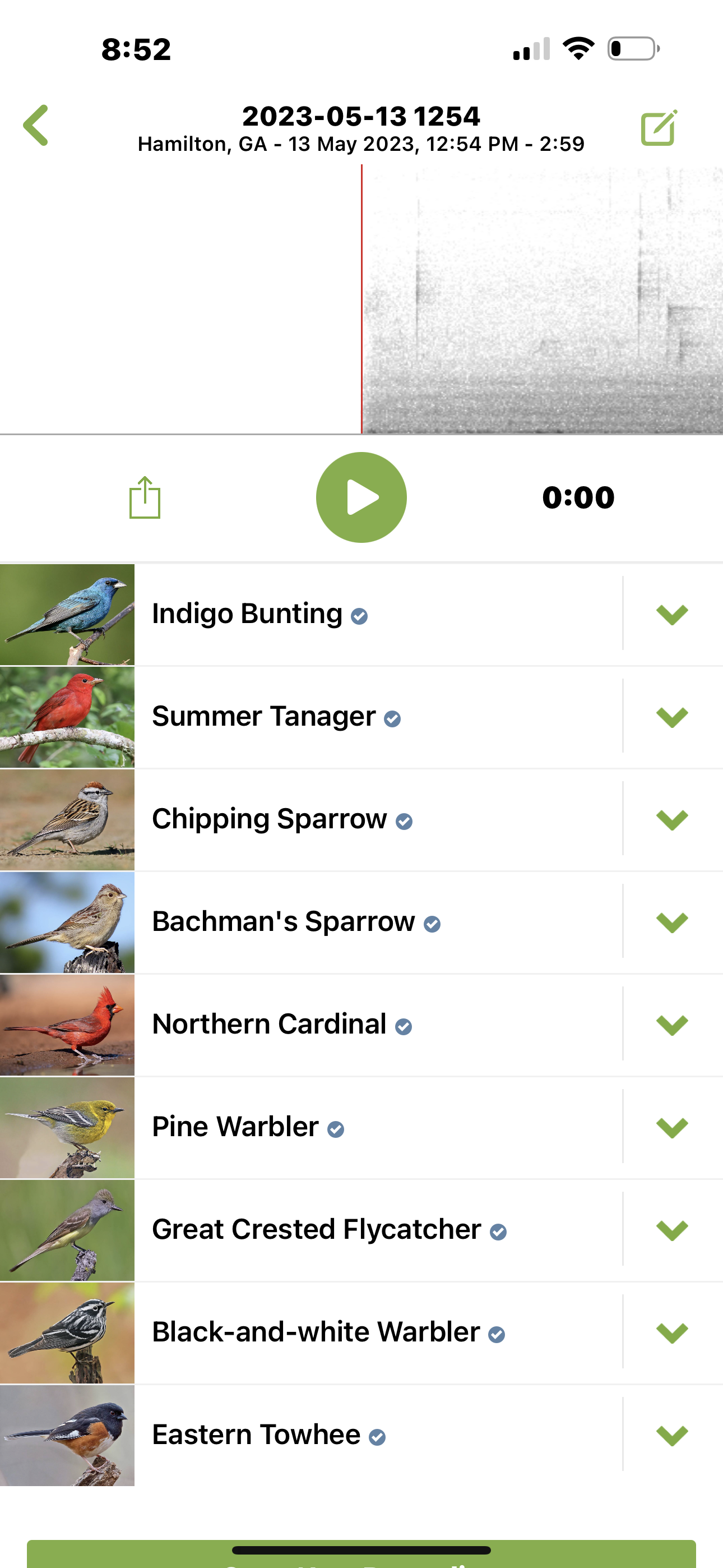
I turned on my Merlin Bird ID to figure out which species were in the area, and I used the tone sensor to figure out where each bird was located in proximity to me. My strategy was to let Merlin’s unmistakable expertise lead, and then to photograph and audiorecord and count the species as I encountered them.
I’d complete a checklist in one spot and move on to the next, all along the mountain. I almost didn’t stop in one particular spot, because the motorcyclists were out on rides in large groups and had a substantial gathering in one of the overlooks as they took a lunch break; I was thinking the noise would deter any birds, but as the cyclists began to leave, I changed my mind and decided to do an observation in this spot.
I sat on this rock overlooking the valley to observe.
I sat on a rock and started the checklist. 12:54 p.m. I was hot and tired. I took a long swig of icy water and tapped into my buddy Merlin, who had already led me to Indigo Buntings, Summer Tanagers, Great Crested Flycatchers, and a long list of other birds not too difficult to spot once I knew they held presence in an area.
No way. This one has to be a mistake, I thought. I watched the tone sensor. These are rare birds, far too shy and rare for a mountainside full of motorcyclists vroooming around.
I thought of Janisse Ray’s chapter on Bachman’s Sparrow. Bird-artist James Audubon discovered the sparrow in 1832 while exploring near Charleston, South Carolina, and named it for a Lutheran minister he had befriended on the street and with whom he was staying, John Bachman. Bachman’s Sparrow has declined since the 1930’s at a stunning rate. It is streaked buff-gray, with a shadowy bill and a long, dark-brown, rounded tail. It measures six inches from bill to tail tip, about the size of most sparrows, and has been called the stink-bird by quail hunters because its ground dwelling can throw off the dogs hot on the trail of a bevy of quail.
Sure enough, Bachman’s Sparrow appeared and continued to light up in yellow highlighting as I searched the trees and located a group of sparrows – and while I never could tell which sparrow was Bachman’s through the high-powered lens focused in the trees down the bank on the side of the mountain, I knew that at least one of these elusive birds was somewhere in that mix. Right there in that tree. Right near me, singing its cheery greeting, lighting up a few times on the app.
Bachman’s Sparrow in Merlin ID
On Global Big Day, that Bachman’s Sparrow was my mother reaching down from heaven for a tight hug on Mother’s Day weekend, letting me know she is watching over me, reminding me to be strong in my faith: many times, we can’t see something that we KNOW without a doubt is there surrounding us, and these things are forever real.
God, mothers in heaven, birds. Ever present, forever real.
With special thanks to Two Writing Teachers for giving writers space and opportunity to share our love of writing











 Common Threads