


New Poetry Forms Nonet
today I get to write with students
showing them new poetry forms
#hashtag acrostics await
poems taken from prose
hidden in the lines
existing text
there for the
prompt of
words
When the high school teacher called asking if I would be willing to come write poetry alongside students, I jumped at the offer. As a District Literacy Specialist mostly wrapped up in the operational world of data and school improvement, I miss the opportunities of the classroom. That’s where we make the biggest difference.
She read to me the AP Standard on taking poetry from prose and wanted to feature blackout poetry. As we chatted, I shared with her my blog post that day and gave her a copy of 90 Ways of Community, a book on poetry written by one of my writing groups. Together, we considered the various poetry forms that we could use if we modeled the process ~ blackout and found poetry were already on the list, but we added Haiku, X Marks the Spot, Acrostic, Golden Shovel, and Zip Odes as a geographic timestamp bonus of sorts. The students have already created their own personal writing, and we’ll show them how I used a blog post to extract poetry and urge them to do the same.
We’ll model the process.
We’ll feature an overview of possibilities – – a menu of choices – – and then watch their creativity flow onto their paper like they’re mining for gems that they pull out to polish and sparkle.
I’ll remind them that poetry is a process – – not a product. In fact, I’ll probably open the class with something like, “poets and artists have a mindset of creating a lot of bad poems and a lot of bad art.” They’ll wonder who the crazy lady is, but I’ll explain what I mean: perfection is not the goal. Writing is the goal. Thinking is the goal. Not every race is a marathon, not every photo wins awards, and not every book gets 5 stars – – it’s finding the pieces of what we do well and building on those parts so that the process becomes somewhat of a habit. I’ll explain to them that I think in metaphors and syllables, and I take a lot of random pictures to come back to little things I see that will work their way into poems.
Take this, for example:
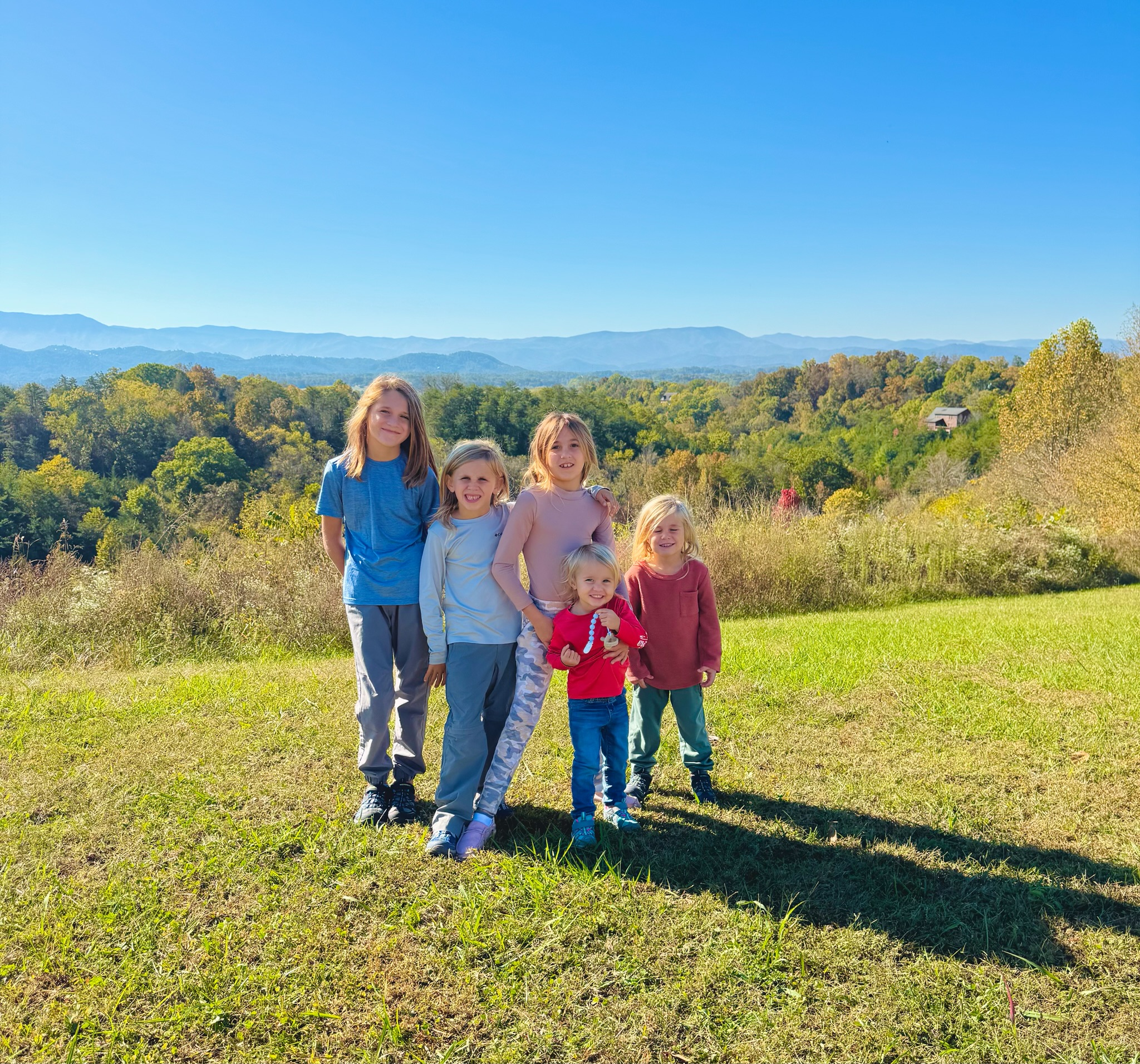
These kids are a big part of my life. Here stand five of my seven grandchildren in the very spot at the top of a mountain in Sevierville where their parents were married in May 2012. Their other grandparents own that land, and at the bottom, there is a fishing pond. Let’s take a deeper look.

I see two boys (yes, they’re boys – they just have lots of hair) exploring the trail that leads to the pond, tacklebox in hand, ready to to cast a line and spend time fishing. I’ll explain to them that already, my thoughts are swirling in metaphors of adventure, seeking, a quest, a tackle box of what it takes to find, a hook for the found thing to be caught, and the patience and grit to stick with it – and the treks through the mud and the weeds to get there.
Because fishing isn’t about the fish. You can go to the grocery store and get fish. You can order fish from a restaurant – or better yet, you can Door Dash fish.
No, fishing is no more about the fish than poetry and art are about perfection. It’s about the adventure and the process, and the wait for just the right inspiration.

It’s about engaging in what it takes to do a thing, whether writing a poem or creating art or catching fish. It’s having the stick-to-it-ness to stand still and be quiet for two hours of a morning and be determined when you’d almost always otherwise be doing something else, but you learn to love a thing and know that there is something, something, something that will bite and that you’ll reel it in and be proud of it, whether it’s big or small.

You’ve caught something you’re proud of, and you can’t wait to share it with the world. So you pose for the photo, holding a fish mouth open the way you’ve been taught, holding the fish a little closer to the camera to make it look bigger than it actually is, and you see the great things about your fish.
And then you release it back into the world, knowing that next time you come back, you may catch that same one again – – or something different, like that turtle your sister caught.

Either way, the one thing you cannot buy, like that Door Dashed fish, is the mud on your own shoes from the lived experience.
And that is what poetry is – life, experience, thinking, waiting, casting a line and seeing what comes up on the end of the hook.
So while I may say I’m going to school today, what I’m really doing is going fishing
And I can’t wait to see what all we catch!


















 Common Threads