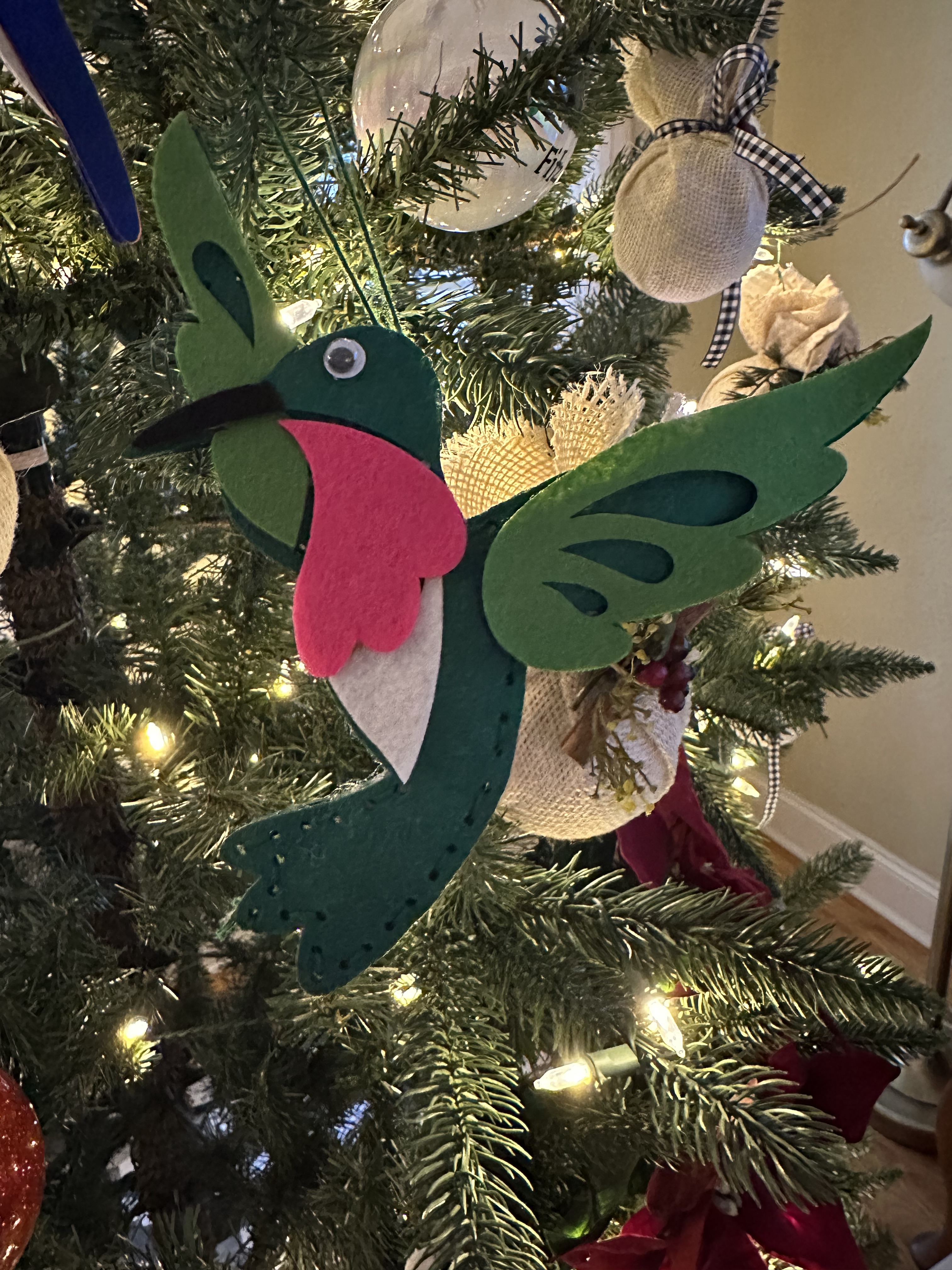
For Christmas, my grandchildren made me hand-stitched birds. The love that went into each stitch is precious and was a labor of love and patience for them and for their mother. They will adorn my new office space as soon as we get moved into our new building. These are far too lovely to hang only once a year on a tree. I need them where I am reminded daily of my blessings, for those times I get caught up in the work day and forget that there are so many reasons to smile and take things in stride. I love that their mother is already teaching them that the key to the fine art of gift giving is in the heart of the recipient – and that handmade gifts are the most special of all!
We have three schnoodles, all rescues, who came to us bruised and battered, scarred and scared.
We understood.
Going from abandonment, abuse, neglect, and betrayal to a shelter or foster home, to a forever home must be filled with all sorts of emotions and confusion – and I am a firm believer that dogs have emotions.
That’s why we forgave Boo for biting a couple of times at the start. Here was a dog who was shivering with fear in the back of a van in a wire kennel. He was matted and thin, dirty and smelly.
He almost wasn’t ours. We’d found dogs online twice that we’d come to adopt, and both times we’d completed paperwork only to find that when we arrived, our dog had “just been adopted” by someone else. Right out from under us.
Boo Radley a/k/a Einstein at the rescue - picture sent to us by the organization on his intake day
A dog they dubbed Einstein for his wild hair had just arrived in the parking lot on one such occasion, and was being held in a van until he could be processed. They could not put him out for adoption with the other dogs yet. I think the lady who’d promised us the cute female Maltipoo with some sweet little Hawaiian name truly felt bad that we’d driven an hour to adopt her only to find she had just left with another family, so she’d added, “But there is one other possibility. I can’t let him go today, but he’s just arrived. Want to take a look?”
We did.
We followed her to the parking lot, where she’d opened the van doors to reveal the most frightened dog we’d ever seen, visibly shaking and unsure of what was happening to him.
I stuck my head in and spoke softly to him, and he calmed down. I asked to hold him, and the woman reluctantly allowed it after explaining that the landlord of a nearby apartment complex had brought him by and begged her to take him. She told the woman that the dog’s owners had left two weeks earlier, that this dog had been abandoned in a duplex, and someone must have thought he would be found immediately. He wasn’t. They’d left food and water down, but it was all gone by the time the cleaning crew showed up to find a huge mess teeming with flies and one terrified dog.
Boo Radley the day we picked him up from the rescue
We adopted Einstein and named him Boo Radley. He had no reason to trust anyone anymore – if he ever had – and we had a lot of ground to gain with him. He snapped and bit at first, but with love and time, he has come to be a loving companion, despite his many lingering issues.
Boo Radley watching the driveway for his people to arrive home (he’s a full time inside dog who wants to wait outside for his family following his afternoon walk)
This is the dog who will cower to the laundry room and shake when anyone’s cell phone dings. Let it ring with music and he will howl at the moon.. He becomes agitated and obsessed with killing flies if he sees one buzzing around. If he smells the heat of a toaster, he will shake with fear and seek a lap. If the smoke alarm (or any timer or noise such as a clock) goes off, he goes into a tizzy. We think that somewhere along the way, he experienced a fire.
Boo Radley – ready to play keep away with his ball. Where other dogs fetch, Boo has trouble sharing his toys.
But this is the same dog who sits awake all night at our heads, guarding us as we sleep, then sleeps all day. This is the dog who sits at the head of the driveway and doesn’t want to come inside until both of us are home from work. He knows he has a family, and he knows his role is to protect and love us – as ours is to protect and love him. This is the same dog who knows he will never again be abandoned or abused or neglected. The same dog who now rests assured of his place in his forever family.
This is what rescue will do.
Boo Radley – sleeping like an owl in the early morning after guarding his people all night (don’t let him fool you: he’s a fierce working dog, not a mere lap dog).
My friend Margaret Simon of Louisiana hosts the weekly Poetry Friday Roundup by posting a photo and inviting writers to compose a poem inspired by the photo. Last week, she visited the North Georgia mountains with her family as a Christmas gift to her children and their families, and she posted her cherished moments of making memories with them. She invites us this week to write a poem about this photo of her mountain house.
Margaret has been using the elfchen form, also called an elevenie, in which the lines fall into the sequence of 1 word, 2 words, 3 words, 4 words, and concludes in summary fashion with 1 word that ties it together. She will announce her One Little Word tomorrow, and hints that it may be the last line in her own poem (Connection), so I’m giving an enthusiastic nod to her choice by using a form of connection as the last word in my own poem. You can read her post here, along with other poems that were written about the photo, and her picture that inspires her poem (and others) is below:
Mountain House photo by Margaret Simon
Presence
unhindered
time spent
unhurried memory making
letting presence be presents
connecting
Try an elfchen! These are fun to write, and what a fabulous way to preserve memories – using photos and short forms of poems. I like the way just a few words can encapsulate an entire experience and bring all the memories and good times rushing back.
A special thanks to Margaret Simon for inspiring my writing today. Some of my greatest blessings are my writing community friends, who encourage and inspire me to be better.
At the end of each month for the past decade plus a few years, I’ve reviewed my yearly goals and spent time reflecting on how I’m living the life I want to live ~ a way of becoming my own accountability partner and having frequent check-ins to evaluate my progress. The process I’ve been using has been helpful in guiding steps of intentionality and observable differences – – it has put teeth of quantifiable measure in the conversations I have with myself whenever I might attempt to believe that I’m making progress and provided a way to articulate exact progress so that I’m not merely shuffling things back and forth and deceiving myself. I make a table, establish goals, and keep an accountability log of accomplishments and action steps through month-end reflections. I learned this system somewhere in my early years of teaching and it was reinforced by my doctoral chair, Dr. Rachel Pienta, who assured me that it would get me to the diploma at the finish line with fewer tears and less frustration.
She was absolutely right.
This year, though, I’m tweaking my process by a few degrees to get to the things in life I need to accomplish. Everything on my list is not an ongoing action goal – – some of these are aspirations, and I need to recognize the differences and prioritize my efforts. Weight loss is an action goal that needs quantifiable progress markers with a timeline. Downsizing and retirement planning needs quantifiable progress markers with a less strict timeline. But gardening and hobbies like knitting or quilting or canning fig preserves are not as high on the list of priorities, and they’ll fit in between the more challenging goals where time permits.
So this year, I’m using a different system. I’m evaluating my progress in bold areas monthly, and all other areas quarterly.
I’m looking through a proverbial viewfinder for the big areas of life where I need the presence of some focal lenses, and I’m thinking of the smaller aspects of those larger lenses as I adjust the diopter lens and take snapshots of my journey.
2024 underway, taking us on a new scenic journey. The conductor punched our tickets at midnight – – (and where we live in rural Georgia, our front door literally shook with a sonic boom from someone’s Tannerite explosion welcoming the new year).
It’s here, folks! Welcome 2024, and cheers to you and yours!
The Viewfinder
Optical Lenses of Focus
Diopter Lenses of Possibility
Snapshots of Success
Hobbies and Life Outside Work
Sewing, Knitting, Quilting Traveling and camping Gardening Birdwatching Monthly reading group with Sarah J. Donovan Writing with Ethicalela.com 5 times a month, and every day in April Writing with Two Writing Teachers at the Slice of Life Blog every Tuesday and every day in March Writing with Spiritual Journey Blogging group on Thursdays The Stafford Challenge – a poem every day starting mid-January Writing group book proposals
These columns will be shared as progress occurs each month or quarter.
For starters, I am sharing my blog post on Slice of Life today. And just like that, I’ve taken a step into 2024 with a hobby that I enjoy.
Weekly Dinners and game nights In Person Visits FaceTime Visits Group Texts Traveling together Celebrate Red Letter Days
Mental and Physical Health
Reach top of weight range (I know this number) by June 1 and maintain it throughout 2024
Walking
Hiking campsite trails
My Table of Plans for Focusing on Success
My One Little Word for 2024 is pray. Today’s diopter word is step. As I pray for 2024 to be a productive and fulfilling year, I must step into it with purpose, and take the steps necessary – to do my part – to make it a great year.
Last week, I presented a family member with a box of verbs to encourage reflection, guidance, journaling, and meditation on positive words and the actions they inspire. She used these words written on miniature Jenga blocks to select her One Little Word for 2024, choosing the word trust because she says, “It’s something I truly want to be able to do.”
When I think of selecting a word of the year, it’s challenging to choose only one. As a lover of words and all their nuances, it makes it even more challenging to parse out synonyms and all their shades of meaning. It’s like having that big box of Crayola crayons and being asked to choose one favorite color – – – only harder.
I really have trouble with that. I love the bright yellow sunshine, the crystal blue water, the spring green grass, the scarlet red cardinals, and the orange embers burning in the fire pit, glimmering with the heat like embers do. I want all the colors, and I want all the words.
Most of all, I want the verbs.
Not just any verbs. I want verbs that inspire positive action in my life and lead me along healthy paths.
After considering a few hundred words for 2024, I’m staying with my 2023 word for another year.
Pray.
I can’t think of a better word fit for me for the coming year. To pray without ceasing is to carry this word each day, each hour. On my way in to work each morning, I turn off the radio and follow the ACTS model of prayer, first offering Admiration, then Confession, then Thanksgiving, and finally Supplication. Mostly, I give thanks for the miracles of blessings received. But I also give thanks for the miracles of things that didn’t happen that I may never realize I was spared.
My friend Glenda Funk is taking the word care as her word for 2024. An article in The Washington Post encouraged her to choose a nudge word – a word that nudges her to live the life she wants to live. She writes in her blog post, “Care is a word I expect to push me to live the life I want to live in the coming leap year.” Fellow Slice of Life writer Sally Donnelly has selected the word prioritize, because she wants to keep the mantra, “Should this be a priority?” in focus as she chooses her path and all of her options.
When I read about all the words my friends choose, it gives me such joy when they share the reasons they’re choosing them. What is your One Little Word for 2024, and how did you choose your word?
At the end of each month, (or beginning), I review my yearly goals and spend some time reflecting on how I’m doing in living the life I want to live ~ a way of becoming my own accountability partner and having frequent check-ins to evaluate my progress. I’m still in the process of revising some of my goals as I encounter successes…..and setbacks. For the month of December, here’s my goal reflection:
Category
Goals
My Progress
Literature
Read for Sarah Donovan’s Book Group
Blog Daily
Write a proposal for writing group’s book
Sarah’s book club did not meet in December, so I started Braiding Sweetgrass by Robin Wall Kimmerer and am hanging on every word. I don’t want it to end. I’ve completed I Hope This Finds You Well by Kate Baer for January’s book discussion, and I think Kate a genius for finding apt responses in her hate mail and flipping the script.
I continue to blog daily, and the daily writing and reflecting is a wonderful habit for me. I don’t feel complete without some form of daily writing, and the blog is a way of continuing the habit.
My writing group is writing a series of new books, and I will spend time sending our proposal out to some publishing companies. We are slow going at this, but we refuse to give up. I did not send out any proposals in December, but we met by Zoom and each decided to send to a couple more, so I need to get on that on the Tuesday and Wednesday before returning to work on Thursday.
Creativity
This goal did not happen in December. There was no creativity except in the making of a hat or two on a knitting loom.
Spirituality
Tune in to church
Pray!
Keep OLW priority
We still watch a variety of churches on Sunday – in Georgia, Kentucky, and North Carolina. We attended a Christmas Eve Service of Lights in Kentucky when visiting family there.
My car is still my prayer chamber for daily prayer, and there’s so much to give thanks for. I continue my conversations with the good Lord each morning and afternoon.
I’m still keeping my OLW my priority: pray!
Reflection
Write family stories
Spend time tracking goals each month
I have shared family stories through my blog this month. This will not be as much of a focus in 2024, but will continue sporadically.
I’m tracking goals, revising, and considering some new categories as I look at my goal table.
Self-Improvement
*Reach top of weight range
This is a true failure goal for me in the last 6 months of the year. The first six months was amazing. Then, we drove down Route 66 and had the coconut cream pie at the MidPoint Cafe in Adrian, Texas, and I haven’t stopped eating anything all year.
Gratitude
Devote blog days to counting blessings
I begin the days this way and end them giving thanks as well. Special occasion birthdays are often reserved as gratitude days on the blog.
Experience
Embrace Slow Travel
Focus on the Outdoors
In December, I’ve traveled within the state to two different conferences – one in Harris County, and one in Paulding County, both focused on Literacy. I have also traveled to see family in Kentucky and South Georgia, and our South Carolina family came to us. I’m about ready to hit the pause button on travel for a while, other than an occasional weekend of camping.
I’m still focusing on the outdoors with birdwatching on the farm so that I know which birds are prevalent during which months right here on the Funny Farm. I’m planning to shift partially to focusing on the indoors, paring down possessions so that we can, perhaps, by the end of the year, have a viable plan to downsize our home to a barndominium for our coming retirement years.
In the coming week, I will examine ways to keep monthly goals and the best ways to share progress quarterly. I’m also searching for the One Little Word I’d like to take with me through 2024. I will share that word in the coming week as well.
We are visiting my childhood home today – St. Simons Island, Georgia, on the 8-year anniversary of my mother’s death from Parkinson’s Disease. Although the family house where we grew up has long since been leveled and rebuilt, so much of the 1970s decade is still ever present here on the island.
When I was young here, the Tastee-Freez was the place we’d go on our bicycles to get ice cream and hot dogs. It has since been a Dairy Queen and now a Frosty’s, but the original poster is still hanging by the door.
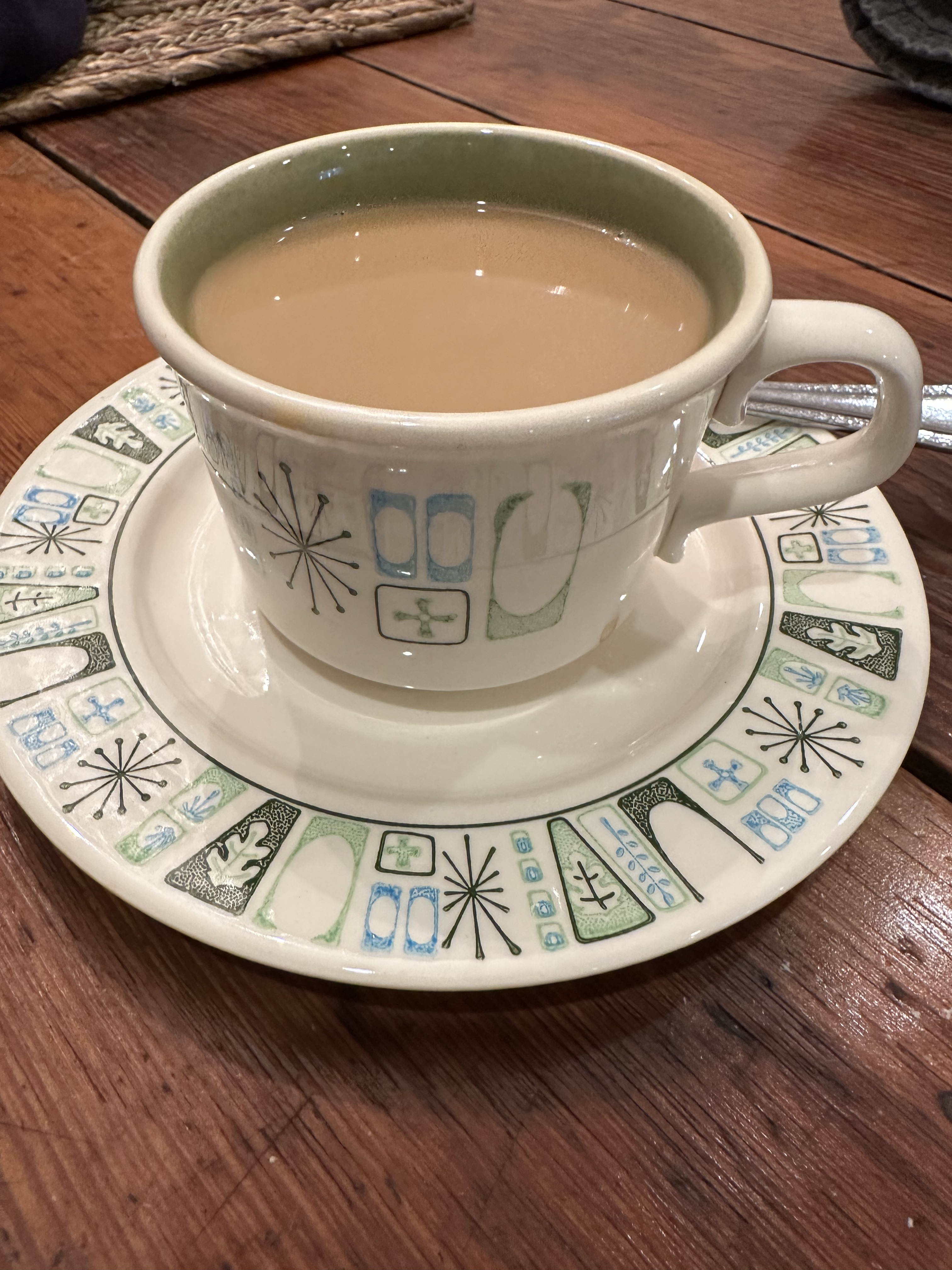
I also love my brother’s dishes, which were our family dishes in the 1970s. This morning, I used a smaller coffee cup and a saucer than I would normally use, just to eat from these dishes. The retro vibe is strong on the olive green pattern.
It’s a welcome feeling to walk back through the decades. As we go through years of memorabilia with our dad, my brother and I are reliving memories and sharing the stories. Even though the annual “family meeting” is sometimes uncomfortable with the details of how families move forward after losing a loved one, it’s also filled with plenty of time around the table, enjoying great food and laughing.
As we move into a new year, laughter is a word that I’ve considered as my One Little Word for 2024. It’s surely something that improves my whole outlook!
We’re missing Mom today, but we know she is close. As my brother and I were driving this morning, a hawk flew directly over us – – a sure signal that all is well in Heaven.
From the Yule Log recipe notes: A French Christmas tradition that dates back to the 19th century, the cake represents the yule log that families would burn starting on Christmas Eve, symbolizing the new year to come and good luck ahead.
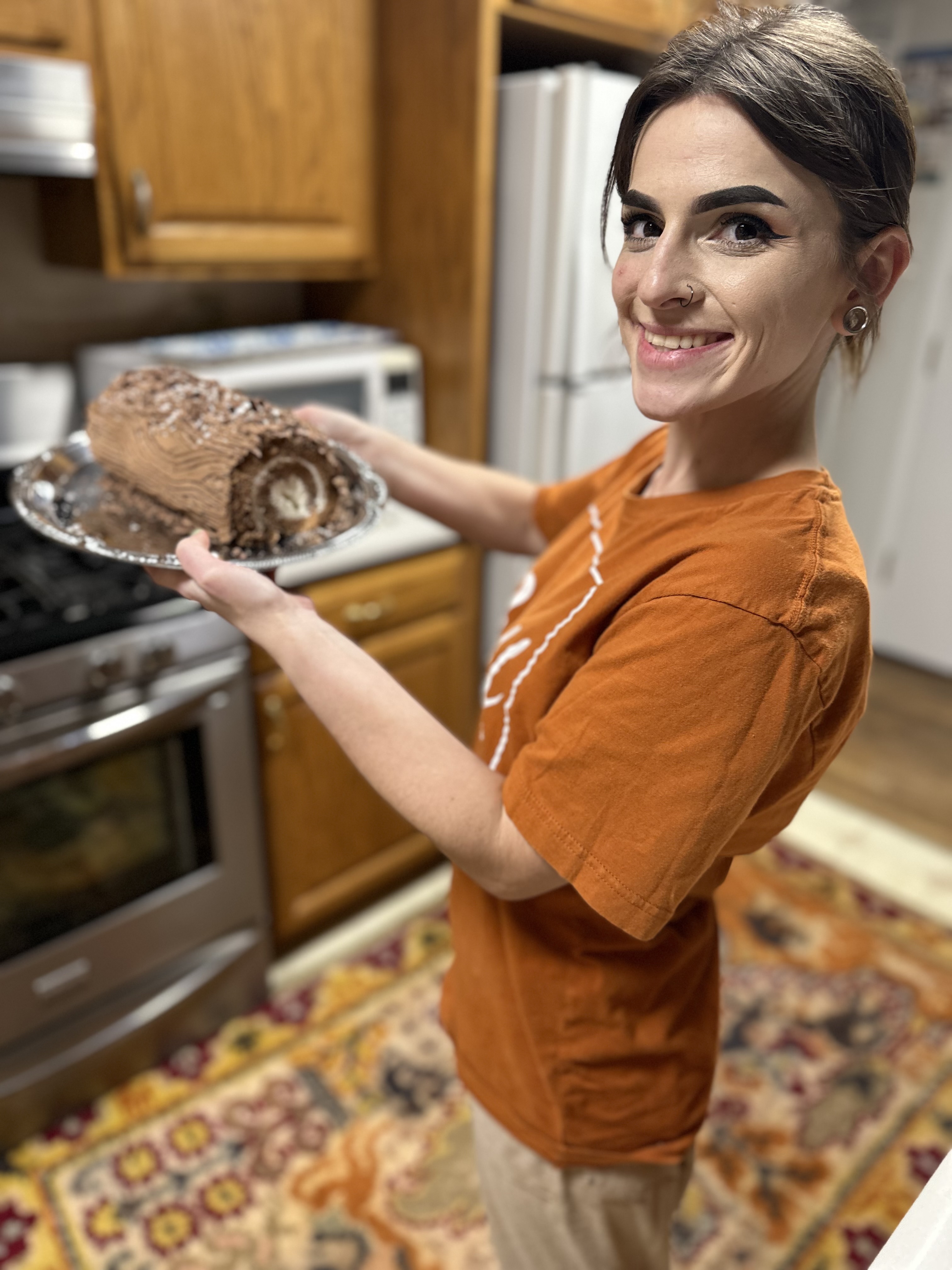
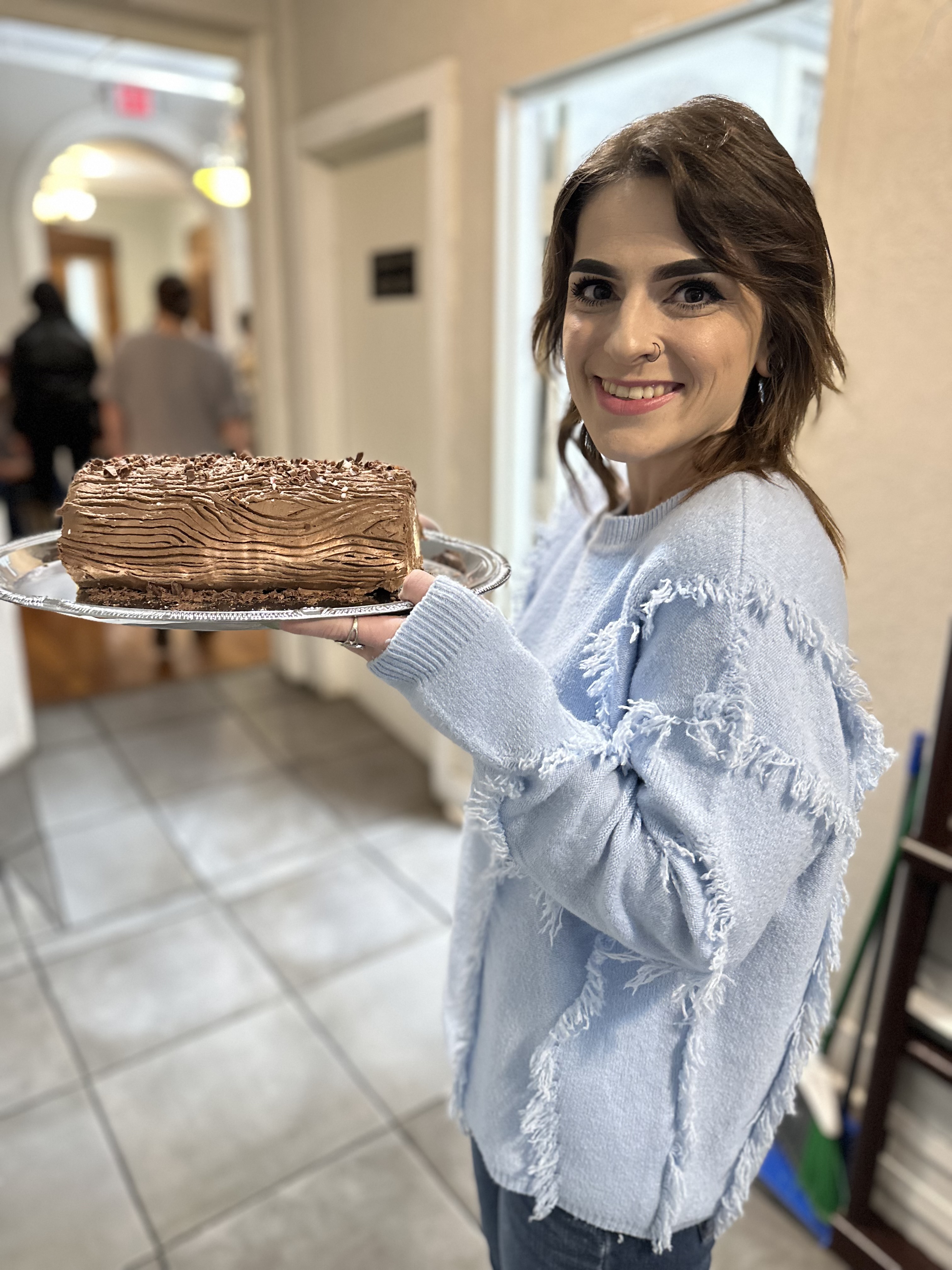
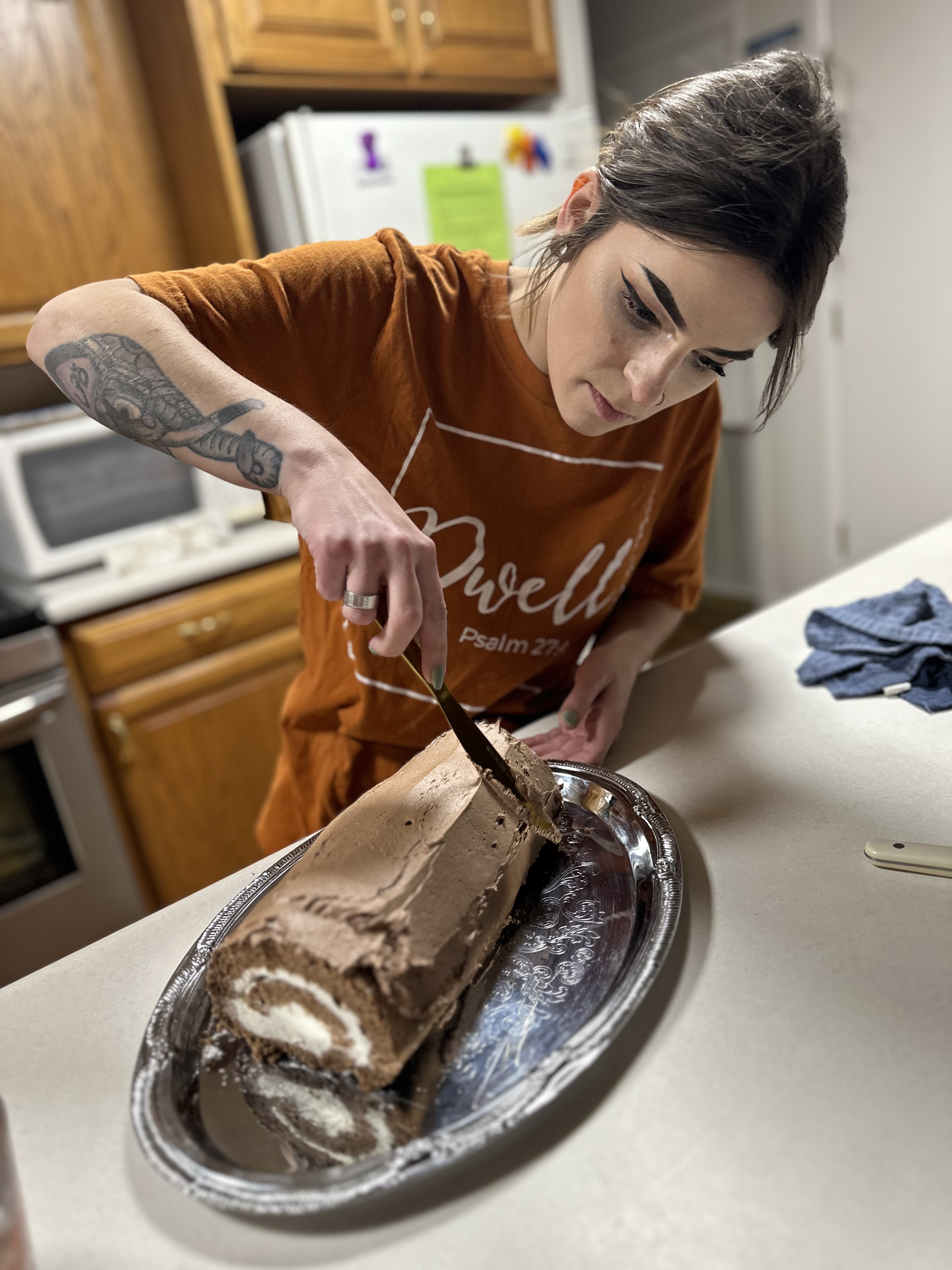
After baking the Yule Log cake and spreading and rolling it with heavy whipped cream in an inside whirl, my daughter went to work icing the cake to look like a tree log.
When her masterpiece was complete, she thanked me. ”Without you, I probably would have given up.”
Her comments stopped me in my tracks. I hadn’t offered much of anything other than simply being there. I’d been the one to make the mistake of flipping the frosting onto the floor. Fortunately, it had landed like Mount Crumpit, allowing me to scoop off the top of the mountain and then clean up what was touching the floor, saving what was usable for the bark frosting and discarding the rest – – while she stood there laughing (shhhh…..don’t tell anybody this part).
But it sure got me thinking about the Yule Logs of our lives and the teamwork we need to conquer their challenges to reach their summits. I thought of the lessons I’d learned.
Even if the Yule Log had been a complete disaster, the experience making it was the blessing. Togetherness in the kitchen is sacred, and things happen there that can’t happen anywhere else. There is conversation, laughter, mistake making, and forgiveness.
The one who reads the whole recipe and sees how overwhelming it will be may be less equipped than the one who has never read it and sees the whole journey as merely a series of small steps. Some of us work on long range plans, some on short range plans.
Sometimes supporting someone is just a matter of presence and encouragement – nothing more.
Just because she’d never made a Yule Log didn’t mean she couldn’t turn out a masterpiece. I’m pretty sure Michelangelo had never painted a Sistine Chapel ceiling before, either. He nailed it on the first attempt, and so did she. Not only was this Yule Log gorgeous, it was also delicious.
I need to stop counting the obstacles and focus on the possibilities. Dollar General sells $15 mixers on Christmas Eve, and they do the same work as the top of the line Kitchen Aid mixers. The gas oven is the same 350 degrees that an electric oven is. There are bowls that will appear out of nowhere when you need another one – some plastic, some metal, some glass. You get a second wind somewhere at the beginning of a long task, and it will see you through.
Without each other, we can accomplish much more than we can accomplish alone.
There is both starting power and staying power in support and encouragement from others to make it to the finish line.
When I wonder why I’m standing in a kitchen on Christmas Eve never having guessed I’d be making a Yule Log, that’s the time to listen for the lessons that life is sending my way through the blessings of my children. It’s in the unfamiliar, uncertain places where we draw on faith and learn our greatest lessons.
I need to do a better job of expressing to each of my children how very proud I am of each of them and how much I love them. They do things that terrify me and things that amaze me.
It isn’t luck or magic that is needed for any of this. It’s prayer and divine intervention, and they are not the same things.
In the years ahead, my hope is that the moments of making this Yule Log burn warmly, living on as embers that remind us that the living of life is in the journey, and it isn’t for the faint of heart. It takes each other, and it takes willingness and courage. It takes a lot of work, and there will be mishaps. It takes forgiveness and laughter. But most importantly, it takes faith, hope, and love.
8 O taste and see that the Lord is good: blessed is the man that trusteth in him.
At 8:00 p.m. on Christmas Eve, my daughter and I began our first-ever Yule Log baking adventure in our pajamas in a rural countryside VRBO kitchen that was unfamiliar to us. When our Kentucky family got together to plan the Christmas dinner, everyone decided to divide the menu and each prepare a dish. Ever so daringly and boldly, she volunteered us to bring a Yule Log. She’d found an ambitious recipe online and had shopped for all the ingredients. She measured them into bags and brought them to the rental house.
By the time we arrived back from the only open store, a Dollar General on the backside of nowhere, we were well into the Christmas Eve hours when children are tucked into bed and elves begin working their magic. And we needed more than magic. We needed divine intervention. Lots and lots of prayer – my One Little Word for 2023.
The recipe looked intimidating. We watched the video of the woman making it to try to ease my apprehension. So much had to go right, and I was fearful of a flop.
The old whipped-cream-on-the-nose baking pose
To ante up the challenge, we were using dishes that weren’t ours, cooking in a gas oven we didn’t know. The cardinal rule in baking is to “know thine oven,” and this beast was a complete and total stranger from another realm.
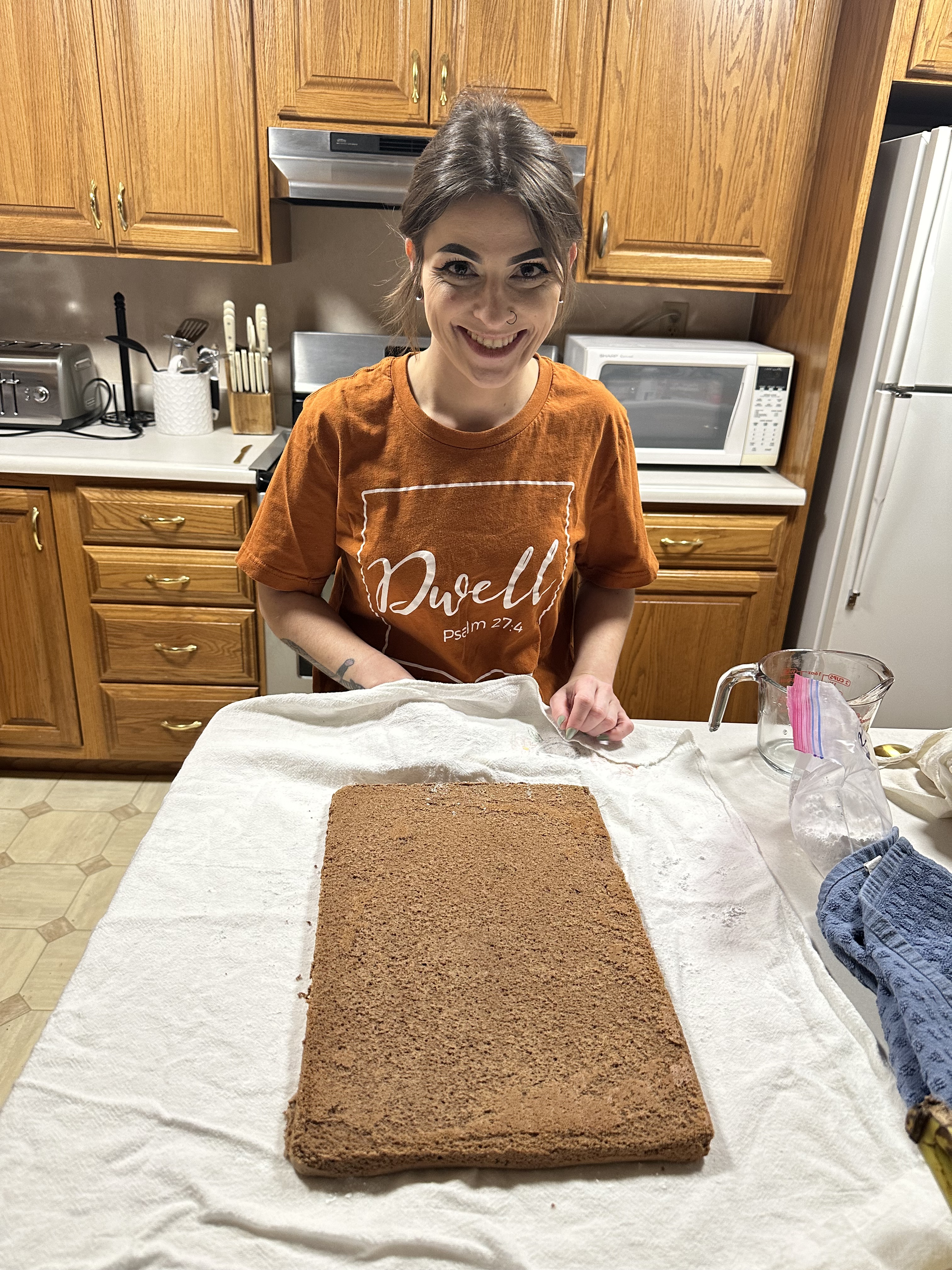
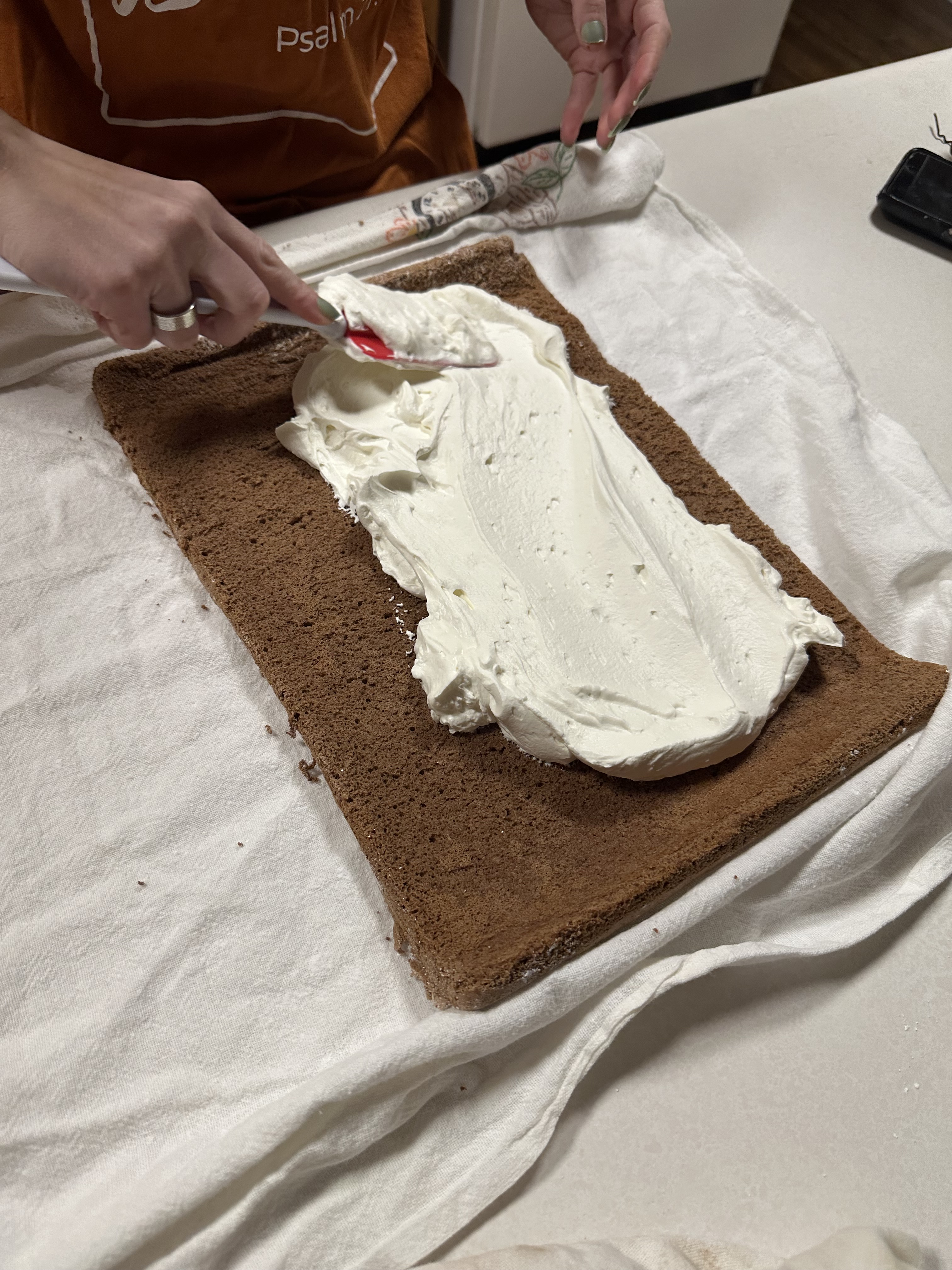
Somehow, though, after all the beating of the egg whites with sugar to form stiff peaks and folding in that mixture with the flour and egg yolk and cocoa, she pulled a perfectly baked chocolate sponge cake from the oven, ready to be inverted onto parchment paper and rolled in a thin white towel and placed in the coolest part of the room to set before spreading the heavy whipped cream on it and re-rolling it. My daughter was unflappable throughout the whole process, but my nerves were on edge the entire time. I was trying not to show it.
The cake is ready when it springs back into form when pressed
We watched the recipe video again when it came time to unroll the cake and spread the layer of whipped cream on the inside.
The entire process involved phases of blending, folding, baking, setting, cooling, spreading, rolling, unrolling, and waiting. It also involved a lot of laughing to keep the nerves under control. It felt a lot like walking across a landmine with someone who didn’t know we were on a battlefield with so many potential pitfalls.
As every step turned out, my daughter smiled through the entire process. She was baking a miracle as I stood amazed. Turns out, she hadn’t read the entire recipe before she started. Each small step was not overwhelming to her. I, on the other hand, saw every mile of the long journey and knew how risky it could be.
It came time for the rolled log to be iced, and her artistic flair came out in full force.
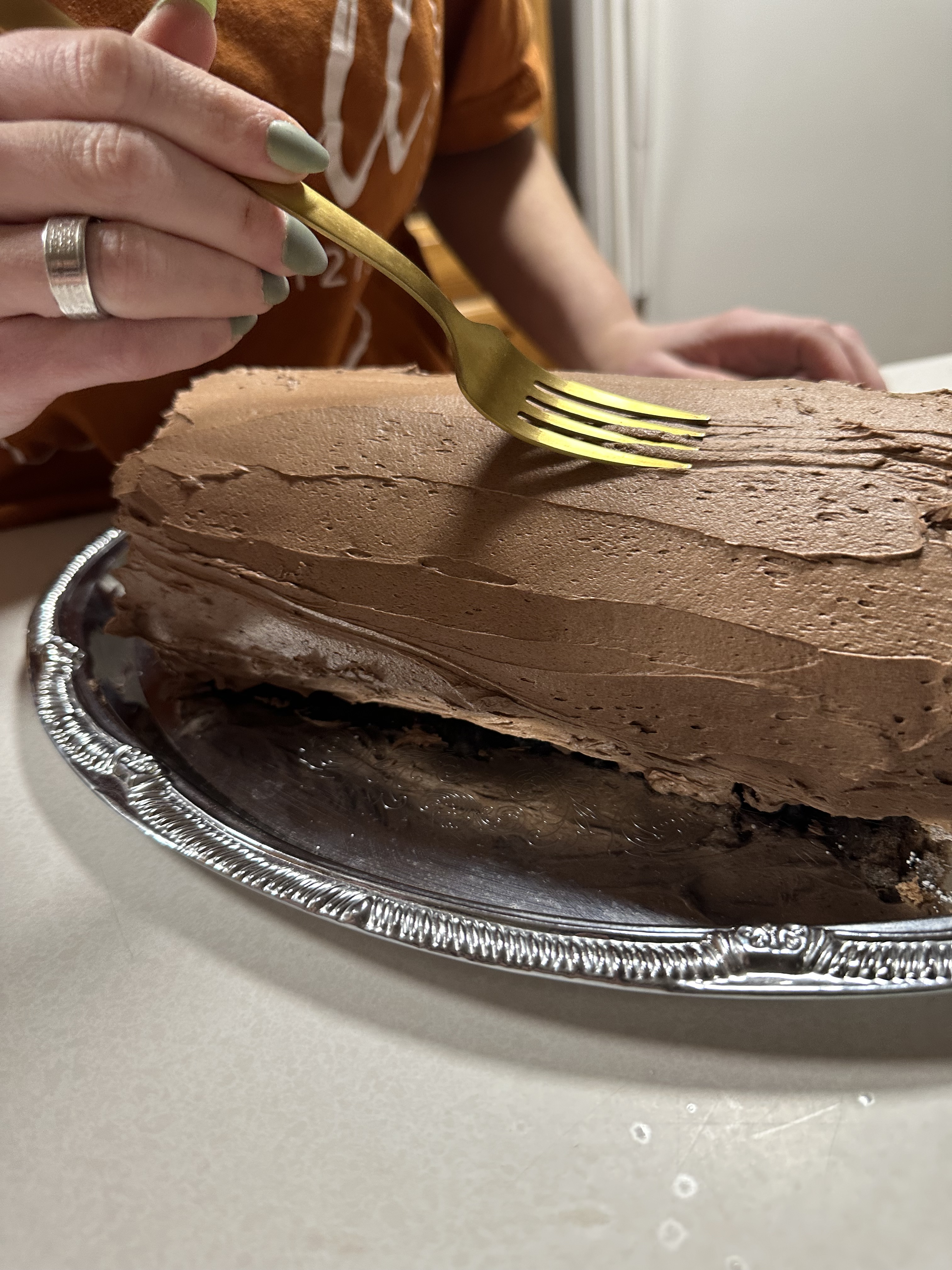
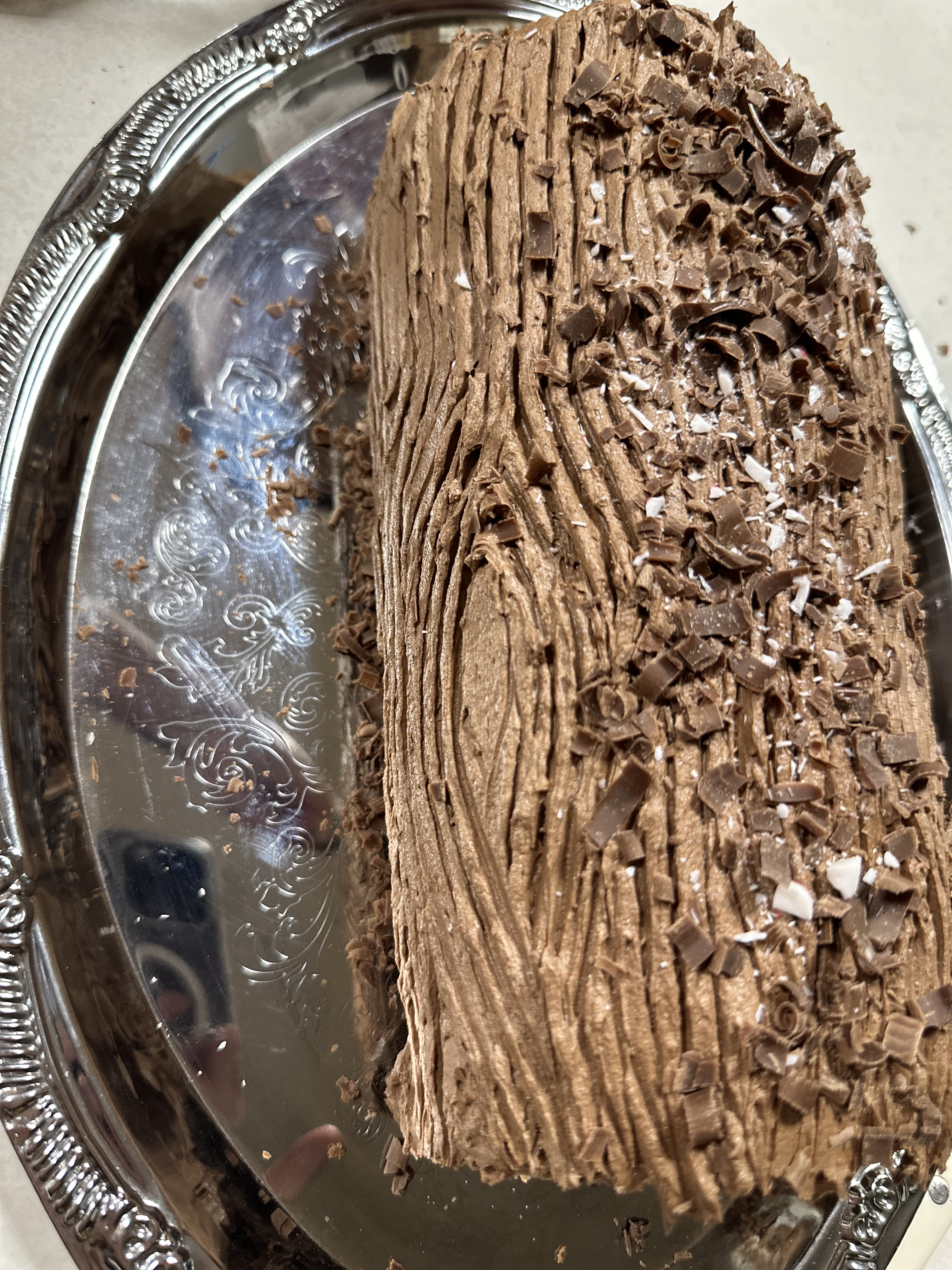
She evened out the chocolate buttercream frosting into consistent thickness and began her artistic presentation using a fork to make bark lines, even making an elliptical shape to make it look more knotty and authentic, like an owl might pop its head out at any moment and ask us whoooo we were. She softened a Hershey bar and began the tedious process of shaving thin chocolate curls with a sharpened knife. And she placed peppermints in a Ziploc bag and crushed them to look like shimmering snow to top the Yule Log.
And when her masterpiece was finished, she stood back and admired it with pride.
“Look what we did, Ma! Thanks for making it with me. Without you, I probably would have given up.”
I hugged her close, thinking, No, dear daughter. This is all your creation, not mine. I never would have even attempted it. You are far more courageous than I will ever be.
She inverted a mixing bowl to cover it like a cake lid and placed it in the refrigerator to chill overnight. I admired her accomplishment and thought of that Yule Log as a metaphor for all the ways we need each other.
And we hugged goodnight, looking forward to sharing it with family on Christmas Day.















 Common Threads