Glenda Funk of Idaho is our host today at www.ethicalela.com for the second day of the July Open Write. She inspires us to write poems featuring our chosen meaning of the word wave after looking at all the definitions of the word. I chose the traditional hand wave. I’m about to give a big one.
We’ve all heard it said that love is blind, and I’ve sure been a champion and a victim of that a time or two. But when it comes to our own family members and their relationships, it hits home in deeper ways. Someone I care about has recently broken off a year-and-a-half engagement. I’d had my suspicions about things when the wedding planning never got started and there was a wrinkle or two of bickering for a week or so another time, but I kept praying that things would work out as they should. And they did. The one who said, “I didn’t break it off sooner because I just kept hoping it would all work out” has experienced that rocky road of discovery where we must accept that even love that is blind can still see the truth when it has looked long enough.
The question came from a fellow Georgian, a member of The Stafford Challenge at Lewis and Clark College in Portland, Oregon on the last day of our poetry conference.
Do you want to go walk in the woods? one called out.
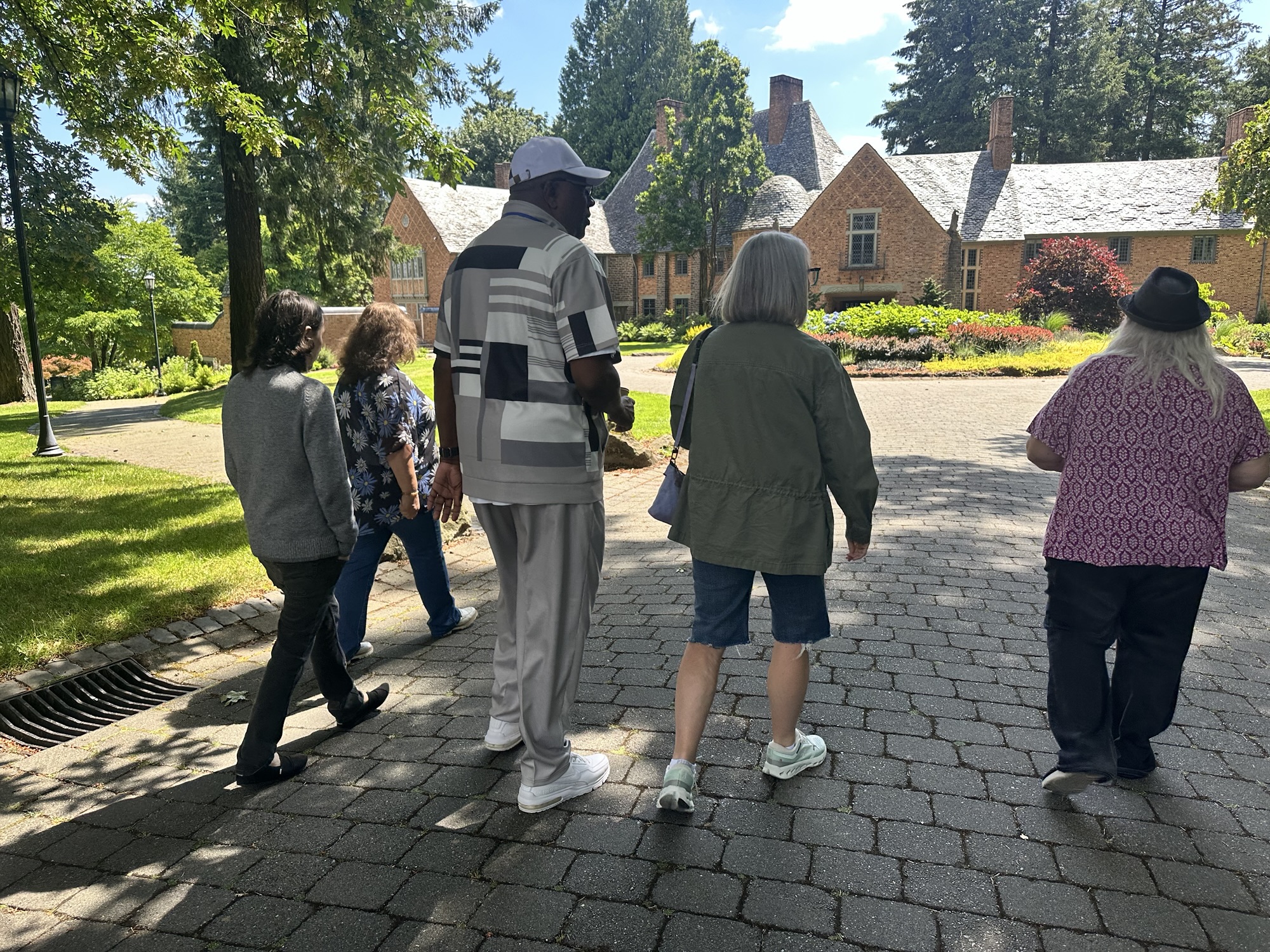
Seven of us set out to walk in the woods together on an adventure to see the world in the forest floor in the cloud-shadows of Mount Hood. And this is how we made friends.
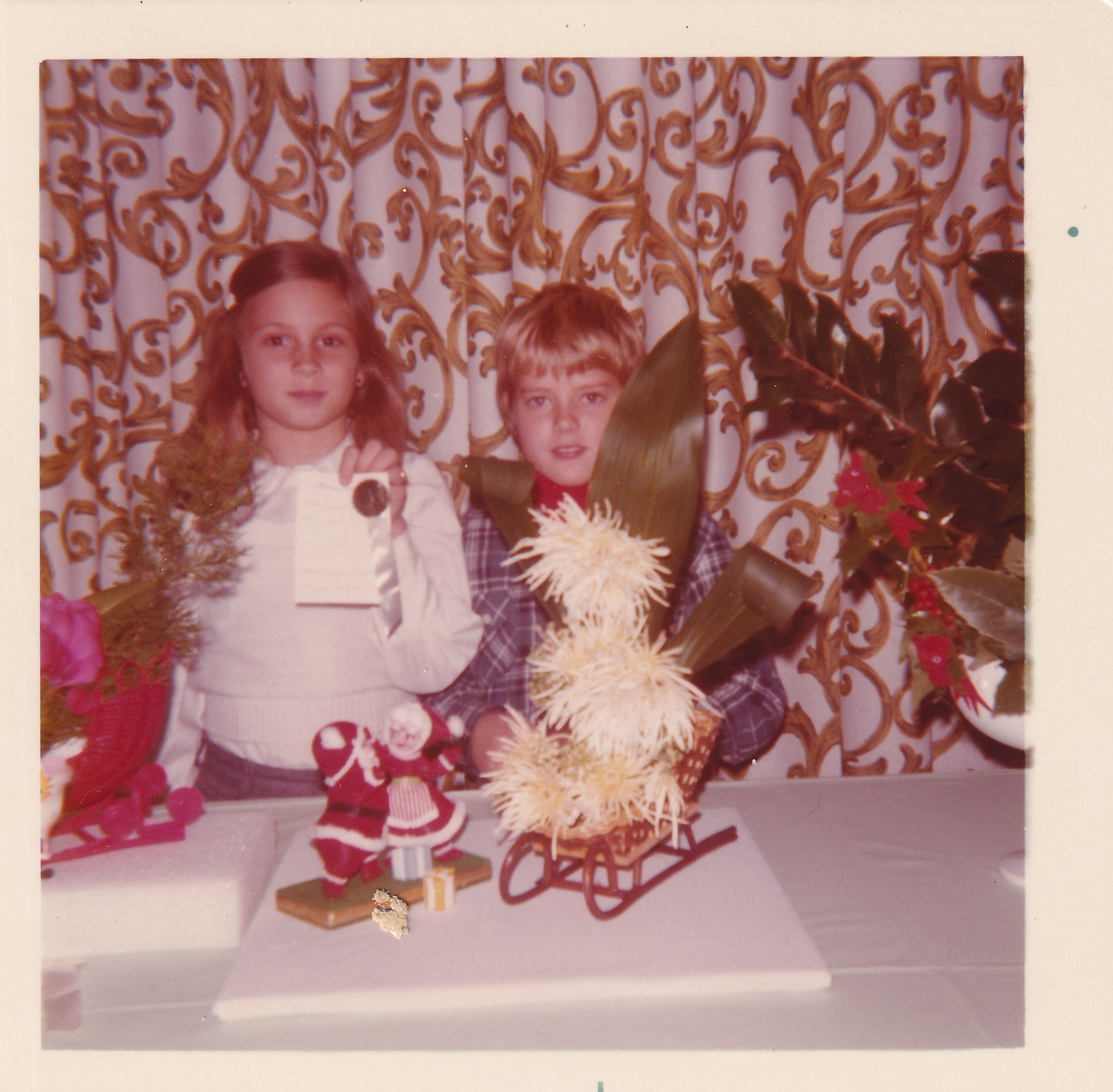
Sometimes the picture speaks in ways we cannot. I’ve been sifting through tubs and tubs of family photos, digitizing them and organizing them in folders to share with family members who, like me, would rather have them on a flash drive than taking up prime real estate in photo albums in the back of the attic. In some cases, I’m sharing via Facebook Messenger if I find those taken with friends who would enjoy the throwback. On a random weekday morning last week, I sent this one to my childhood friend Nancy so we could both remember the years we created floral arrangements with the help of our mothers as we competed in the annual Garden Club’s Christmas Flower Shows.
My friend Nancy (right) and me at the annual Garden Club’s Christmas Flower Show, early 1970s
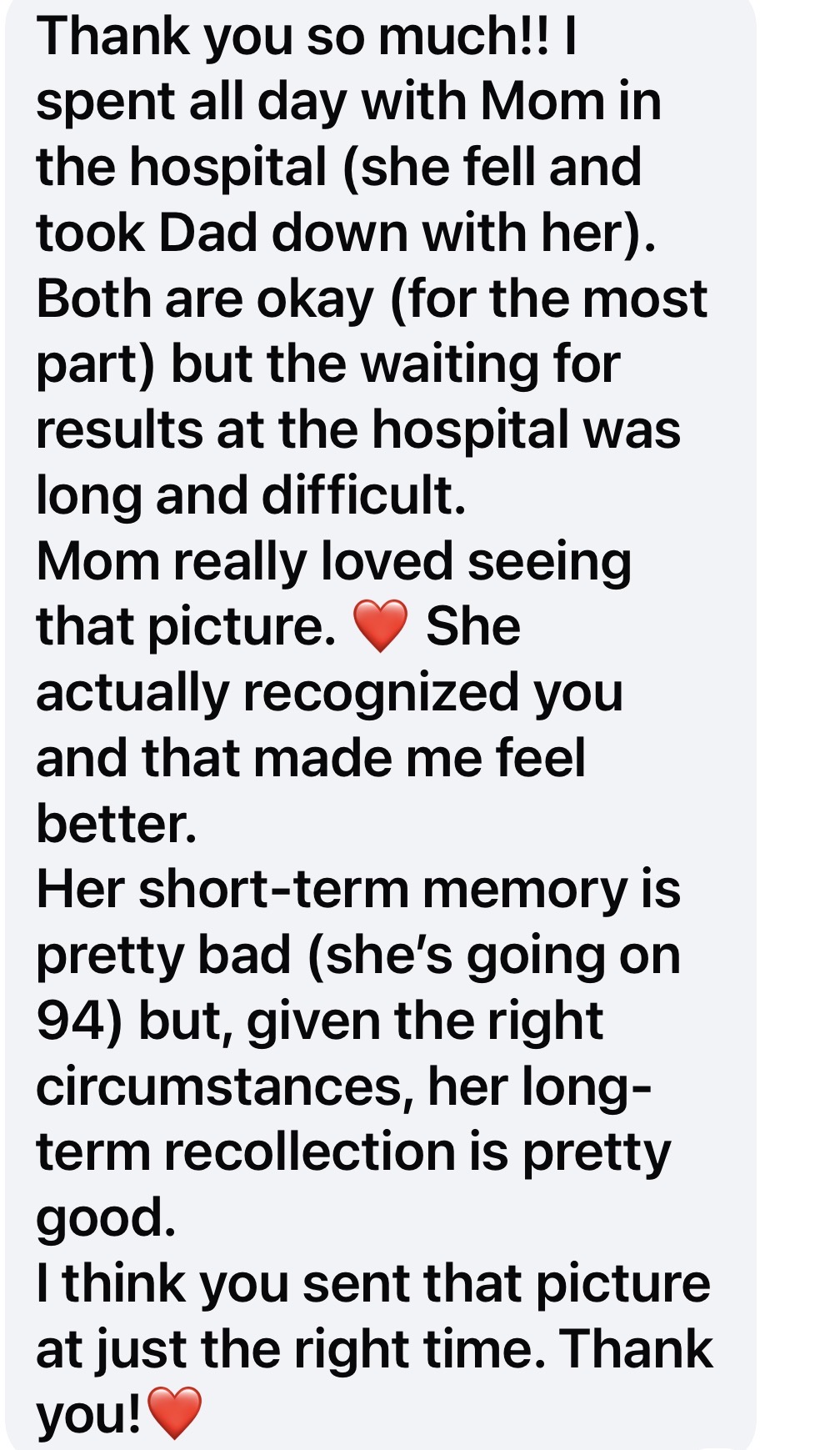
I wasn’t expecting this response, and it showed me how the power of the photograph can often reach back through the years and find the places that older generations can remember – – like trying to scratch an itch that you never quite can find, and then suddenly you find the sweet spot of relief. This is Nancy’s reply:
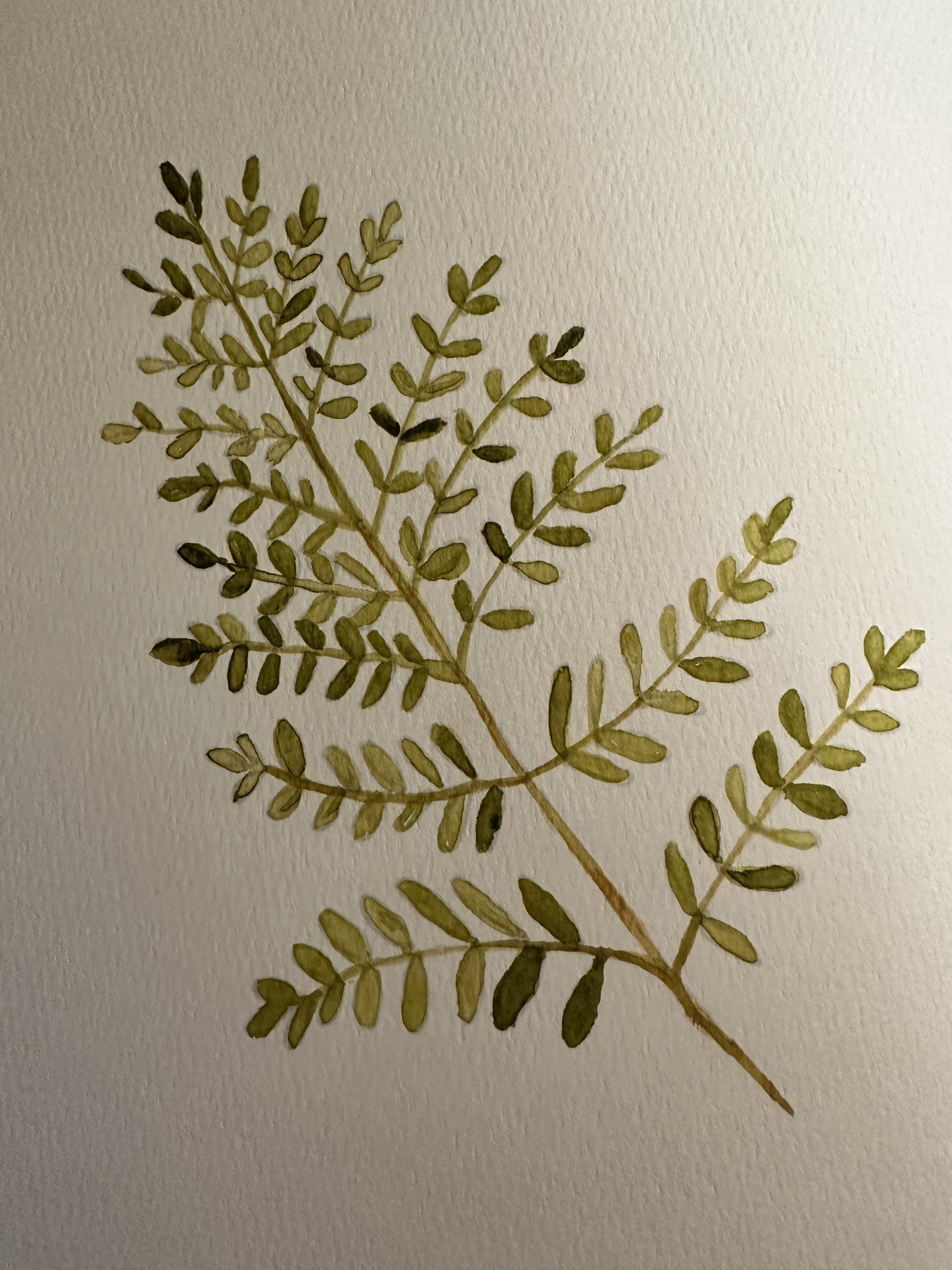
I knew when I painted a fern branch earlier this month that it would be my favorite of all the firsts. It looked real, with the variegated green leaves and authentic stems, like I’d plucked it fresh from the edge of the forest lining my driveway and placed it right here on the paper. It appeals to my simple side – – just two colors and one brush, a recycled coconut Oui glass yogurt container filled with water, and a page-bound piece of watercolor paper. And the directions.
Yes! Finally, something that looked real and that might be framed in an art gallery by some lesser-known semi-famous watercolor artist from a rural town in middle Georgia.
I liked it, so I set out to use the plain white notecards I’d found in the craft section of one of our six local Dollar Generals no more than five miles apart on every map throughout the southeastern United States to create a hand-painted notecard. And I worked and worked and started loving it, too…..until…..
Screenshot
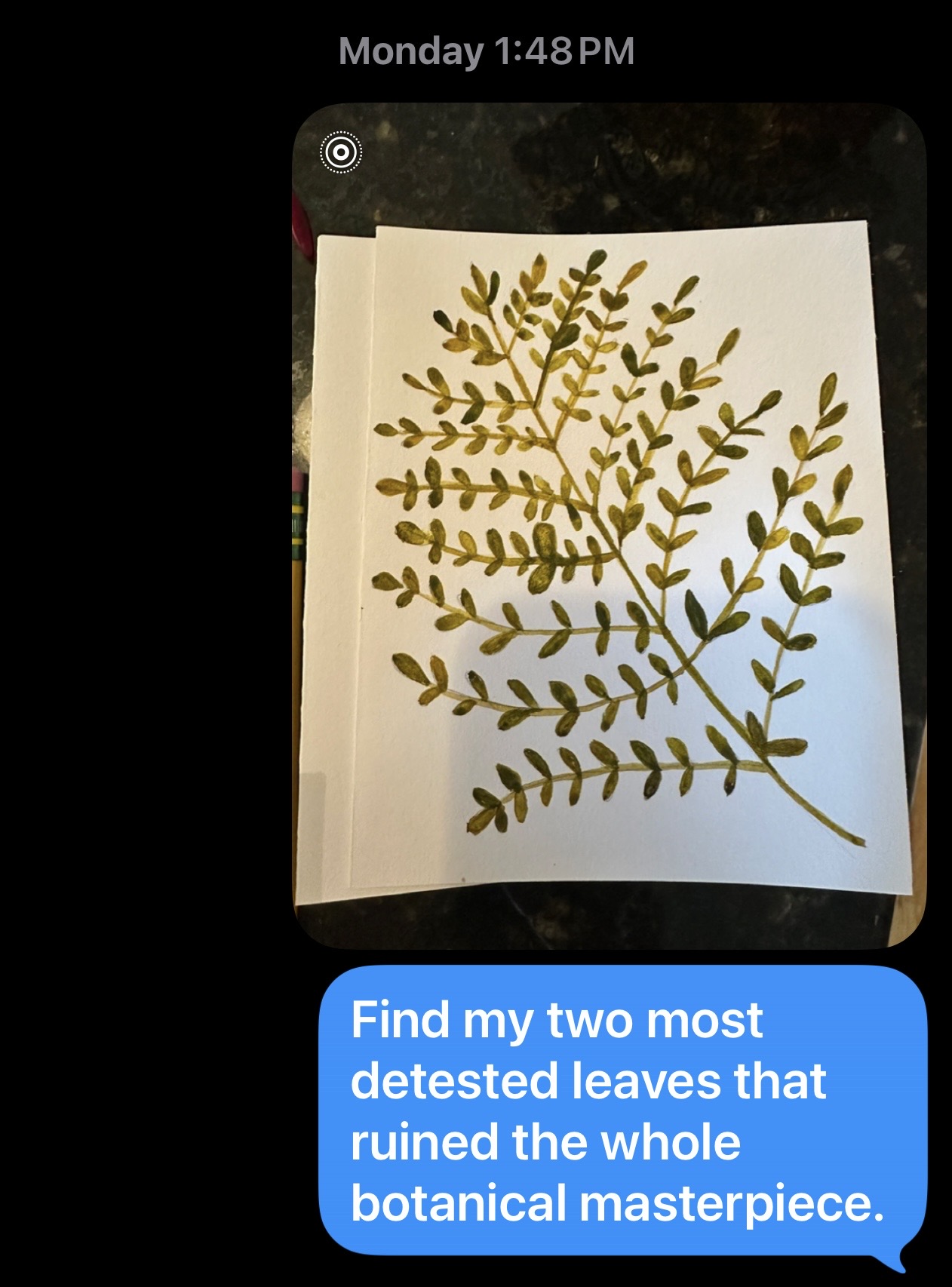
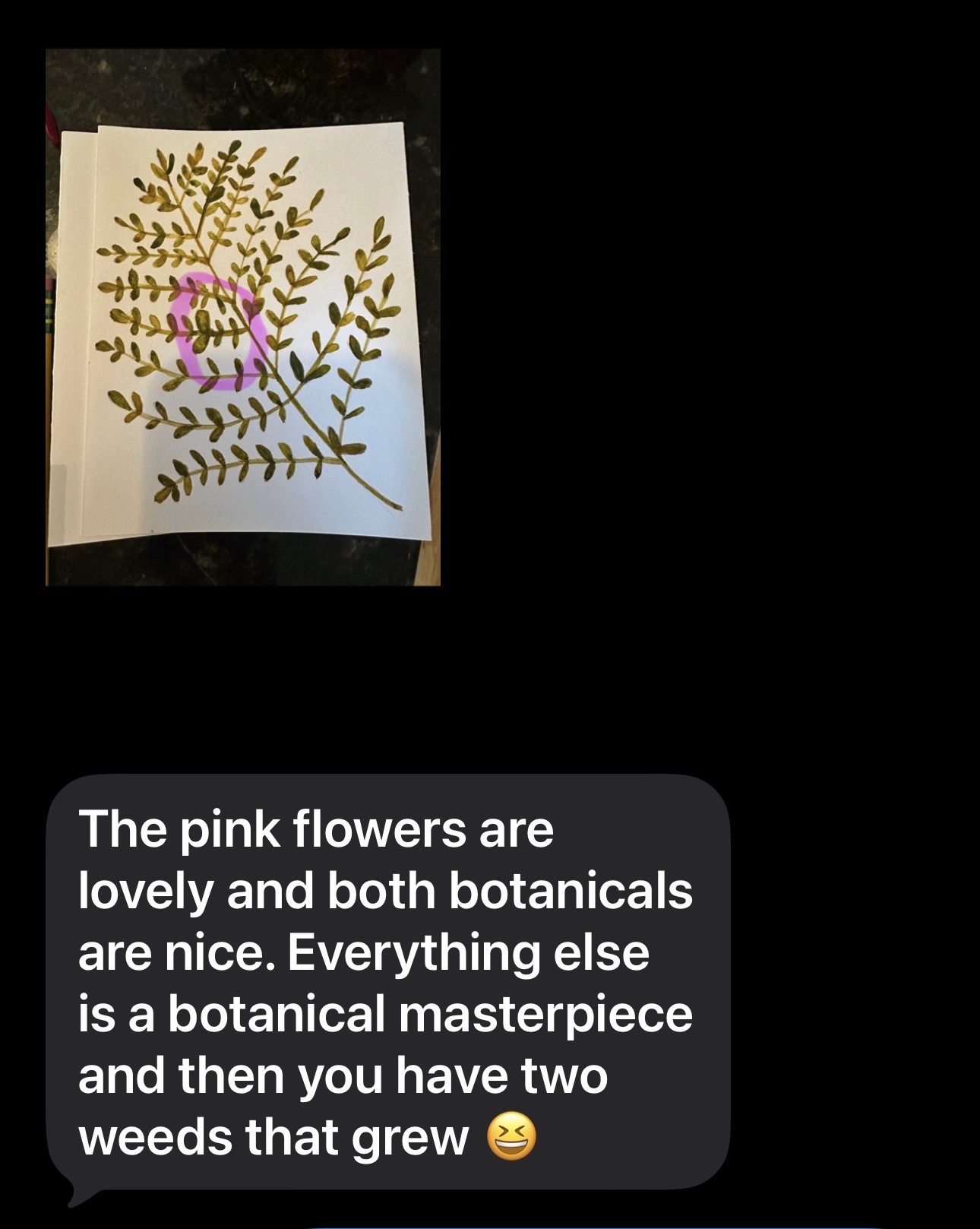
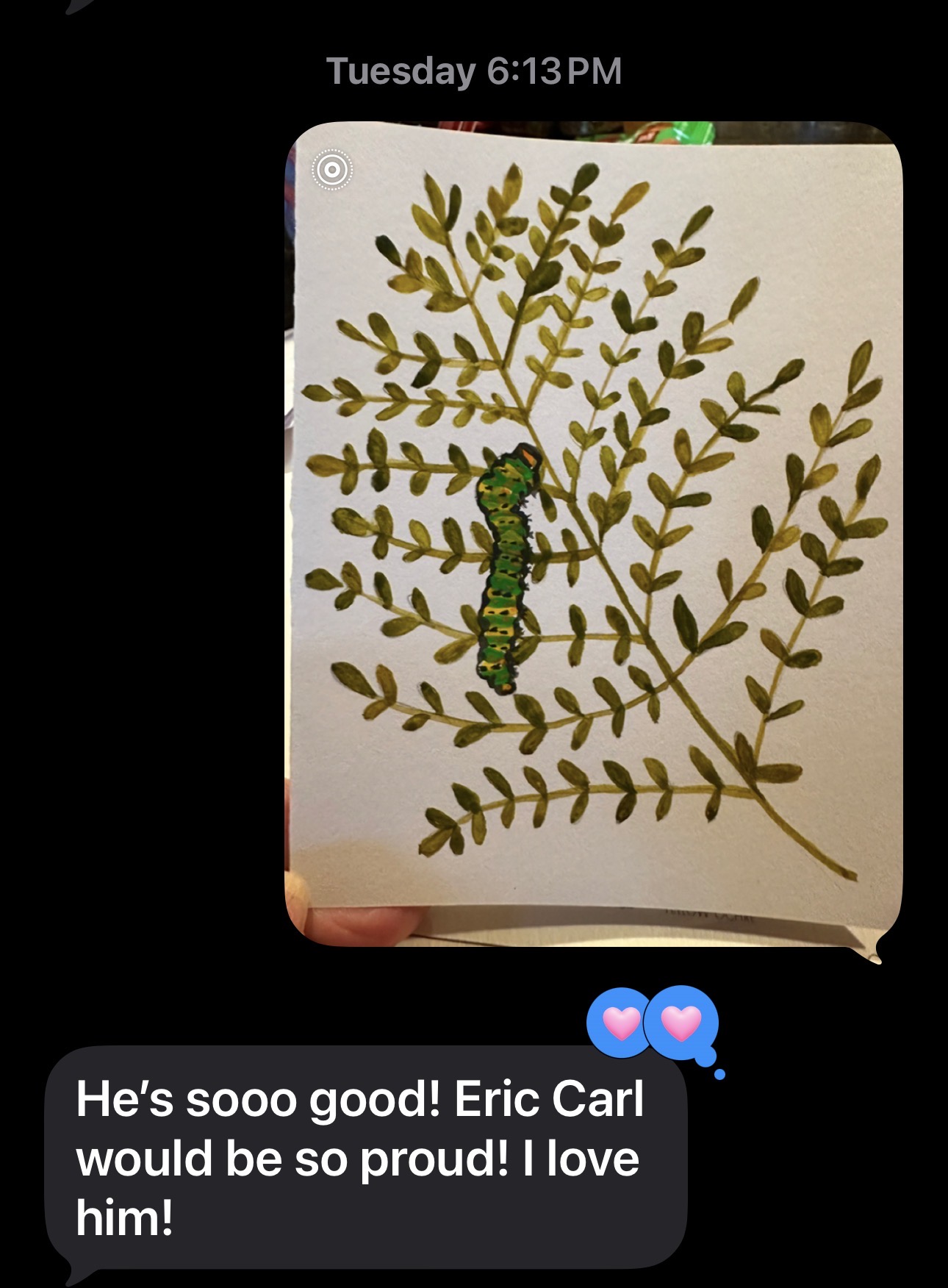
…two little leaves halfway down the page and to the left of the stem became problematic. Instead of leaving them as their own sort of natural trouble, I started trying to fix them with my human eyes and perceptions of how fern leaves should look. And tried and tried, and ended up with what looked like two leaves on a stem that a novice watercolor human had tried unsuccessfully to fix. Definitely not those up to par with a semi-famous rural watercolor artist.
I’d heard that “all art is fixable,” a long time ago. I decided to text my older daughter, who had been to college as an art major, for tips on what to do. I sent her the picture and asked if she could find the mistake, thinking maybe it was just me, measuring with my own human eyes my perceptions of what a leaf should be. But she, too, found it and marked it up in her phone and sent the photo back like she’d found 1990s-famous Waldo in a red and white striped shirt sticking out like a sore thumb.
Screenshot
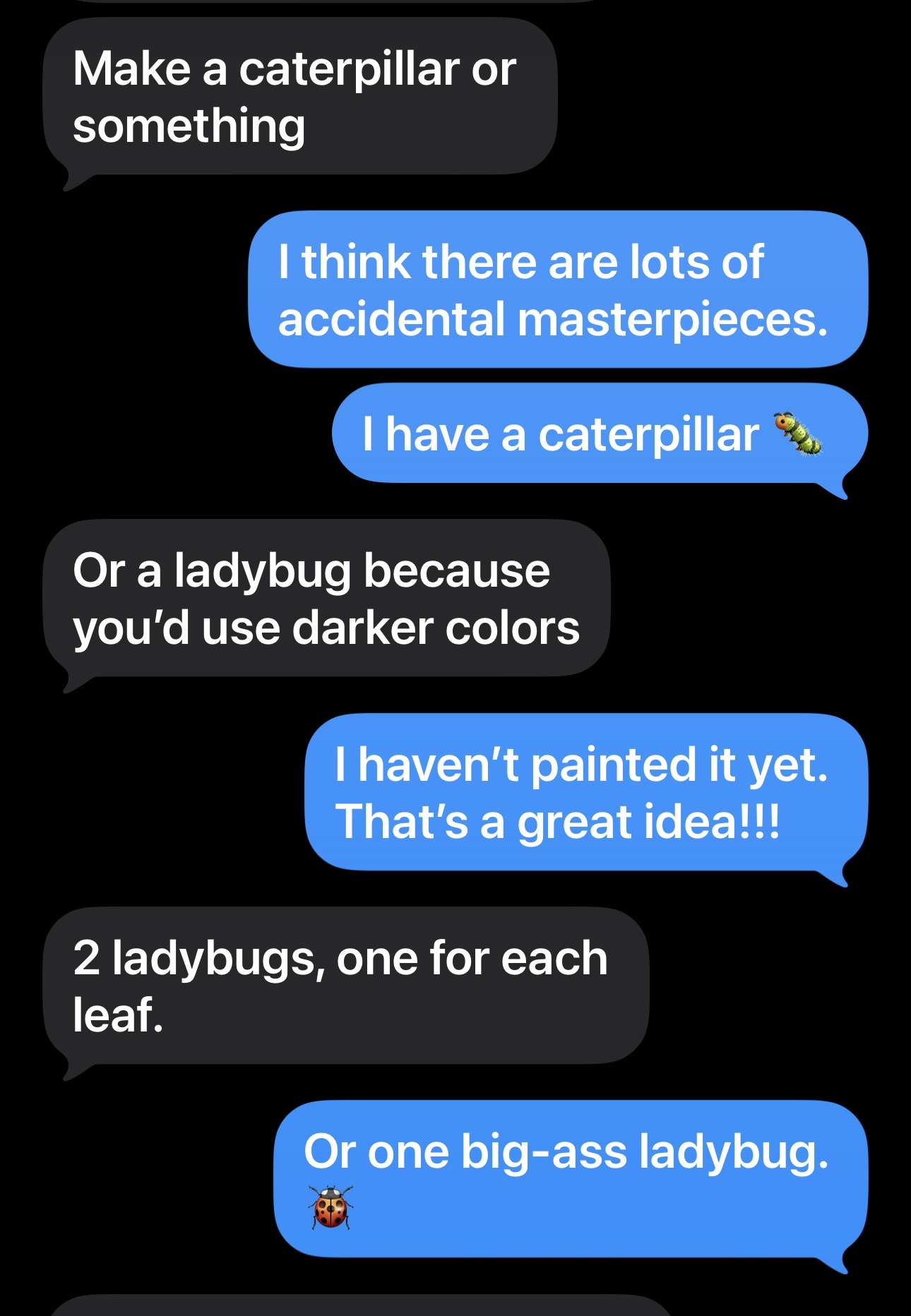
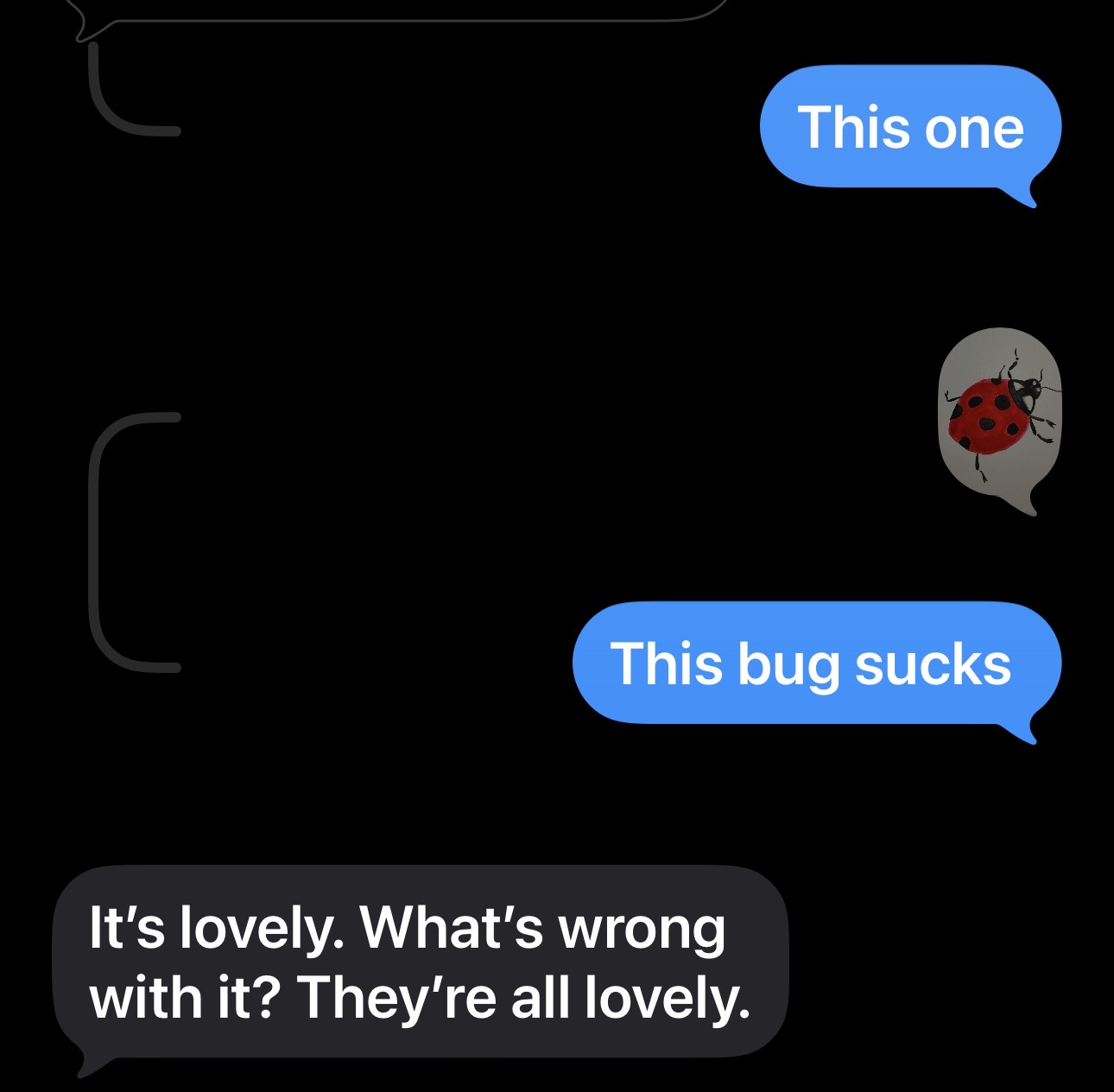
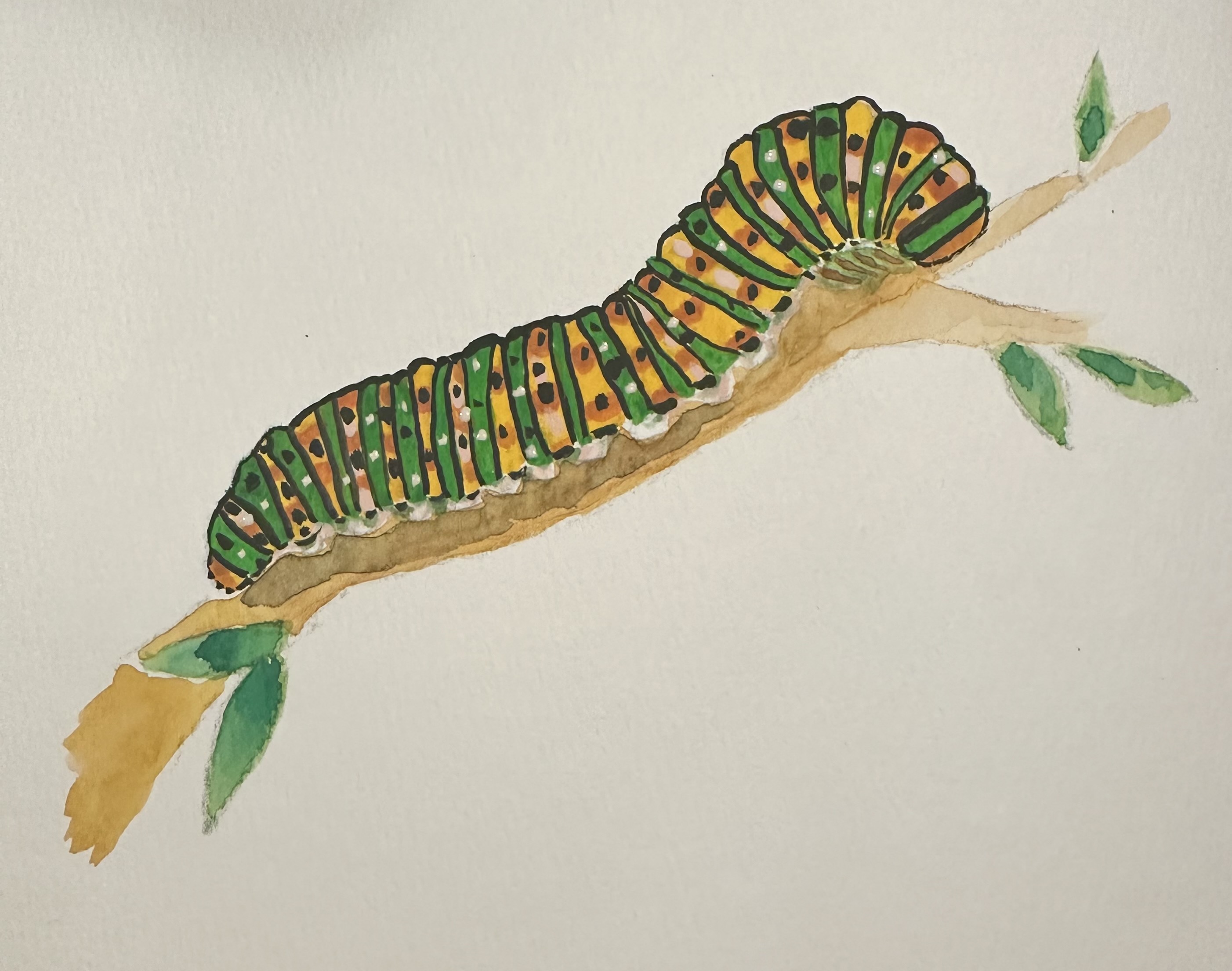
And she suggested what to do to make the art fixable…..painting a caterpillar “or something.” We continued texting, and what I love about texting with my children is that while we are talking about fixing art, we are really talking about life and its universal transfers to deeply held beliefs. I thumbed through my watercolor book and found both a ladybug and a caterpillar and decided on the caterpillar. I did NOT like that ladybug, even though I tried painting it. The legs looked a little off.
Screenshot
Screenshot
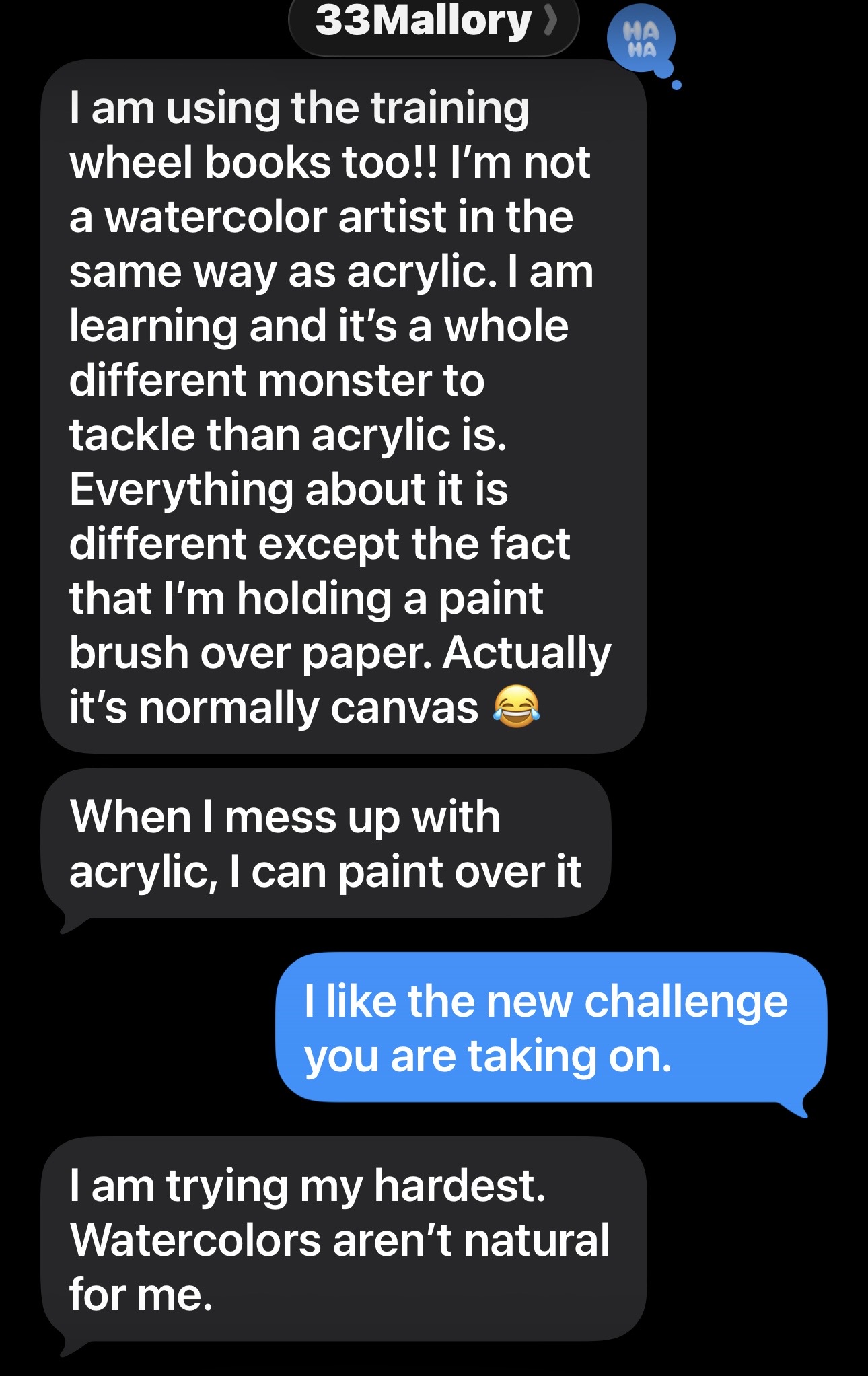
I like, too, that even though she was an art major and has so much natural talent, we are both using our “training wheel” books with the picture already sketched onto watercolor book paper. She will bloom in creativity far more quickly than I will, as she’s already ventured into salt watercolor painting, her own sketches, using filters on her camera to change photos she takes to a watercolor filter to see how she might paint something, and inherently knows more about the artistic techniques that she can apply from other art forms to watercolor painting.
Screenshot
And I really love that a 59-year old mother trying a new hobby can ask her 39-year old daughter who naturally gravitates to all things art like a duck takes to water, what to do about my fern leaf failure. And I love that I took her advice. I found my caterpillar directions in my training wheel book and painted this caterpillar in a smaller form, over those two bad leaves. And as soon as I began, I knew that my next lesson needed to be on perspective and dimension. I’m not sure whether the watercolor training wheel books can teach those skills, but I’m going to go into every painting henceforth reminding myself that caterpillars in the wild do not dangle like gymnasts on parallel bars from fern leaves. But my daughter, ever the optimist, found a way to add an encouraging sentiment in the text thread.
Screenshot
I think I like caterpillars on branches much better….and the more conceptual version of leaves, too.
Move over, Eric Carle……there’s a new hungry caterpillar in rural Georgia dangling by one suckerfoot from a fern, eating all the greenery on her quest to grow a pair of painted wings….. and take flight.
Here we are : the last day of the whole school year. Students graduated a week ago, and teachers leave mid-day today for the summer. Those of us at Central Office watch them wave, disguising our bit of green envy as they head out on cruises and vacations to mountains, beaches, and swimming pools. I’m holding on tight for the summer ride, just trying to get through mid-June and then two weeks at the end of July.
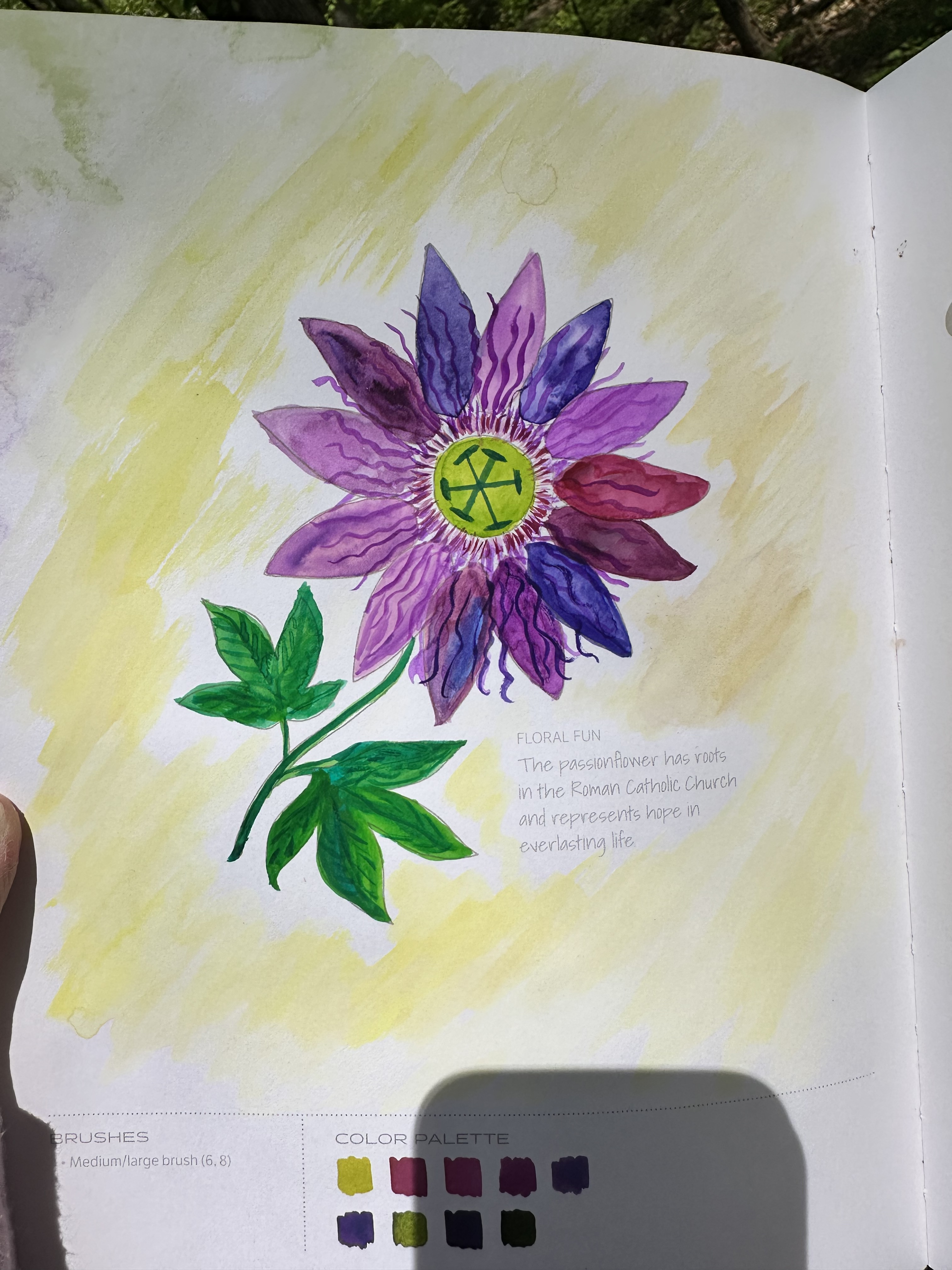
For over a week, we’ve been working on planning a work retreat that seems ever-evolving and unfinished, and I don’t know how things will go. When I looked back at Spring Break and thought back to those early attempts at watercolor painting sitting at that picnic table, just focusing on one petal at a time., I realized that this is good advice for any day. One petal at a time. I thought of the hope of the passion flower. I’m claiming it today as teachers leave for summer and we are left to carry on with work. And each day is one day closer to retirement.
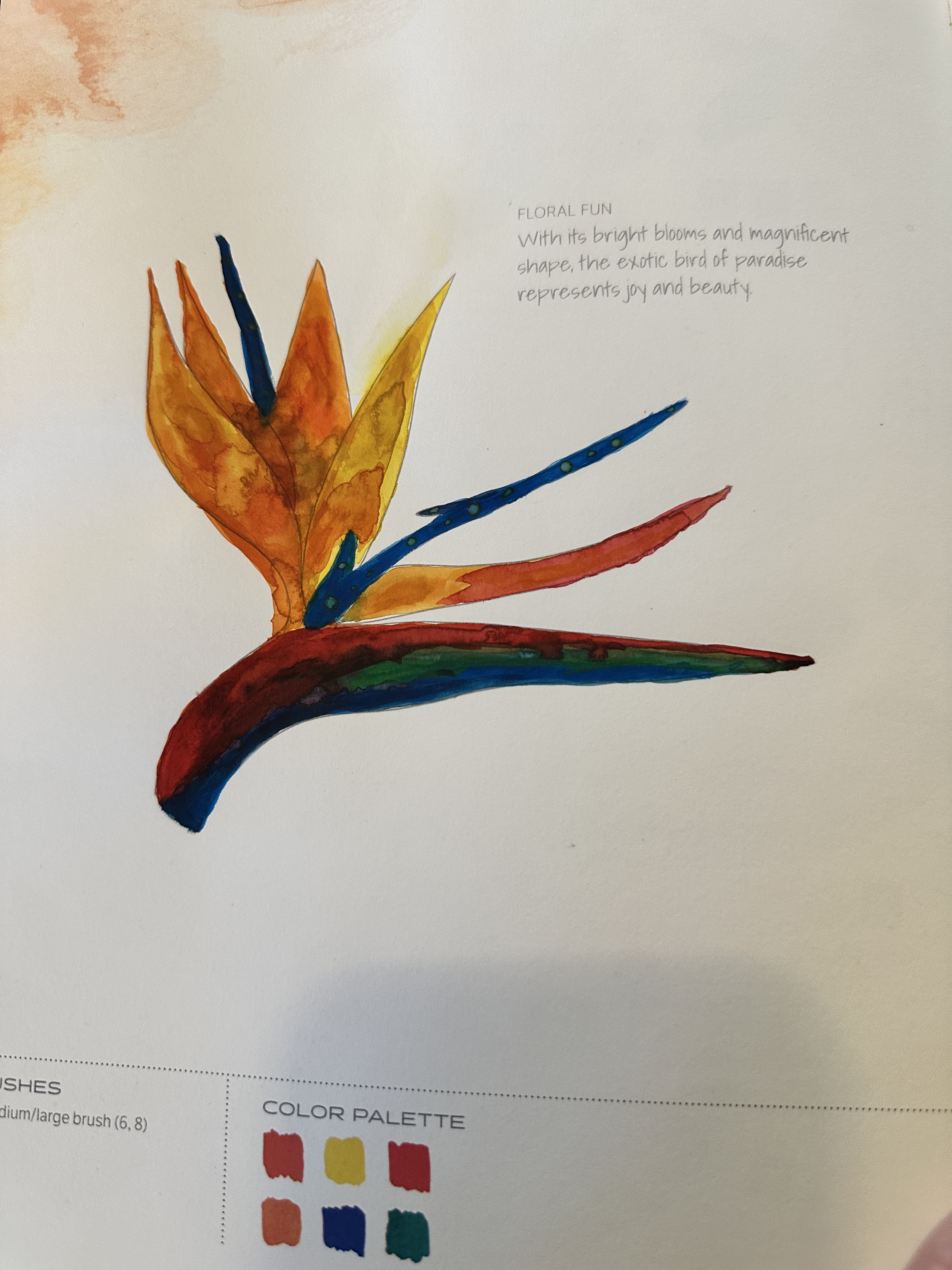
When I first bought my watercolor book of step-by-step directions on a side-by-side guide, I thumbed through the pages and wondered why they had chosen such obscure flowers. There wasn’t a rose or a daisy anywhere, yet there was a cactus and sea holly. And this bird of paradise.
And then, as I started working through the book, I realized that each painting teaches a different technique. The cactus and sea holly teach tiny little lines that look like thistle needles. The cactus pot teaches shadows in gradient colors. This bird of paradise, while I don’t love it, teaches the effects of wet-on-wet painting and how colors blend when water is used to move the paint around in an area.
I think the teacher in me needed the instructional framework spelled out, starting with the learning target, including an objective, and success criteria in little boxes to check if I accomplished it all. This is one of those examples that shows that process is more important than product – because the blending of color here in a first attempt carries into other flowers that have blending involved.
I don’t like this painting at all. But I appreciate it, because it gave me practice to be able to blend color in a hydrangea that I do like. And this is how watercolor painting is teaching me that life is like that, too. We learn skills in small attempts that transfer into other areas. Take the Karate Kid, for example. He learned Wax On/Wax Off and Sand the Floor and thought he was being used as a free worker. All along, he was preparing for that fight at the end of the movie that helped him put that blond-headed bully in an agonizing face plant down on the mat.
Looking back at the new learning gives me the reassurance that old dogs CAN learn new tricks. And even better: they can teach themselves if they can read and follow directions.