With special thanks to Slice of Life for giving writers inspiration, space, and voice
Slice of Life Day 26 of 31: Journeys (my March theme)
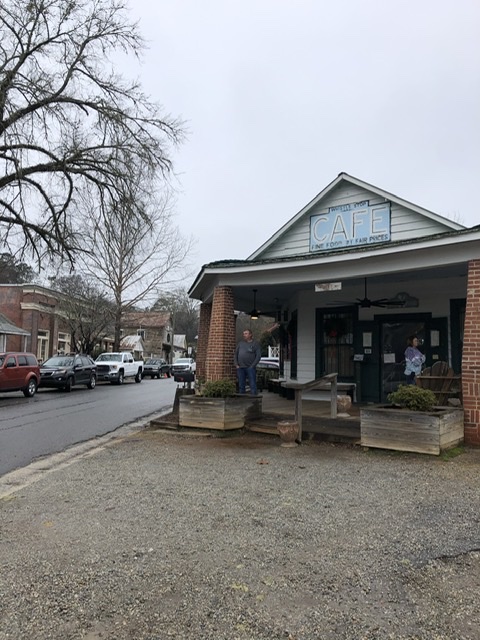
If you’ve ever read the book Fried Green Tomatoes at the Whistle Stop Cafe by Fannie Flagg or seen the movie Fried Green Tomatoes, you may recognize the photograph below as the Whistle Stop Cafe in the tiny town of Juliette, Georgia.
The Whistle Stop Cafe, Juliette, Georgia – January 2021
Some of our favorite journeys we take are camping trips that are less than an hour from our home. Dames Ferry Campground is situated on Lake Juliette about 20 minutes north of Macon, Georgia and just over an hour south of Atlanta. Whenever we camp here, we like to watch the movie again before stopping in for a plate of fried green tomatoes (we still haven’t eaten Bennett’s Barbecue, but that day is coming).
After we’ve shared a basket of these, we ease on back over to the lake and put the life jackets on the dogs for an evening kayak paddle on the lake to work off our dinner. It’s one of the few fried foods we believe to be worth the indulgence.
With summer coming and the tomato plants going in the ground soon, you may want to try these delicious vegetables. Even if you don’t plan to be in Juliette, Georgia anytime soon, you’re still in luck. Amazon sells the batter mix!
And if you’re still in the mood for an even more classic Southern tradition, stop and get yourself a bottled Coca Cola and take a big swig. Then, pour in a half bag of salted peanuts and drink up! It’s the perfect storm of salty sweetness.
Fried Green Tomatoes at the Whistle Stop Cafe (with sweet tea in a Mason jar)Early morning on Lake Juliette
Therefore let no one pass judgment on you in questions of food and drink, or with regard to a festival or a new moon or a Sabbath. These are a shadow of the things to come, but the substance belongs to Christ.
With special thanks to Slice of Life for giving writers inspiration, space, and voice
Slice of Life Day 25 of 31: Journeys (my March theme)
Travelers’ tales are classic Chaucer! Connecting with others by sharing about all the journeys we’ve taken, our traditions, our love of food and pets and family, and all of the deep points of connecting often occurs more naturally when traveling with complete strangers than with those we know in our own hometowns – at least it seems that way for me! I was thrilled to meet this group of educators, all training to be EF Tour Leaders, as we prepared to lead our own travel groups the summer before the world shut down during the Covid pandemic. Our proverbial wagon to Canterbury was rolling with travel tales as we sat around tables sharing meals and experiences we’d had throughout the world.
On the steps of Sansoucci – Potsdam, Germany – May 2019EF Tour Leader Training, Berlin, Germany at the Brandenberg Gate – May 2019
Our Tour Guide each day was Silke, a native of Berlin who guided us through the city’s history and landmarks and shared her best travel tip for keeping large groups together in the context of our real time travels. All through the streets of the city, she held Squeaky high and squeezed it repetitively to keep us together. Where other guides used brightly colored umbrellas, we came to prefer the quirky duck because we could hear Squeaky better than we could keep track of an umbrella in the thick crowds no matter how festively it may have been decorated – plus, it was amusing watching crowd reactions and facial expressions to a grown woman squeaking a duck all through the streets.
Silke with Squeaky, Berlin, Germany – May 2019
The subway was a prime example of Squeaky’s ability to keep us together better than an umbrella; when we couldn’t all fit in the same Subway cars, we knew how many stops to make and then we would hear the duck as we exited the train and made our way toward the squeaks.
Berlin Subway MapTraffic Light Man is unique to Berlin, Germany Traffic Light Man Straddling the space where the Berlin Wall once stood – May 2019
The energy of enjoying life and making the most of it, the stories that happen along the way, the shared travel hacks, and the fellowship with others always keeps me looking forward to the next trip. I belong to several Facebook travel groups and frequently scan Pinterest for the latest travel ideas, but nothing compares to the heightened awareness of fully absorbing the details of the world like sharing our travel adventures with fellow travelers. Please join us at ethicalela.com throughout the month of April, and come share your own “quirky story” or travel adventure (or both) on April 11!
Judges 19:17
And he lifteth up his eyes, and seeth the man, the traveller, in a broad place of the city, and the aged man saith, ‘Whither goest thou? and whence comest thou?
With special thanks to Slice of Life for giving writers inspiration, space, and voice
Slice of Life Day 24 of 31: Journeys (my March theme)
I recently went to see the movie Redeeming Love, and an avalanche of memories of Ketchikan, Alaska came rushing forward from my week in May 1998 spent learning about life in the Gold Rush days of Alaska. Women did what they had to do to survive, and the lines were heavily slanted toward survival over living. Dolly Arthur’s house along Creek Street offered a sobering glimpse of life known to the women of those days in Ketchikan. We didn’t stick around this former red light district too long with the kids – we moved on to some G-Rated stories.
In the rainiest city in the state, we were pleased that our excursion to Totem Bight State Park did not get cancelled; we’d looked forward to seeing the totem poles carved by the Tlingit tribe.
The Liquid Sunshine Gauge in KetchikanMallory and Marshall standing at the entrance to historic Creek Street in Ketchikan – May 1998
Each of the totem poles tells a story that you can read here, and there is also a map of the village as well.
Mallory stands below Raven at the Head of Nass
Pole 10 is Raven at the Head of Nass – a chief in a dance hat tops the pole. At the bottom is the chief, Raven-at-the-Head-of-Nass. Raven stole daylight from Chief. The small human figure represents ancestors of the Raven clan who were happy to have daylight. The space between the figures represents respect for the chief.
Marshall listens to the tour guide tell about Man Wearing Bear Hat
Pole 3, Man Wearing Bear Hat, is a man of the Bear Clan wearing a large carved wooden hat with a bear’s head, its brim surrounded by painted whales. The hat was worn on storytelling occasions.
As we listened to the tour guide tell the totem stories, I felt a deep connection to the power of the oral tradition of storytelling. I thought of its impact throughout history and its importance to future generations. The preservation of stories through totems and monuments combines art and reverence for what is held sacred. The experience here in this Native American village was spiritual and moving.
I reflected on my recent afternoon at the Azalea Storytelling Festival in Lagrange, Georgia and the entertainment and messages that are so powerfully felt when a human voice is sharing lessons through story. What a gift – one I need to savor more frequently.
Matt 13:34
All these things Jesus said to the people in the form of stories; and without a story he said nothing to them.
With special thanks to Slice of Life for giving writers inspiration, space, and voice
Slice of Life Day 23 of 31: Journeys (my March theme)
“He was a newcomer in the land, a chechaquo, and this was his first winter.” – To Build a Fire, Jack London
The coldest I have ever been in my entire life, by far, was in Skagway, Alaska on the side of a mountain on a Gold Rush tour in May 1998. Winds whipped bitterly from the snow-covered trees, stinging my nose, chapping my lips and cheeks, chilling my ears as if I weren’t bundled up in a coat, sweater, gloves and hat – or anything else – to keep out the cold. That was the day I became an honorary member of the Arctic Brotherhood and understood for the first time, for one fleeting moment, what cold meant. I was, as Jack London would say, a chechaquo.
Arctic Brotherhood Card
We left our stateroom A641 aboard the Sun Princess and set out on a tour of Skagway along Alaska’s Inside Passage. I was most excited about this particular port because it was the place where Jack London set out on the Chilkoot Trail for his Klondike quest that would become one of the greatest adventures in all of literary history. Plus, I love a good story with a dog as a character – and who more than Buck, whose spirit I felt roaming the streets. My heart skipped beats seeing the sleds in the Gold Rush Museum, where the provisions for sledders along the trail sent my mind spinning with all the things they had to take just to survive (one full year’s provisions).
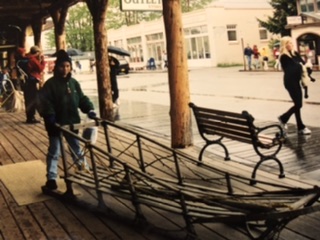
Mallory on a sled in Skagway, Alaska – May 1998
As two of my children learned from a real gold miner lessons on How to Pan for Gold 101, I watched and listened, reminded of the hardships of the turn of the century that brought so many men searching for that one nugget that they believed would bring them security, and the risks they were willing to take to strike it rich. And I understood the primal need To Build A Fireand bask in its warmth in a way that had only ever garnered a half-hearted nod of agreement to London’s words on the page…..until I felt the paralyzing cold on the side of that mountain in Skagway.
Panning for gold, May 1998 Mallory at the White Pass Railroad, Skagway, Alaska – May 1998
With special thanks to Slice of Life for giving writers inspiration, space, and voice
Slice of Life Day 22 of 31: Journeys (my March theme)
Juneau, Alaska is a state capital that cannot be reached except by boat or plane. No one gets there by car because no roads lead to Juneau. Another seldom-realized fact about Alaska is that the shortest distance between Alaska and Russia is only 2.5 miles – frightening in times like these.
I visited Juneau, Alaska in May 1998 while on an Inside Passage cruise with my family. Mendenhall Glacier was pristine and beautiful, and the salmon hatchery was educational. I learned to spot bald eagles when the tour guide told us to “look for golf balls in the trees,” and they would be the heads of eagles. It worked, every time!
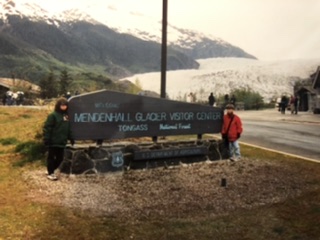
Mallory and Marshall at Mendenhall Glacier – Juneau, Alaska, May 1998
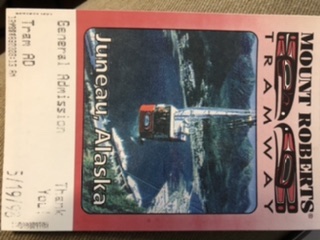
But my favorite part of Juneau was a ride up the Mount Roberts Tramway, where two of our children enjoyed playing in a dusting of snow and watching wildlife at the top of the mountain overlooking the port of Juneau. We saw signs letting us know which wildlife species we were likely to see that day – among them, the red squirrel. We’d become proficient at spotting eagles, so we looked forward to seeing some other cold climate creatures – we just didn’t want to encounter any bears along the mountain trails, and thankfully we didn’t.
The perspective high above the port overlooking the city below was breathtaking, and I fully appreciated the majestic beauty of the “eagle’s eye view” in those moments. I also understood, standing on that mountain with my children playing in the magical snow and watching squirrels, why having my feet on the ground is equally as beautiful. The lyrics of Climb Every Mountain were belting out from my heart across the snow-capped Alaskan peaks as if I were standing in Austria singing with all of the passion and none of the voice talent of Mother Abbess……hence the video version below:
I do not own rights to this music but share for experiential purposes only on a non-profit blog
7 How beautiful on the mountains are the feet of those who bring good news, who proclaim peace, who bring good tidings, who proclaim salvation, who say to Zion, “Your God reigns!”
With special thanks to Slice of Life for giving writers inspiration, space, and voice
Slice of Life Day 21 of 31: Journeys
Eating escargot
Snails swimming in butter
Culinary delight
Artistically arranged
Round swirly shells
Good source of protein
On May 24, celebrate National Escargot Day
Tres delicieux!
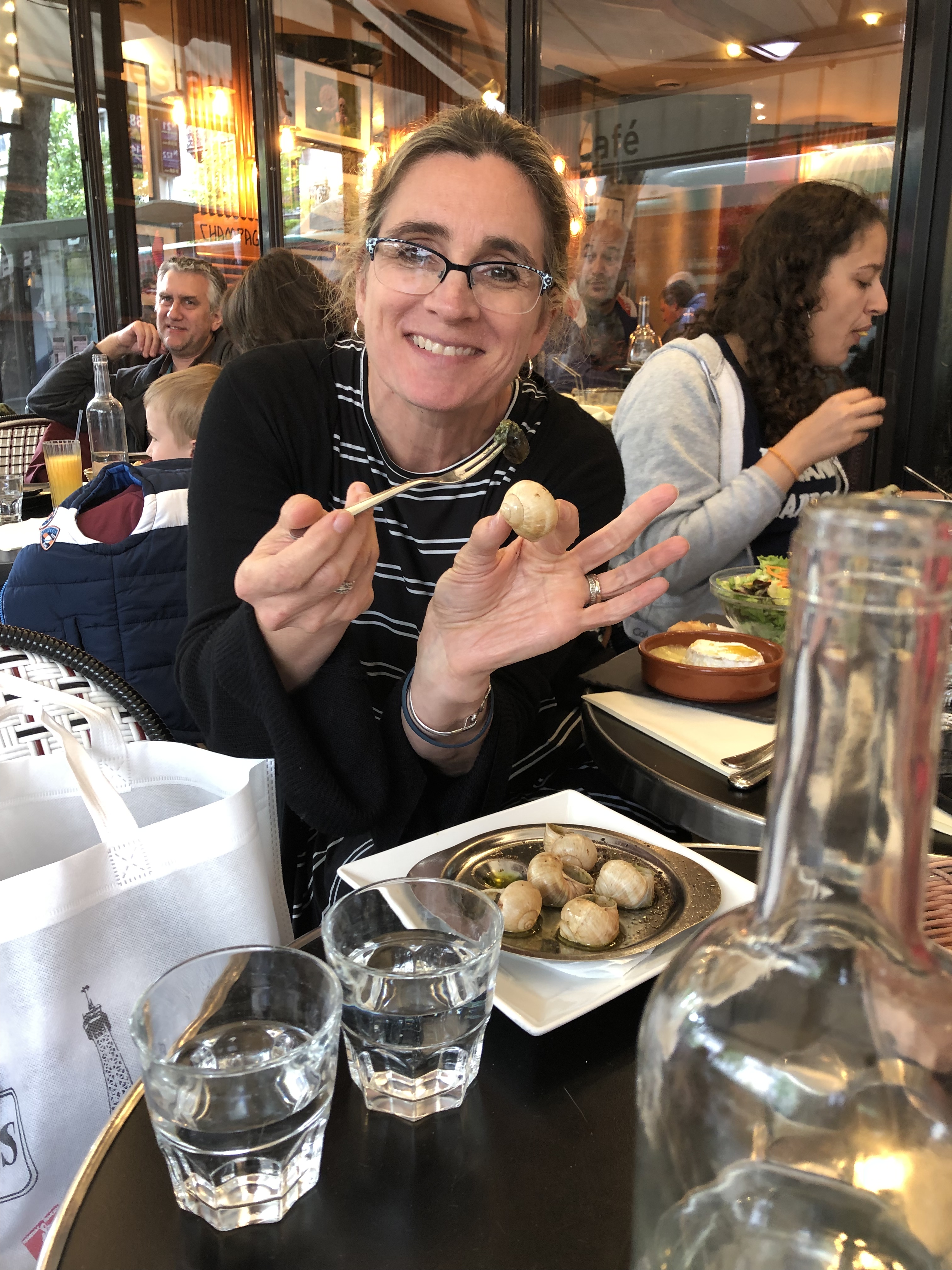
There are only two places where I have ever eaten escargot: on cruise ships and in Paris, France. Honestly, I was apprehensive about eating land snails. Or any snails, for that matter. But I maintained cautious optimism and tasted the little shelled delicacies for the sake of immersing myself in a full French cultural experience.
The most appealing part of eating escargot is the melted butter – the unsalted quality kind, not like movie theater butter drizzled on popcorn from a pump dispenser. Snails are savory and a little chewy, and even if on the off-chance they had actually been chunks of those tiny little high-bouncing rubber balls like the kind kids buy out of those quarter machines, they were delicious because they swam in pools of melted butter.
Where everything is far bigger in Texas, everything is far smaller in France – especially the food portions. They give you a tiny little fork and a tiny little plate with some tiny little snails. They even set out wee baby water glasses. And if you want, you can order a tiny little cup of coffee. When I did that, I was served an espresso, because the French call their espresso coffee and drink theirs the way Americans drink a shot of whiskey, throwing it back all at once. It’s served in a tiny little espresso cup, the size of my childhood china teddy bear tea set, with sugar crystals that are supposed to float on the top if it’s made properly. It took some detective work to figure out that if I wanted coffee as I knew it, I should ask for an Americano. Once I learned these European coffee ropes, I was a happier traveler all the way around – and my companions appreciated my much-improved morning outlook. After holding that tiny little espresso cup, I now understand how the one-tiny-little-finger-pointing-up-when-sipping came to be a thing.
Eating Escargot in Paris, France – June 2019The Eiffel Tower lights up at night! Artistic palette at the L’ouvre – – for the traveler who desires a full spectrum of color choices when taking care of business.
Isaiah 7:15| Butter and honey shall he eat, that he may know to refuse the evil, and choose the good.
With special thanks to Slice of Life for giving writers inspiration, space, and voice
Slice of Life Day 20 of 31: Journeys (my March theme)
I’ve never been to Auschwitz, but my daughter Mallory says her travel group was rendered speechless for hours after they visited 12 years ago. They’d all had to regain their composure before being able to talk again. After reading Night by Elie Wiesel and watching the documentary of Oprah Winfrey going back to Auschwitz with him years later, I can only imagine what it must have felt like to have stood mere inches from the clothes, shoes, and other precious belongings – including teeth – of the innocent people who were taken there, separated from their loved ones, and killed at the hands of merciless monsters.
Mallory and her travel companions visiting Auschwitz
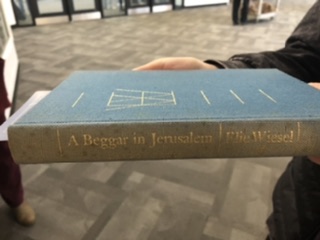
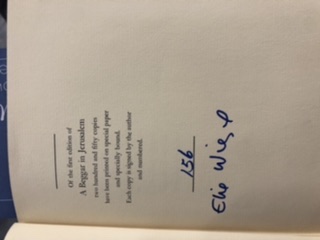
On a morning that started like any other, I was standing in the hallway of the high school preparing for a meeting when an English teacher shared that she had been cleaning off her bookshelves and discovered a book that piqued her interest. Upon further examination, she found that the book, A Beggar in Jerusalem, was one of 250 copies signed by Elie Wiesel himself.
A Beggar in Jerusalem by Elie WieselBook signed by Elie Wiesel
As I beheld the signature, I was instantly transported to all the harrowing moments of Night – from the prophetic words of Moshe the Beadle that I reflect on more frequently than I care to admit, to the marches from the ghettos, from the cattle cars and the fighting over a scrap of bread on the train to the screaming of Madame Schachter, from the machine gun killings of infants used as target practice to the hanging of the young boy on the gallows, from the starving man who was shot crawling to the soup pot to the sickness that overtakes Elie’s father, from the image in the mirror where Elie sees the corpse staring back at him to that iconic photograph of him among the crowded, starving men in the wooden bunks. That one signature took me to all of those moments at once as I gazed with heartbroken sorrow at the ink there on the page, knowing the hand that signed the book had lived through those terrible times.
A trip is not a prerequisite for a journey, and journeys like these catch us off-guard. This one came out of nowhere and punched me in the gut. I had to pull myself back together quickly and move on with my morning. I’m glad we are past those times, I told myself. Nothing like this would happen today. The Moshe the Beadles of our world would warn us.
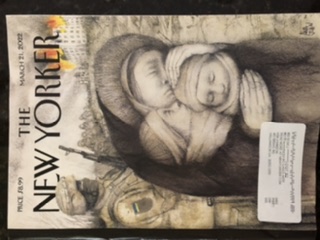
I arrived home and stopped at the mailbox, excited that my weekly copy of The New Yorker had arrived. Then I studied the image on the front cover.
I wept.
The cover of The New Yorker, Week of March 21, 2022
With special thanks to Slice of Life for giving writers inspiration, space, and voice
Slice of Life Day 19 of 31: Journeys (my March theme)
“We don’t take a trip. A trip takes us.” -John Steinbeck, Travels with Charley
The London Eye offers a unique perspective of the city. High above it all, one can see for miles and miles and note distances between landmarks. To the traveler, perspective is important; but the majestic view can’t compare to what we see when our feet are on the ground.
Ticket to the London Eye, June 7, 2019
Looking out, I thought of Peter Pan, flying above the city with all the freedom and fearlessness of a child – especially above Big Ben, even though they were doing some cleaning and refurbishing of the iconic landmark in the summer of 2019. The classic red double-decker buses, blood cells coursing the veins of the city, brought back memories of the metal toy bus that my brother had brought home from London years ago.
View of Big Ben under refurbishment from the London Eye, June 2019
I’d visited London in 1984 with my parents and brother, and again in 1999 with my first husband. Its beauty and history hadn’t changed when I visited in 2019. Of all the things to love about London, my favorite is its theater. Something about those stages mesmerizes me – the smell of musty old wood, the creaking of floors, the old velvet seats and thick-piled carpets, the dust settled long into crevices that always make me wonder whose strand of historical hair may be resting somewhere beneath my feet, the lights and the actors and actresses that bring stories to life.
But there is one entertainer who comes to mind frequently and has the power to melt my heart at the sheer memory. Have you ever had one of those moments when you saw something so beautiful that completely captured your heart to the point that you had to fight off tears that threatened to come out of nowhere- and then you just gave up and let them flow – and people were aflutter all around you, not seeing the very same thing you found so moving? I have – and still today, I have to keep that memory guarded, because if it slips up during a meeting at work or in the frozen foods at Kroger, my eyes may get glassy and I may be moved to a place of deep introspection.
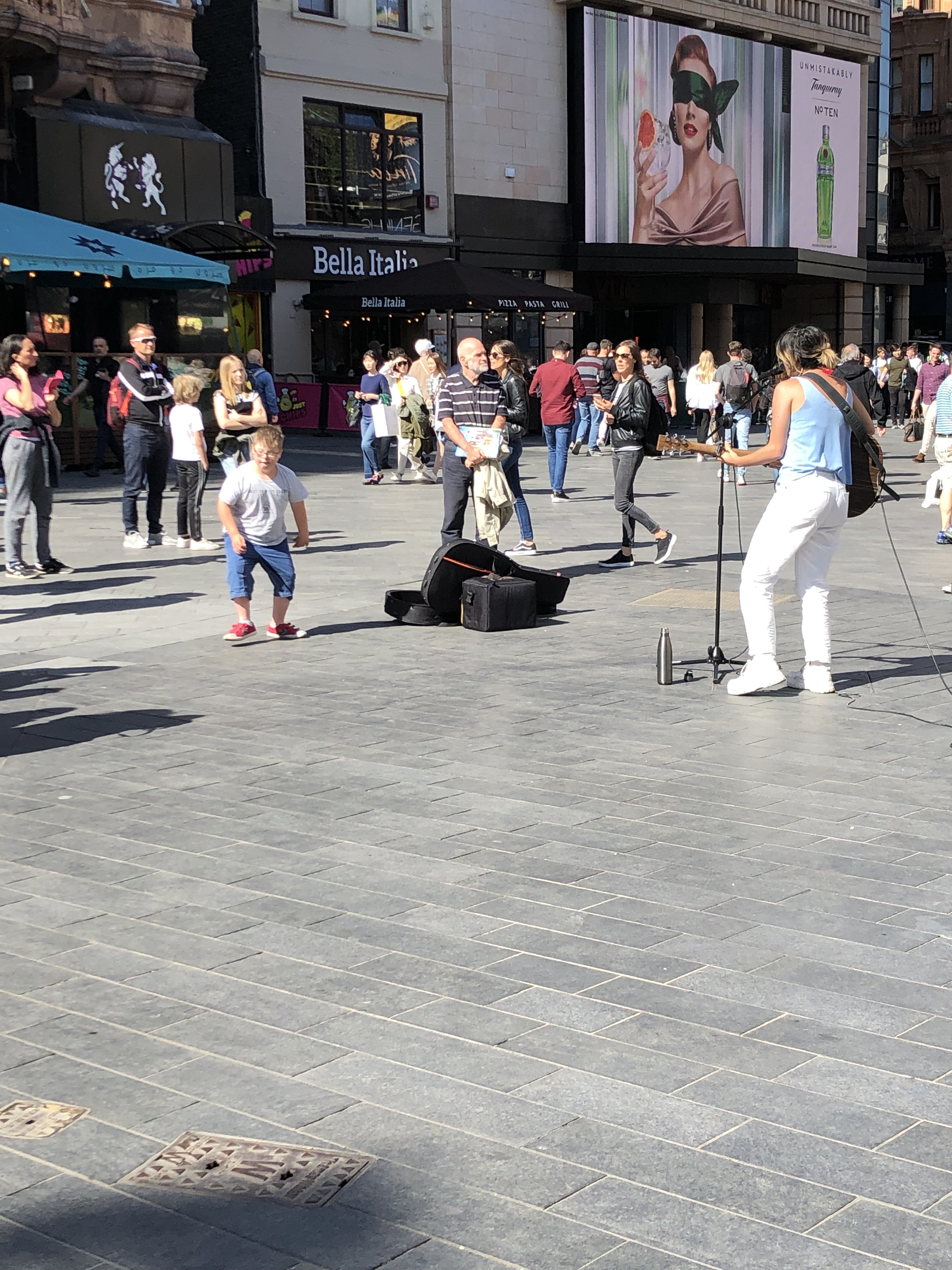
I heard one of my favorite songs and stopped to listen to the street performer singing Leonard Bernstein’s Hallelujah. People were walking in all directions, some running, like human versions of the London buses flushing veins and arteries with blood cell movement, ……and then I saw the little dancer on this crowded street in Covent Garden, without fear or inhibition, living fully in each breath. I had no inkling of the profound effect that this one single moment would have on me then or in the coming years, especially when the world shut down with Covid the following spring and the dance brought smiles in the midst of sadness and loneliness. It found a place in the crevice of my heart, like that theater dust that settles in and takes up residence.
This little dancer caught my eye and stole my heart
He jumped, he leapt, he spun, he twirled, exuding joy and the love of the moment that no one else around him seemed to have. I watched, completely taken by this child’s in-the-momentness. I don’t know his name or where he lives, but in my impossibly full travel itinerary, he brought pause and wonder – a shift in my approach – a deeply introspective personal challenge henceforth to look for what is missed by everyone else: what’s the one thing that I see that no one else sees? I need more embracing of life like this kid understood. Big Ben is boldly there for all to see. Peter Pan will always be soaring in the minds and hearts of those who live on the edge of childhood. The stages of London draw the eyes of millions every year.
And yet it wasn’t a landmark, it wasn’t a Lost Boy from literature or a stage that took my heart on a completely unexpected journey in the heart of London.
It was a young boy whose name I will never know, dancing to the music of life. As we all should.
He danced like no one was watching – exactly how I want to live life! I told him what a great dancer he was and that I wished I could dance that well – he smiled and embraced me and I hugged him back, two strangers sharing a moment, and I saw his mother with teary eyes, watching our interaction.
With special thanks to Slice of Life for giving writers inspiration, space, and voice
Slice of Life Day 19 of 31: Journeys
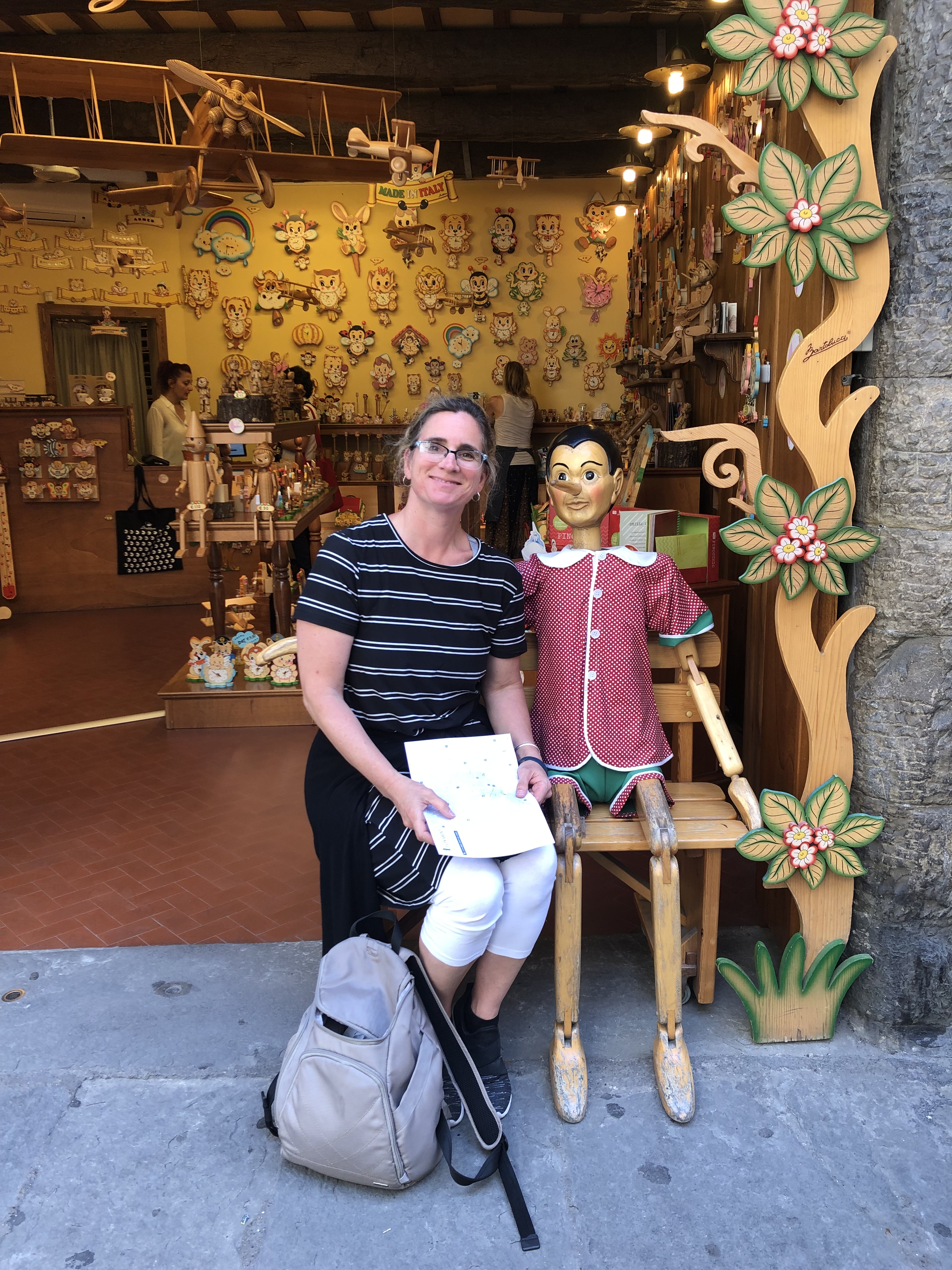
With Pinocchio, Florence, Italy, June 2019
I’ve always been fascinated by the ability of children’s literature to shape character and teach values. As a child, I was curious about those “bad troublemaker” characters and wondered what fate would befall them, and I evolved into a page turner with an insatiable desire to see how other people’s situations play out on the pages of books. Today’s efforts to ban books will, no doubt, prove a classic tale of be careful what you wish for – – you might just get it. And the unintended consequences that those pushing for bans never considered. When we take away books that allow children to learn through the stories of fictional characters, they will learn through the nonfiction stories and mistakes of their own.
But what bothers me almost as much is that the logic of this war on books doesn’t add up. I think of The Adventures of Pinocchio by Carlo Collodi as a prime example of secular literature that shares similarities with the Biblical story of Jonah. Both Pinocchio and Jonah found redemption in the belly of a whale. Both were having trouble listening and obeying (a prime reason that people want to ban any book these days – -because <dun dun dun> someone wasn’t being a “perfect Christian”). The radical banning clan is quick to want to erase secular books like Pinocchio for disobeying Gepetto, yet quick to validate the consequences of disobeying that Jonah suffered by not going straight over to Ninevah.
I mourn the loss of classic literature and its threatened extinction from childhoods of today. The common threads of literature throughout the world carry similar messages and common values in different settings and stories – there are Cinderella and Little Red Riding Hood stories in almost every culture of the world. Books teach lessons and build character, and they offer readers a glimpse into the troubles of the world that might be avoided by learning from characters who just might offer a child a voice of reason he hears more clearly than that of his parents.
Books reinforce values and teach lessons that we cannot possibly teach. We should expect that the nose of Pinocchio grows – – and as it does, we should suppose that the nose of Pinocchio shows.
The Duomo, Florence, Italy – June 2019Travel Journal from Europe – June 2019 – it’s my story, and I hope it never gets erased.
Jonah 1:17
Now the LORD had prepared a great fish to swallow up Jonah. And Jonah was in the belly of the fish three days and three nights.
With special thanks to Slice of Life for giving writers inspiration, space, and voiceRiver Street – Savannah, Georgia
When I was a teenager living on Hilton Head Island, South Carolina, I attended H. E. McCracken High School in Bluffon, South Carolina. In the early 1980s, no one waited to be a senior to take part in Senior Skip Day. We all eagerly honored our graduating class each year by skipping school right along with them on the traditionally declared skip day, piling into cars and crossing the nearby state line into Savannah, Georgia to join the throngs of people who converge on the city every year to attend the nation’s second largest St. Patrick’s Day parade and celebration. We flooded River Street, carefully descending the old stone steps and navigating the cobblestone streets to admire the river that was turned shamrock green back in those days to commemorate the occasion. We stood along the streets cheering the parade, decked out in green beads, wearing green “Kiss me, I’m Irish” or “Patrick was a saint. I ain’t” t-shirts, green eyeshadow and glittery antennae four leaf clover headbands. Green beer flowed more swiftly than the Savannah River on those streets, but a few of us stopped at a taste or two just to say we’d partaken in such novel revelry. Then we’d go home at our regular weekday times as if no parents were ever the wiser.
It was all fun and games until the wreck.
Highway 46 was the two-lane highway that led to Savannah. It was paved with narrow lanes and curves that required careful attention; there wasn’t much margin for error on that highway back then.
I’d been home for a while that afternoon when the house phone rang. I was in the den when my mother answered, and as a preacher’s kid, I knew all the meanings of the tones when my mother summoned my father from his study- from the joyful news of babies just born to the heartache of disease and dying to the crisis mode of Dad dropping everything and leaving in a hurry to go be present with someone.
Whenever Dad went to go be present with someone in a crisis, it was hard to resume any focus until we knew things were better. This time, they weren’t. We learned that a student from our school had been driving home drunk from Savannah and had swerved across the center line, killing a father in our community. The students in that car all survived the wreck; one was the son of one of our church families, and his parents were in shock and disbelief at the scene.
Since that dreadful day, there hasn’t been a St. Patrick’s Day when I haven’t remembered the impact of the choices that we make and the effects that they have on others. On this St. Patrick’s Day, I journey not to a senior skip day, not to a place of celebration or parade festivities, not to a place where I dwell on luck and leprechauns and rainbows, but instead back in time as I remember those who lost a precious family member forty years ago and think of all that was taken from them.
















 Common Threads