Monday morning joy
Schnoodle snuggled up for warmth
Chasing rabbit dreams


Patchwork Prose and Verse
Monday morning joy
Schnoodle snuggled up for warmth
Chasing rabbit dreams
Something they want, plus
something they need, something to
wear, something to read


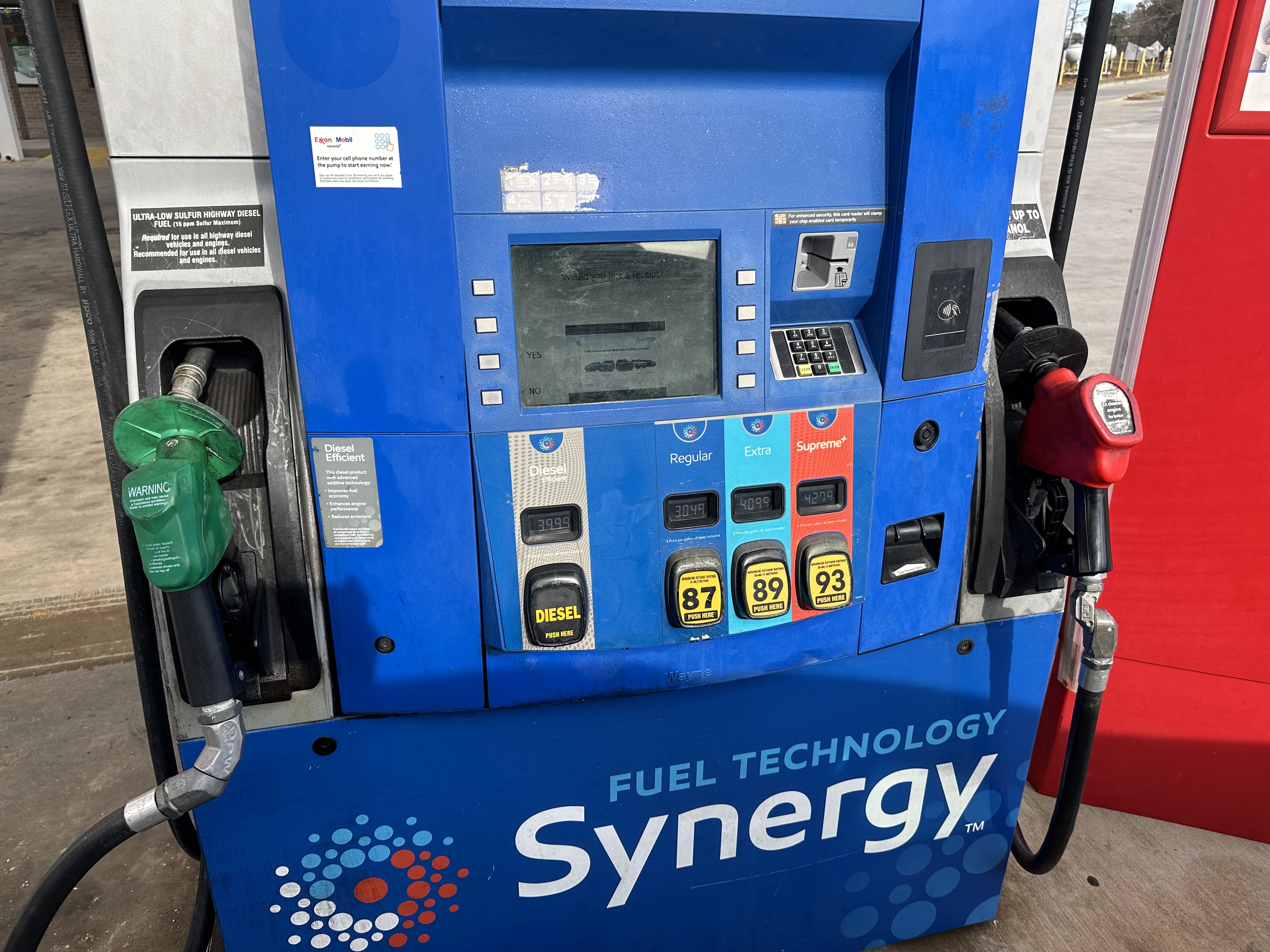
Earlier this week, I watched a Tik Tok video showing a prank a teenage girl played on her father by telling him she was having car trouble and didn’t know why. She said she’d put gas in the car and loved the festive red and green gas pumps the stations were putting out for Christmas like she’d seen on Tik Tok, and that she’d chosen the green one. She knew she wasn’t out of gas.
“You didn’t!” her dad muttered in disbelief, before using a few choice words about staying off of Tik Tok.
When I pulled into the gas station on my way home from a conference yesterday, I chuckled when I saw the pumps. Sure enough – red and green.
I chose the red one.
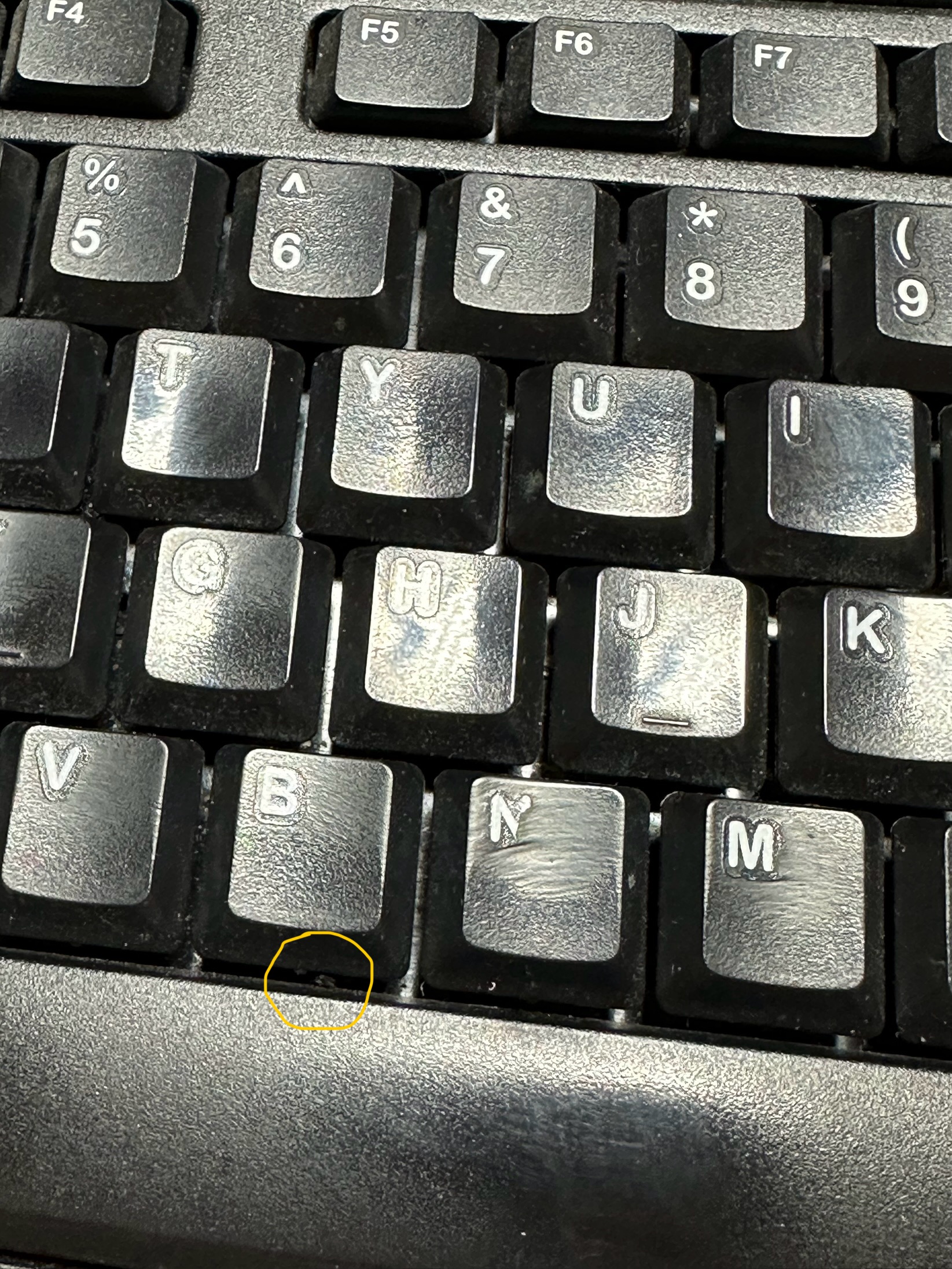
wee techie geek gnat
sneaked beneath my F5 key
reappeared at B

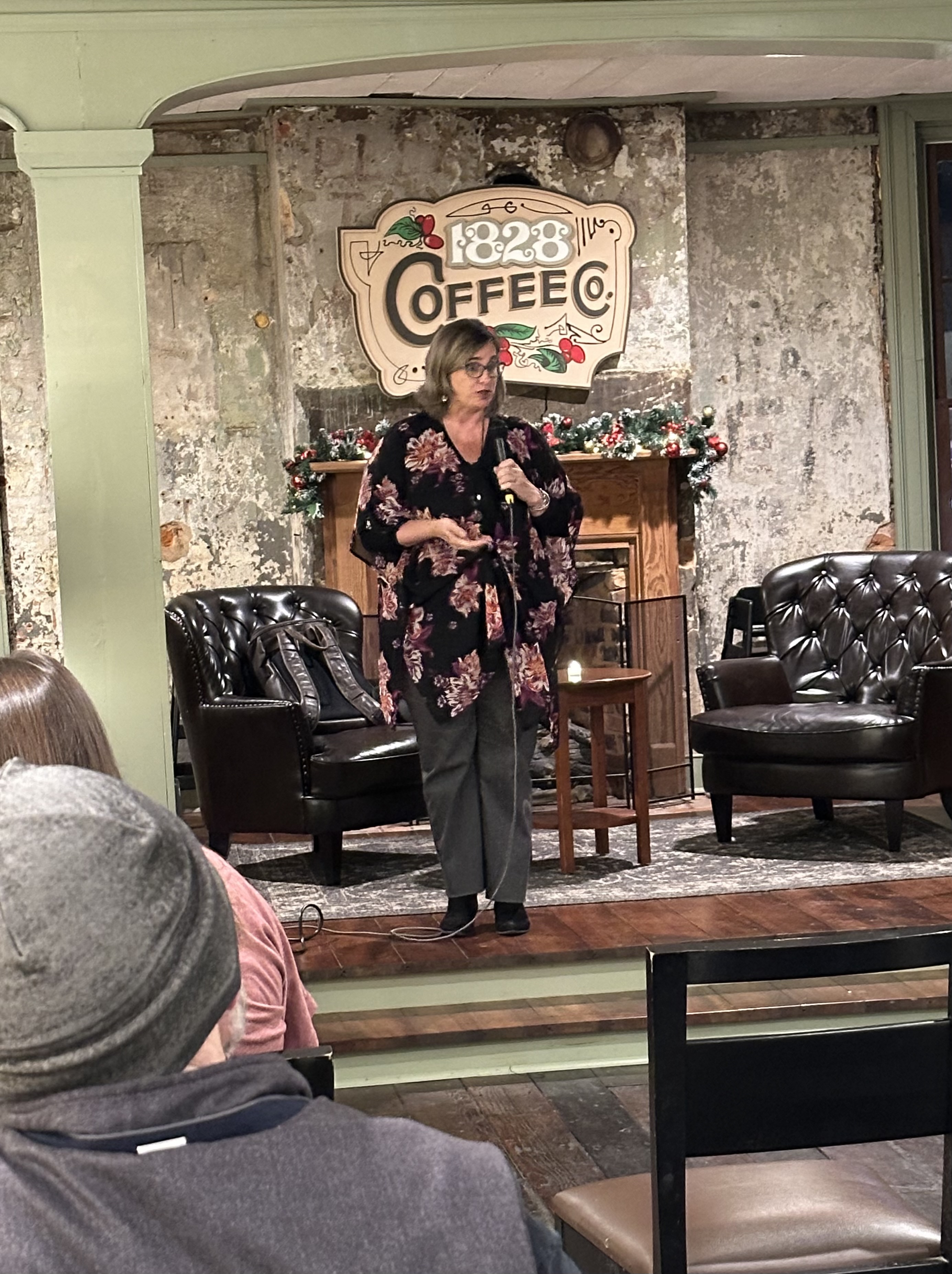
Storytelling night
Connecting small-town strangers
who are all now friends
Earlier this week, I blogged about the increasing popularity of rage rooms and the owners who are purchasing vintage glassware, antique dishes, and grandma’s oil lamps to be smashed with baseball bats and golf clubs in controlled settings across the nation. They’re scouring estate sales for the dishes that families have gathered around for the last century or two, purchasing what folks can no longer persuade their children or other relatives to use in their own homes, and wearing helmets with eye protection as it’s all beaten to smithereens behind a concrete wall.
This may seem to some like a violent death of memory and sentiment. It may show disrespect to the items being smashed, from the artistry of the design to the materials used to make these things that have long held presence around tables feeding families or that have held oil to light rooms and keep aglow the faces of loved ones centuries ago.
Perhaps, though, the best chance of life these items have is in their recycling – – a reincarnation, of sorts, for things boxed up in darkness, locked away in storage, held hostage as prisoners of uselessness for decades, like the aging adult’s own version of the Island of Misfit Toys with nowhere to go and nothing to do but wait. A rage room may at first seem in direct opposition to the gratitude factor of thankfulness – but is it really any more offensive than attics full of items without purpose, kept that way by those who should value them most and keep their spirits bright?
As I drove to visit a family member having surgery two states north of me last week, I listened to Braiding Sweetgrass: Indigenous Wisdom, Scientific Knowledge, and the Teachings of Plants by Robin Wall Kimmerer. The author herself reads the book on Audible, and hearing her voice is almost as pleasant as pausing every few minutes to truly soak in the meaning of her words from a new perspective – – and an important one. Similarly to the way Aldo Leopold reminds us of our duty to be good stewards with a strong land ethic in A Sand County Almanac, Kimmerer reminds us in her chapter “Allegiance to Gratitude” that every single item we eat or use comes at the cost of the life of a plant or animal. As good citizens, we should follow the guidelines for the honorable harvest of consumption, from the wood in our furniture to the food on our plates. Allegiance to gratitude is what begets abundance – not the collecting and storing of items that are not being used, because this disrespects the energy from Mother Earth to produce these things and invokes perceptions of hoarding: get all you can, can all you get, and sit on your can. Taking and using only what is needed is the way to be environmentally responsible for future generations. Having what can be used and fully appreciated cultivates a fuller appreciation of all of our blessings.
Gratitude has been a year-long spotlight word for me – – a goal word. It is fitting that in December, I am reading Kimmerer’s words with a renewed sense of gift giving. This year, we’re practicing a different gift-giving arrangement for my grandchildren. They’ll each receive something they want, something they need, something to wear, and something to read. We’re simplifying, redefining less as more.
We’re cultivating gratitude.

We will have an open mic night at our local coffeeshop this evening, where we will share stories. Mine is entitled Ancestral Spirits.
Before my mother died 4 days after Christmas in 2015, I asked Dad to look through the recipe box and give me some recipes written by the hands of my ancestors. I framed them, and they hang on the wall of my kitchen to welcome the kitchen spirits for those times I attempt to cook anything. They gather, I’m sure, standing over my shoulders, shaking their heads, convinced by now that I’m a complete kitchen misfit.
Throughout her life, Mom was a great everything, teaching my brother and me the ways of the outdoors on the coastal island of St. Simons. We crabbed and fished off the pier, collected shells, and learned how to identify all kinds of birds.
Mom had some inner sensor that alerted her to bird presence, particularly hawks. My brother Ken and I frequently send text alerts: Mom was on a wire by Highway 362 checking to make sure I had my seatbelt on, warning me the cops are running radar up ahead.
We believe in the presence of birds to convey messages.
Ken and I were a little divided on where she’d be buried. We walked through Christ Church Cemetery, my preference being in the old section, where she’d have casket neighbors who were friends. My realtor brother was concerned with the oak roots and preferred the new section.
“Fine, brat,” I told him. “I picked the spot, you pick the plot.” So he picked the new section.
I wrestled with it and lost sleep. At breakfast, I confessed to my preacher Dad (who did her funeral) that I needed reassurance from Mom that she’d be okay up there by herself until more burials happened. “I prayed for a sign – – some majestic bird, with a large wingspan, like an eagle. Since there is no tree canopy up there yet, I want her send a bird to let me know Ken didn’t mess this all up.”
We pulled into the cemetery for the graveside service, and parked up by the tent. And when the car doors opened, we heard them before we ever saw them.
“What have you done?” My father looked at me accusingly, like I’d done some voodoo magic.
We glanced up, and three buzzards circled overhead.
My brother elbowed me and pointed to the skies, chuckling. “Look! She showed up! And she brought her parents.”
My ancestral spirits seem to enjoy their gatherings, always giving us signs and messages.
Imagine our deep comfort when, just last week, one of my grown children was having surgery two states north of here. As we left the hotel for the hospital that morning, there on a wire above my RAV 4 was a hawk. Mom. Gathering with us. Waiting on us to say everything’s going to be okay.

I have family members who have been preparing to open a new business – a Rage Room. If you haven’t heard of these, here’s an article that explains the concept. You take all your anger into a room filled with appliances and glassware and dishes and use a bat or sledgehammer to smash everything all to pieces. These businesses are rising in popularity across the nation – not as a substitute for therapy, but as a way of releasing pent-up anger in a controlled setting.
My relatives were heading to another estate sale last weekend to buy all the china and crystal, lamps, and anything else that’s smashable, including televisions and microwave ovens. It stopped me in my tracks when I considered what some of my other relatives may think about this if they realized that their precious items may be destined to be violently destroyed.
I have other family members with storage rooms. They have been paying monthly rent for years to hold onto items they believe to have value. Unfortunately, the financial profit potential is red – it has been for years, just holding onto things, and it gets redder and redder every month a storage room’s rent is paid. By now, the cost of holding onto these things exceeds having bought them brand new several times. The greatest value that these items will ever hold, at this point, are the memories – – which can be of no value when they are held hostage in storage rooms with little to no regular use. Many haven’t seen the light of day in years, and are either in non-climate controlled storage slowly molding or are waiting their turn to be taken to a landfill.
There seems to be a commonly held belief that if we have something we got a great deal on, we could turn that as profit. And perhaps we could if we found the right buyer and if we sold it at the right time for the right price. But just like the next person, most of us are not buying things at full price. We’re looking for the deal, too.
I feel a heavy burden for a colleague’s mother who’d had a large collection of antiques and memorabilia. She’d checked on eBay and Facebook Marketplace to see what the going rates were for some similar items she’d owned for years and believed what she saw as what some of her items were worth. The sellers who mark items for sale at $12,345.67 using the negotiating strategy or assign their own notions of value to their own items had created a false sense of hope for her retirement dreams. When she died last spring, my colleague and her siblings hired an estate sale company to come in and auction all of the items that had been collected for all those years and held as sacred family artifacts.
The hard and sad truth is that these items held no sentimental meaning or memories for my friend and her siblings. They had purchased all their own furniture and belongings through the years and had all they needed, so there was no space for them to put any of their mother’s sentimental items in their homes. They each chose one small item before the auction, and that is all that remains. The rest may be getting smashed.
For some, the smashing may come as a shock. For others, the release of years of collecting items that now border on hoarding may come as a liberating, sweet goodbye to the memory of loved ones whose belongings had more hold over them than time spent with their loved ones. Whether the items they leave behind are purchased to be used as dishware at Christmas tables with families or whether they are being shattered with baseball bats and golf clubs, one thing is true: they will ultimately be released in some form or another to a new and different life. I’ve heard it put this way: Heaven isn’t lined with U-Hauls.

Yesterday, I shared about the time spent with my daughter during her recovery from surgery the last week of November. We’ve been knitting hats, having great conversations, and keeping her occupied so that she can focus on doing things with her hands – which is said to take the mind off of pain.

Anticipating the time we would be spending together, I also decided to bring some sketch books, puzzle books, and Christmas coloring books for adults. And I brought the smooth colored pencils that I scooped up back in the good old days when Hobby Lobby still had the daily item for half price with the online coupon. My guess is that they couldn’t keep Scholar Prismacolor oil-based pencils in stock, so they had to stop that kind of giveaway.
At home, I never take the time I should take to knit a hat or to color a picture or work a puzzle while having a great conversation, and it’s probably something I need to do more often – even sharing a cup of tea and talking more often on FaceTime – to feel a greater sense of presence and togetherness.
Starting right now.
We all need healing rituals.

I’ve had a few surgeries in my lifetime, starting with a tonsillectomy when I was in kindergarten. We lived in our house on Timmons Street on St. Simons Island, Georgia during this time, and I remember it as clearly as if it were yesterday. The house was white with a royal blue exterior wall in the carport and a 1970s modern-at-the-time artistic architectural barrier wall of cut-out circles that gave a false notion of privacy between the car and the road.
Since we had just moved to the island back in those days, Dad serving as a new pastor with long hair and sideburns looking a little bit like every picture of Jesus I’d ever seen, the members of the church showered us with things for me to do as I recovered. They stopped by and held my baby brother, and they brought ice cream, popsicles, soups, coloring books and new crayons, and books to read. I got spoiled early on to the ideas of what recovery from surgery meant: all the ice cream I wanted, and fun new stuff.
That’s why I began thinking about the silver linings of surgery before I came to be with my adult daughter as she recovers from a tonsillectomy. This isn’t easy surgery – – the older you get, the rougher the recovery. I was even more certain of this when the surgeon appeared from behind the curtain as we awaited the magical hour.
“Are you ready for this?” he asked her.
She had a far more enthusiastic response than either of us was expecting.
“Well, it’s going to suck,” he warned her. “There. I’ve said it. I had this same surgery at your age, and it’s not easy. But it’s worth it. There are healthier days ahead.”
I am a fan of new, young doctors with all the new technologies like the one I had when I broke my foot in 2022, but I took great comfort that this ENT looked older than I am, and I began saying silent prayers of thanks for his level of experience. The good Lord sent comfort on many levels for this mother’s heart as I watched my child being wheeled out to the operating room.
The silver linings and up-sides of surgery include time together, even though we aren’t running around having all kinds of adventures and fun. We’re sharing the sweetness of flattened Coca-Cola so the carbonation doesn’t sting, and we’re having conversations about hopes and dreams.
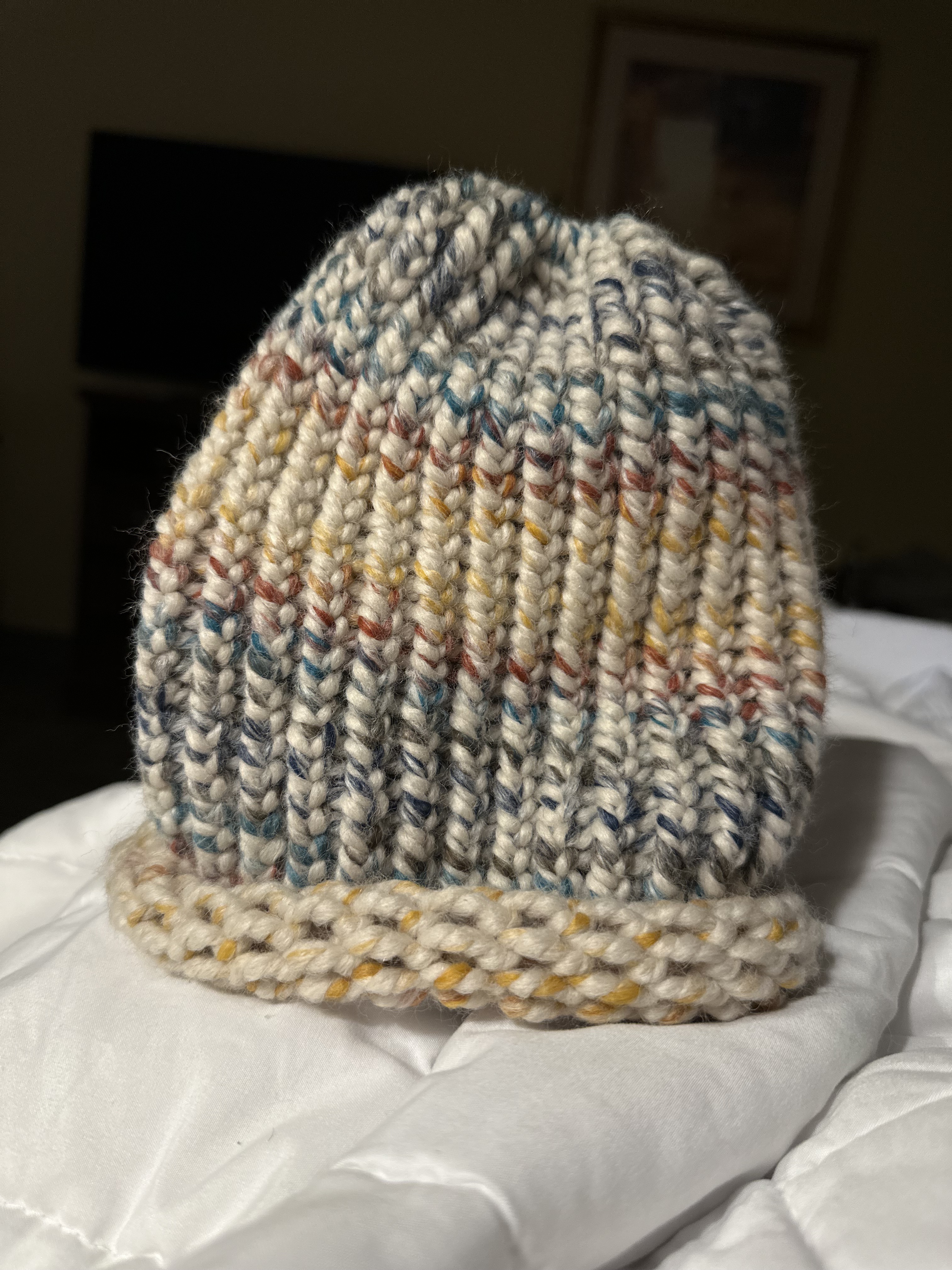
We’re also knitting hats. I was thinking back on the days when I was young and someone gave me a weaving loom. I must have made a hundred potholders and loved every single project I finished, carefully sorting the colors into piles and counting the numbers I’d need to be coordinated and not all willy-nilly random about weaving just any old colored loop in there.
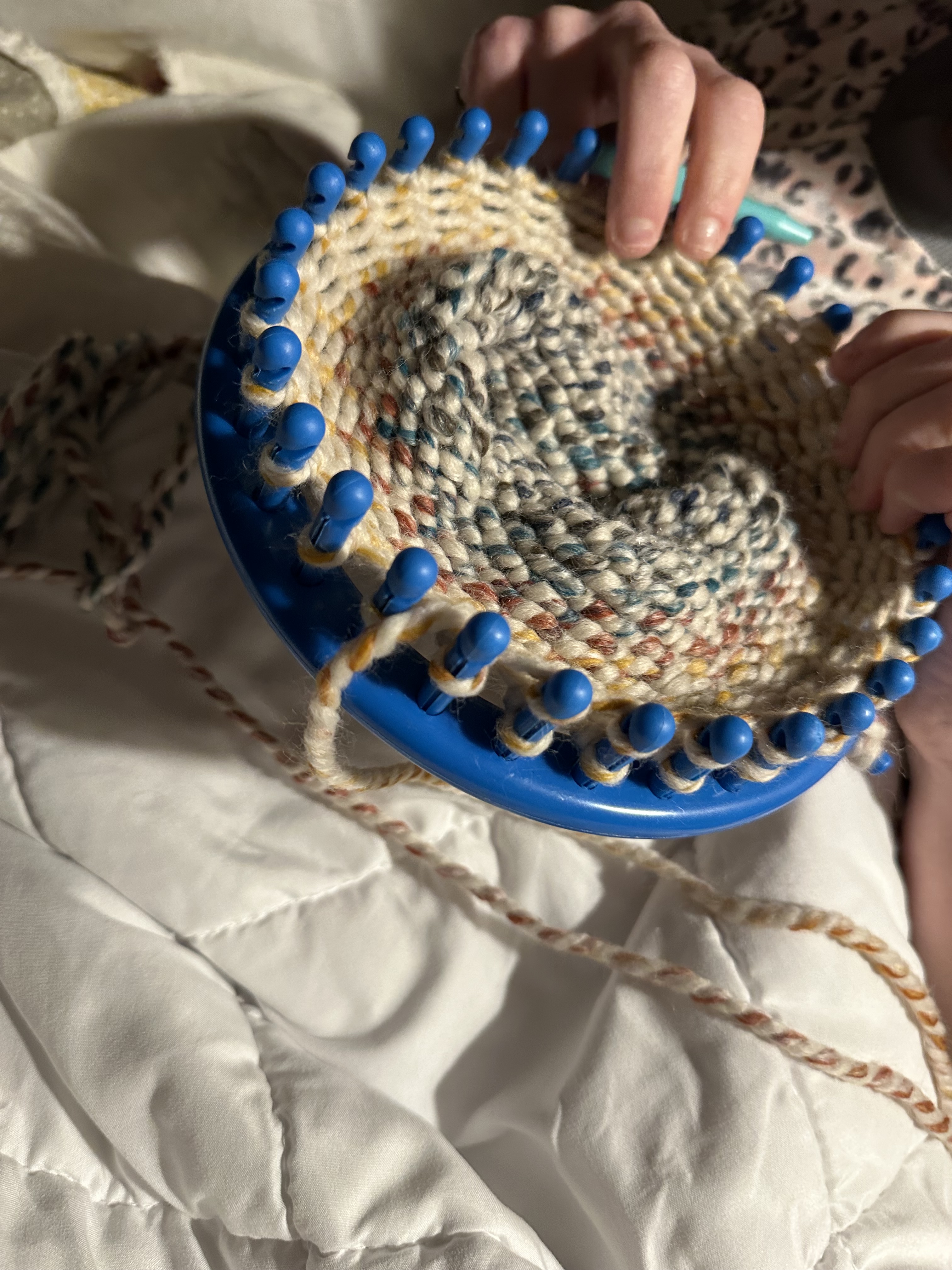
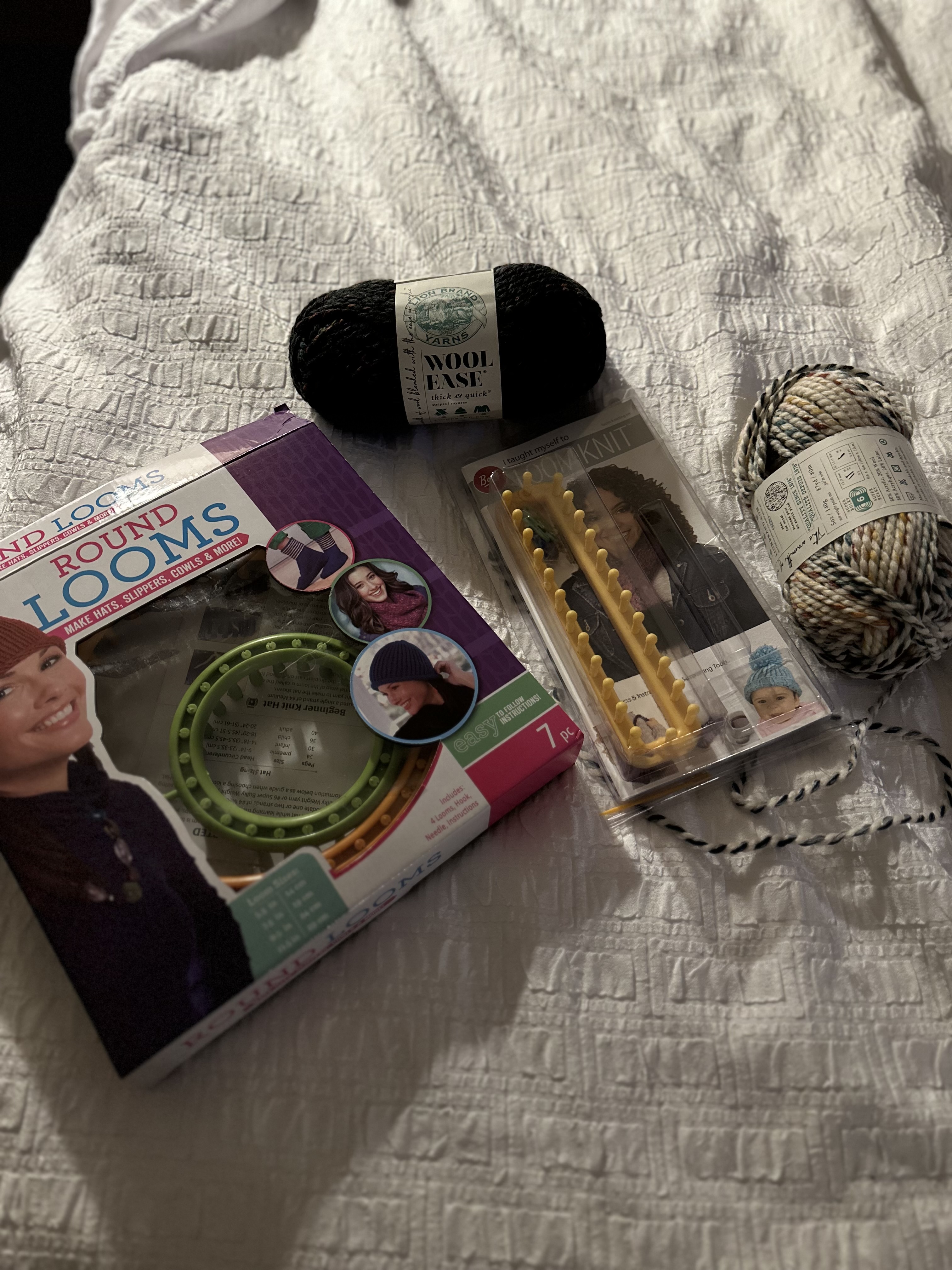
Years ago, we made a bunch of hats using round looms. I’d passed the looms on to someone else to enjoy once we’d squeezed all our own joy from them, so I stopped in and got some new ones, along with some yarn for the journey. Together, we watched a refresher YouTube video to re-learn how to cast on and cast off, and we started our handiwork.

Oh, the fun of simple time, talking through the hours, sipping apple juice, and creating something that will bring warmth and all the pride of wearing a handmade item. I knitted a baby cap for a new grandchild, and she worked on a hat for herself for the coming colder days.

Somehow, working with her hands has taken her mind off of her throat and given her a different focus. And watching her work has given me a deep peace that everything will, indeed, be better.
Healing is a process that takes time, but togetherness and family time makes it all more bearable.
 Common Threads